
Camino de Santiago with Kids
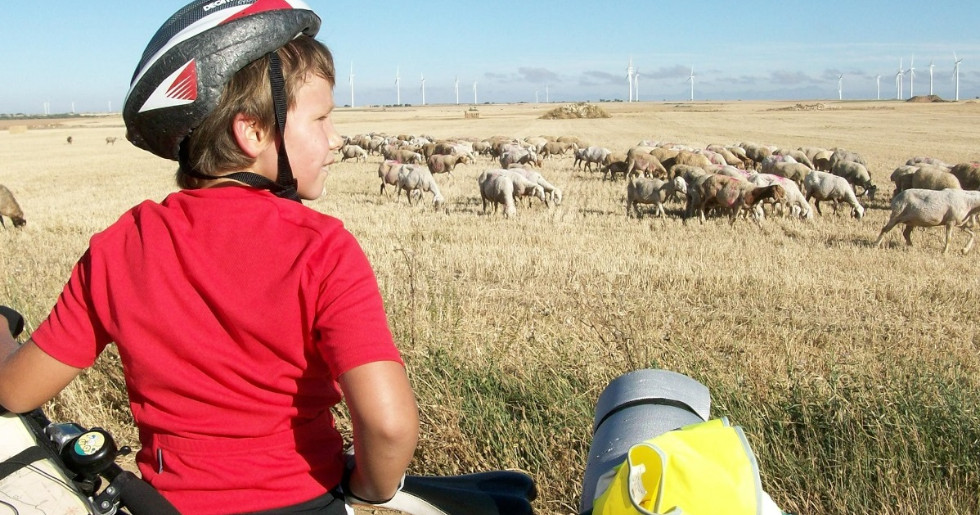
Camino de Santiago with Kids Written by Stephanie Mutsaerts Photos by Jesus Caso and Stephanie Mutsaerts Open their world to New Experiences One of the greatest things about travelling the Camino de Santiago with kids is the opportunity they have to interact with pilgrims from all walks of life, all the cultures and languages under the sun. Fostering chit chat along the Way and developing their international – friendly social skills is wonderful. We are social creatures and the Camino is the ideal playground for them to expand their horizons. My children made ‘amigos’ every day. Kids ride about the same speed as a walking pilgrim, so the days’ pathway would likely end in a shared dinner with the pilgrims we met and travelled with that day. What better way for kids to speak and share moments with people they would otherwise not have the chance to meet? Life-long learning It was a high priority for me that my children find joy in alternative travel, learn to appreciate a challenge, do their best to reach their goal with a smile on their face. And to find a comfort zone even when they are out of their element – broaden their horizons. It is about building their confidence through living experiences that are unique and life changing. Today their confidence reflects years of experience of, among other things, spending countless days (and nights) in the outdoors, cycling or hiking hundreds of kilometers, scaling the heights of vertical rock walls, or skiing and snow-boarding on challenging slopes. Monkey See Monkey Do Clearly there is a correlation between how you live your life and what your kids will choose to do and copy from it. That is to say, young kids tend to want to do what you do. So, if you spend your free time in front of the TV, in all likeliness and, given the ease in which one can fall into that routine or habit, your kids will become the next generation of couch potatoes. Make the effort to take your kids on a travel adventure and broaden their horizons, like doing the Camino de Santiago. You will have them cycling along country trails, skiing the white peaks of the Pyrenees, or climbing a ‘ferrata’ – let them be the next generation of adventurers in the family. If you yourself become enthralled in adventure they will follow in your footsteps! NST makes travelling with kids Better We would love you and your family to join us on the Camino. Find out more about what we can do for you and your little adventurers by writing us an email or plain old whatsapp me, Stephanie Mutsaerts. Let’s get connected! https://northernspaintravel.com/tour/camino-de-santiago-family-bike-tour/
Christmas Eve in the Basque Country
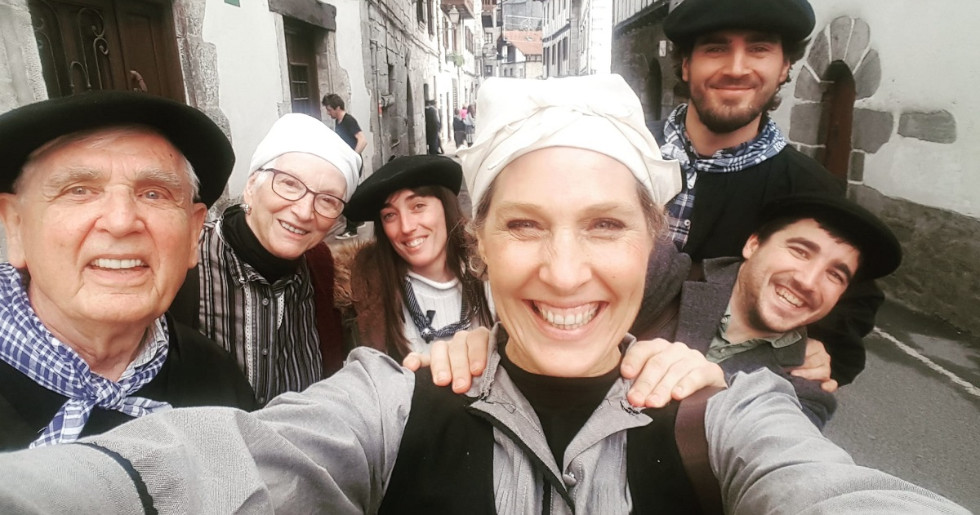
Christmas Eve in the Basque Country Written by Stephanie Mutsaerts Photos by Jesus Caso and Stephanie Mutsaerts We are in the picturesque Navarre village called Lesaka for an outside the box Christmas experience. A happy traveller’s account of Christmas with Northern Spain Travel Early in the day Stephanie came to pick us up at the apartment. She not only came to pick us up – she brought surprise packages of Basque clothing for us to wear. A man’s outfit of blue, wide fitting pants (which René didn’t wear in the end), a black smock, black beret, cream coloured heavy wool socks, and black shoes that lace all the way up the calf. For me a full skirt (elastic waist band luckily), matching blouse, a dark burgundy wool shawl, a white head scarf to tie turban style, and the same style of socks and shoes as René’s. All attired, we drove out to Lesaka, a village deep in the mountains where the annual Olentzero Competition was being held. Olentzero is the Basque equivalent of Santa Claus. He is a character in Basque Christmas tradition who comes to town late at night on the 24th of December (in most places) to drop off presents for children. He is an overweight, somewhat drunk, jolly man and representations of him appear in many places and in many forms – on posters or in three dimensional models. In Lesaka groups of float builders gather to create their own version of Olentzero, typically doing some mundane activity such as feeding his chickens, making hay, enjoying a pintxo and so on. These models are placed on a platform which is then carried on the shoulders of the group that created it. One by one the groups come before the judges (who are high and lifted up in the bandstand of the town square) where they stand, sing the traditional Olentzero songs, and have their float scrutinized for creativity, originality, construction etc. The singing and general presentation are also judged. Groups are formed by very young children, adolescents, adults. The judging also takes into account the ages of the contestants and their experience, as well as their ability. Inhabitants of the village and visitors from all over the area flock into the main square, most of them wearing traditional costumes. Most of the women had outfits pretty much like ours but the men, in addition to the standard pants and smock wore shaggy sheepskins on their backs. Everyone was in jolly mood as we gathered close to the open area where the floats were displayed one by one. Follow us in Instagram where we LOVE giving you #travelfromhome adventures Everyone was in jolly mood in the local bar too!! Here we were squeezed tight alongside others enjoying beers or wine or simple grape juice with pintxos of various types. We munched on delicious local tiny, spicy sausage, with bread. A group of musicians wandered in and played lively Basque music for a while. A great atmosphere of jollity and friendship. Once all floats had been presented they were “parked” around the square so we could wander around and take a closer look at them. Winners would not be announced until late afternoon but we were hungry so, instead of waiting, we went to a nearby village to have a hearty lunch in an ancient restaurant – delicious food and equally delicious local cider. Stephanie had “picked up” some local friends as we wandered through Lesaka and they joined us for lunch – one of them was a part time professional singer and he sang to us once the restaurant had emptied out – the wait staff and we egged him on to sing more and more – it was a beautiful. “A delightful, fun, colourful, and interesting outing.” What is an Olentzero? Olentzero (Pronounced in Basque as [olents̻eɾo]) is a character in Basque Christmas tradition and can be considered the Basque version of Saint Nicolas or Santa Claus. Olentzero represents a charcoal burner who lives in the mountains and makes charcoal. According to Basque tradition, this jolly mountain man, the Olentzero comes to town late at night on the 24th of December to drop off presents to the good children and chunks of coal for the ‘bad’ children. In some villages, Olentzero arrives later, for example in Ochagavía – Otsagabia on the 27th and in Ermua on the 31st. In Lesaka in particular, in the place of Ikatzulo where there was an aize ola (wind ironworks) the aize-waves were chimneys where the charcoal burners worked and which were placed on the hillsides to improve combustion and increase the temperature of the ironworks. What is the Christmas Tradition Olentzero? According to many scholars and theories or hypotheses, the origin of the Olentzero tradition was found in the Villa de Lesaka and from there it spread to numerous towns in Navarra and the Basque Country, although there is no specific date to determine when the tradition began. There is no specific date to recognize the origin of the Lesaka Olentzero, but it should be noted that in 1927 a document describes a straw stuffed puppet that is carried in a procession giving blessings and at the end is burned in the square. Until last year, the groups of children that make their Olentzero float would burn these precious works of art. In 2019, the town hall prohibited this nasty tradition and instead were put on exhibition in the square. As for the famous Lesaka Olentzeros and float and singing contest, it was officially organized for the first time in 1950, although it had already been held unofficially long before. How does the Olentzero Contest work? Lesaka’s Olentzero is held annually from December 24 to 25, on Christmas Eve. The celebration is divided into two parts, in the morning the “Olentzero and Births Contest”, and in the afternoon the parade with the winner of the contest. During the Contest, the young people who carry the image of Olentzero must sing two songs (one compulsory “Olentzero Buru Haundia” and another free) while keeping the character in tow. The groups must be composed of at least 6 people and they must wear the typical clothes. To get the prize, Olentzero himself, the clothes and the free song are valued. Previously, the Birth Contest is held with the same dynamics, the groups present the births and sing two songs. In the afternoon, the Olentzero of the winning group goes out in a kalejira or parade through the streets of Lesaka accompanied by the Band of Music. Signing off wishing you health, happiness and the best for 2021, Stephanie Mutsaerts, founder of NST Video Player