You're comparing a private itinerary with a group departure, and the headline price doesn't tell you what you'll really get. The useful question is whether having your own guide, vehicle and timetable will make the trip meaningfully better, or whether a shared tour would deliver the same experience for less.
For affluent travelers, private travel earns its premium through control, local access and logistics that fit the people taking the trip. It doesn't automatically make every stop more exclusive or every day more comfortable. The right choice depends on what you want to control, what you're willing to spend on, and how much planning you want to handle yourself.
Table of Contents
- What a Private Tour of Europe Actually Includes
- Private Tours Versus Group Options Side by Side
- How to Choose a Luxury Private Tour Operator
- What Drives the Cost of a Private Tour
- Sample Private Itineraries Including Northern Spain
- Concerns Affluent Travelers Raise About Private Tours
- What to Prepare and What Happens Next
What a Private Tour of Europe Actually Includes
In Bilbao, one couple may join a scheduled coach tour while another leaves by car with a driver and guide. The second arrangement can include a cellar visit timed for late morning, with the rest of the day planned around the travelers' interests. The practical difference is who shares the service and which details are arranged in advance.
A fully private tour reserves the guide, vehicle and itinerary for your party. Typical inclusions are a private vehicle for specified transfers or sightseeing, a dedicated guide for agreed days or visits, planned stops, and help arranging entry tickets, hotel stays or restaurant reservations. Confirm which bookings are included in the quoted price and which are only recommendations. Meals, attraction tickets, gratuities, airport transfers and guide or driver services outside the scheduled hours may cost extra.
Some trips use a guide and driver throughout; others book local guides for selected visits and leave free time for independent exploring. The itinerary should specify service dates, pickup points, daily hours, luggage arrangements and who to contact if a driver is delayed or a visit changes.
The formats differ:
- Fully private: Your party has its own guide and, where arranged, driver. The definition of a private tour applies to this format.
- Semi-private: The vehicle may be private, but a guide or experience is shared with other guests. It is a shared-service option, not fully private travel.
- Tailor-made independent travel: A planner arranges the itinerary and key bookings, while drivers or local guides may be booked only for selected days.
A custom itinerary can fit a party's interests better, but it costs more and depends on sound planning. A private car will not rescue an overpacked route, and a dedicated guide adds little if the visits do not suit the travelers. The premium makes more sense when a family needs a flexible pace, a party has different interests, or coordinating transport and timed visits would otherwise fall to the travelers. For a straightforward route with fixed stops, a shared tour may be the better-value choice.
A private tour sells control over time, people and access, not just a car and a guide.
Before comparing formats, identify what needs to be arranged for your party: transport, guiding, reservations, pace or particular experiences. Then check what the operator has included, and what remains for you to book.
Private Tours Versus Group Options Side by Side
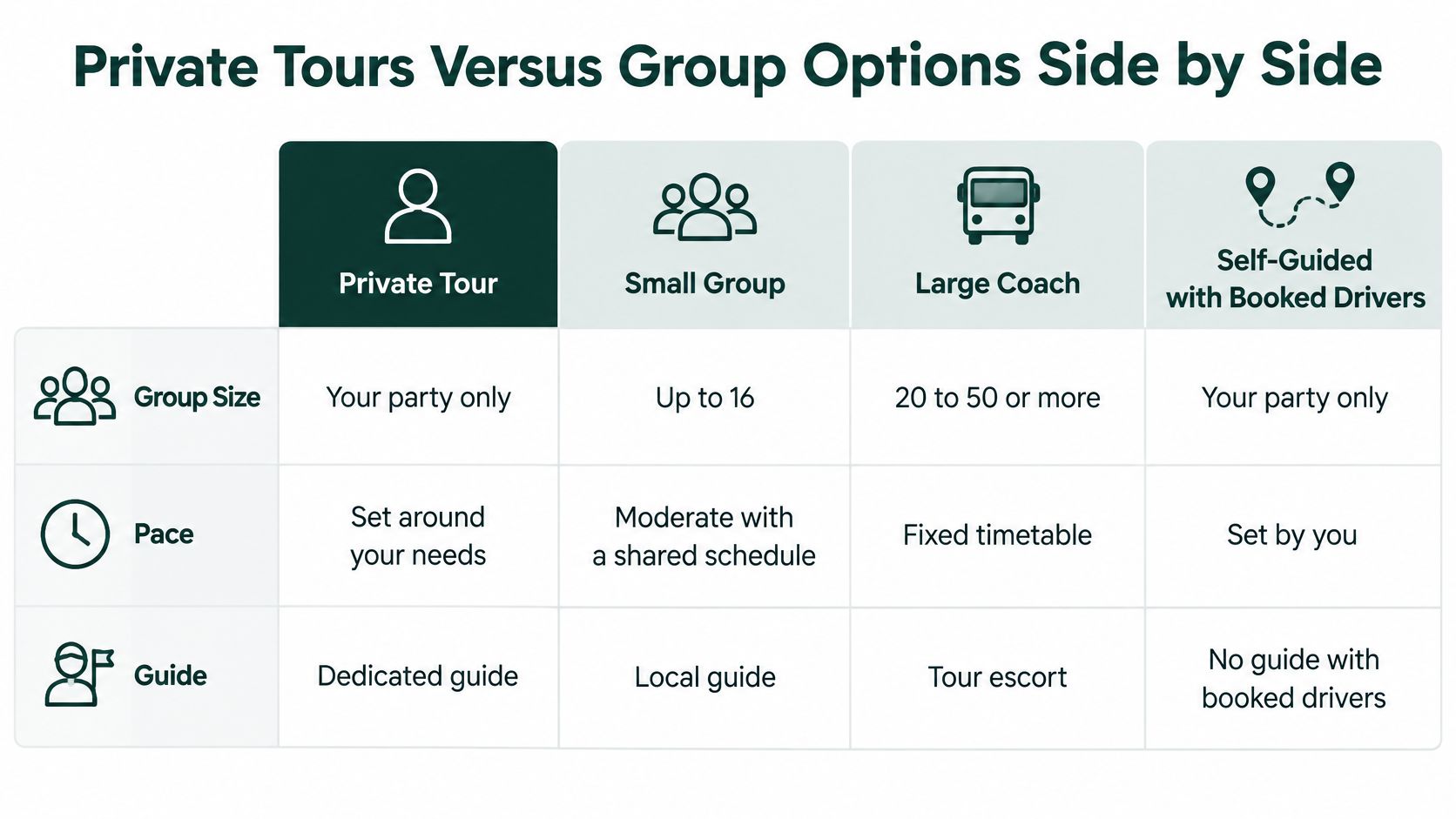
| Criterion | Private tour | Small group | Large coach tour | Self-guided with booked drivers |
|---|---|---|---|---|
| Group size | Your party only | 8 to 16 travelers | 20 to 50 or more | You and your companions |
| Pace control | Set by you, day by day | Set by the guide, some flexibility | Fixed schedule, minimal flexibility | Full control |
| Changes on the day | Usually possible | Limited | Rarely | Full, but you handle the logistics |
| Guide | Dedicated to your party | Shared with the group | Shared, often through a headset | None unless hired separately |
| Access to closed venues | Often arranged | Sometimes | Rarely | Only if booked directly |
| Indicative price per person | Highest | Mid-range | Lowest | Variable, depends on bookings |
Choose by the trip you want
A private tour makes sense for couples who want depth rather than a checklist, multigenerational families with different walking abilities, milestone groups, and travelers who need mobility arrangements built into the day. A private guide can slow down, change the order of visits or help manage a day when someone needs a rest.
Small-group travel is often a better buy for solo travelers who want company and are comfortable with a fixed schedule. A coach can be the sensible choice for a first, budget-led look at a city, especially when the priority is seeing the main landmarks rather than spending time in smaller places.
At the premium end, flexibility can change the feel of a day. Your party might linger over lunch in Rioja instead of rushing through a short group meal, swap an outdoor excursion when rain arrives, or visit a small venue that can't accommodate a coach. These are possibilities to confirm with the operator, not automatic features of every private booking.
A private party can also choose less crowded timings, stay at locally owned hotels and buy directly from small producers. A full coach, by contrast, brings many visitors to the same stop at the same time. Those choices matter to travelers who want their spending to benefit local communities, but privacy alone doesn't prove that it does. Ask which businesses will receive your booking and whether they're locally owned. For another way to travel with others, compare the options for luxury group travel.
Choose private when the cost of a wasted hour or an unwanted stop is high. Choose a group departure when its fixed schedule suits you and the savings matter more than changing the day.
How to Choose a Luxury Private Tour Operator
The most revealing question is whether the experience is genuinely private. Ask the operator whether any seat, table or cellar appointment is shared with other clients. “Private tour” can describe the vehicle while leaving parts of the day shared, so get the answer in writing.
Seven checks before you book
- Exclusivity: Confirm which services belong to your party alone. Ask directly about vehicles, guides, tastings and dining reservations.
- Itinerary design: Find out who builds the route and what first-hand knowledge they have of each stop. Ask how they choose between appealing places that don't fit into the same day.
- Named guides and drivers: Request the names, languages and relevant licences of the people assigned to your trip. If staffing can change, ask how the replacement will be introduced.
- Named suppliers: Ask for proposed hotel, restaurant and winery names rather than broad descriptions such as “boutique hotel” or “private tasting.”
- Contingencies: Ask what replaces a mountain walk if rain, heat or access conditions make it unsuitable. A useful answer names a realistic indoor or lower-exertion alternative.
- On-trip support: Confirm who answers after hours and how that person can help if a transfer, reservation or activity goes wrong.
- Written inclusions: Request a clear list of what the quote includes and excludes, such as entry fees, tips, fuel and tolls.
Look out for quotes that lead with a “from” price but don't specify the guide, itineraries that feel like templates with city names swapped, and operators who can't explain how seasonal availability affects the plan. A low initial figure can be difficult to compare if it leaves out services that another proposal includes.
There's one more verification question worth asking: Which hotels, guides and producers are locally owned? Request their names so you can check where your spending goes, rather than relying on a general claim about supporting communities.
Northern Spain Travel arranges fully private journeys across Northern Spain, using private guides and drivers, selected hotels and on-the-ground support. Evaluate any operator against the same checks: a credible service model should be specific enough for you to verify.
What Drives the Cost of a Private Tour
A couple choosing a midsize hotel, a sedan and a half-day guide will pay differently from a family booking suites, a van and specialist guides for full days. To see which choices drive the quote, ask the operator to price the same route with a few options changed. The table shows how those choices tend to affect costs, not a guaranteed rate.
| Cost driver | Lower-cost choice | Higher-cost choice | Indicative impact |
|---|---|---|---|
| Season | June or September | Mid-July to August | Often the largest swing in lodging rates and availability |
| Party size | Couple sharing one car | Six travelers in a nine-seat van | Vehicle and guide fees are spread across more people |
| Vehicle | Sedan with driver | Minivan or private van with driver | Daily fee rises with vehicle size and seats |
| Guide | Half-day local guide | Full-day specialist guide | Daily fee scales with hours and specialism |
| Lodging | Small boutique hotel, double room | Top boutique hotel or palace, suite | Major per-night cost, priced per room rather than per person |
| Dining | Regional restaurants and pintxos bars | Chef's table or Michelin-starred dinner | Premium per person, with peak-season reservations to secure |
| Access | Public tastings | Private cellar or closed-event access | Quoted per experience, often on request |
Season and party size change the calculation
Peak-season demand can tighten availability and raise prices for accommodation and sought-after experiences. Eurostat's regional seasonality figures show how the concentration of tourism varies across European regions. For a more flexible schedule and a less pressured booking process, consider June or September. If your dates fall in July or August, confirm key hotels and experiences before fixing the route, since a preferred booking may affect where and when you travel.
Party size changes the per-person calculation. Guide and vehicle charges are generally set by the day, so a larger group can spread those costs across more travelers. Hotel rooms are usually priced per room, however, so a family needing multiple rooms may not see the same savings on lodging. Compare the full quote, not just the transport cost.
Changes on the road also carry a cost. A missed connection or unavailable reservation can be harder to work around for a multigenerational party than for a couple, particularly if the itinerary has little slack. Ask what rebooking support is included and what happens if an activity falls through. For a larger group, compare private transport with private coach services, checking the vehicle size, driver hours and any extra charges in each quote.
Paying for private arrangements makes the most sense when they solve a specific constraint, such as coordinating several travelers or securing specialist access. For a simple route with flexible dates and few transfers, a group tour may offer better value. Compare like with like: transport, guide hours, room category, meals and included experiences should all be clear before choosing.
Sample Private Itineraries Including Northern Spain
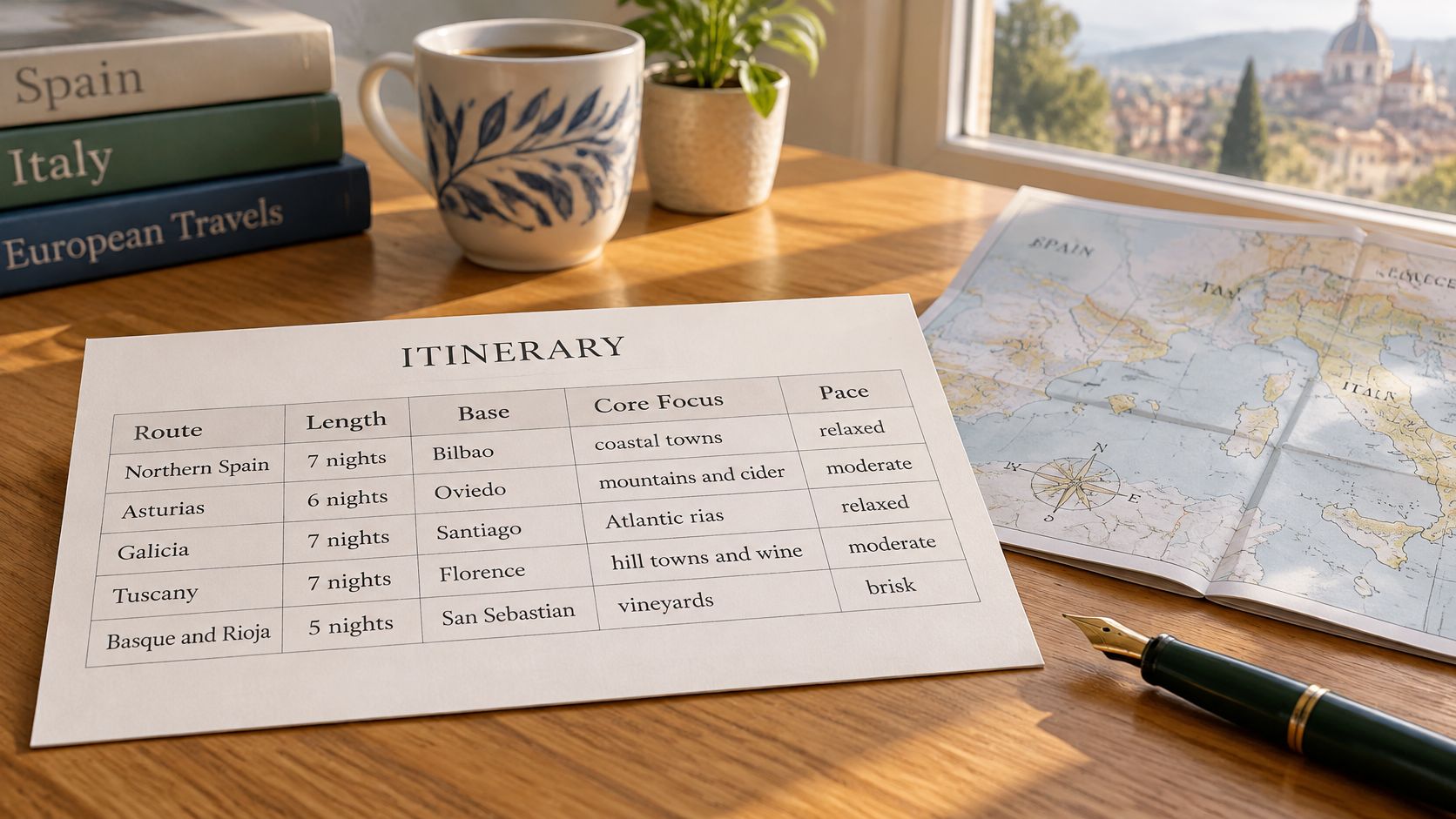
| Itinerary | Length | Base or route | Core focus | Pace |
|---|---|---|---|---|
| Northern Spain coast and wine | 7 nights | San Sebastián and Rioja Alavesa | Pintxos, private cellar tastings, Atlantic villages | Moderate, two bases |
| Asturias and Picos de Europa | 6 nights | Llanes and Cangas de Onís | Gentle hiking at three walking levels, cider houses, scenic drives | Active, with rest days |
| Galicia and the Rías Baixas | 6 nights | Santiago de Compostela and Cambados | Albariño wineries, seafood, old-town walks | Relaxed |
| Tuscany wine and hill towns | 6 nights | Florence and the Siena area | Private cellar visits, cooking class, day drives | Moderate |
| Three generations on the Basque coast | 7 nights | San Sebastián and Getaria | Short transfers, beach time, flexible dining | Slow, under 90 minutes of driving per day |
A week built around the Basque coast and Rioja
A seven-night journey can work with two main bases, giving travelers room to settle in rather than unpacking every day. The sequence below keeps the days varied, with alternatives that preserve the food, wine and coastal character if weather disrupts outdoor plans.
- Arrival in San Sebastián: Take time to settle in, then follow a local guide through a pintxos route. If rain makes a long walk unpleasant, concentrate on indoor stops and shorten the route.
- Getaria and txakoli: Visit the harbour and a rural wine house. If the weather turns, make the tasting the center of the day and keep the coastal walk optional.
- Rioja Alavesa: Drive inland for a private cellar visit and lunch. Confirm the appointment first; if the visit can't go ahead, ask the planner to identify another suitable winery or a local food experience.
- Hill villages and winery hotel: Explore at a gentle pace, then spend the afternoon at a converted winery hotel. In heat, shorten outdoor walks and extend time indoors.
- Lekeitio: Spend the day in this Atlantic fishing village, including a harbour visit. Keep a covered café or indoor local visit in reserve if the weather makes time by the water uncomfortable.
- An unhurried morning and chef-led dinner: Leave the first part of the day open for rest or individual plans. If conditions disrupt dinner arrangements, ask the planner to confirm a suitable restaurant alternative rather than trying to solve it on arrival.
- Departure: Use a scenic transfer if time and conditions allow. For a family version, keep driving under the planned limit and avoid adding a final stop that risks the departure.
For additional route ideas, compare the Galicia itinerary options.
A resilient plan labels walking demands clearly, identifies shaded or indoor alternatives and sets realistic transfer limits. Those details make it possible to replace a canceled activity without turning the day into an unrelated stop. The European itinerary overview offers another visual reference point for thinking about how routes and experiences fit together.
Concerns Affluent Travelers Raise About Private Tours
Privacy, safety and flexibility are reasonable things to question before paying for a private itinerary. A reassuring answer isn't enough on its own. Ask for information you can check, and make sure the operator specifies who is responsible if plans change.
Privacy and safety
Privacy: Ask who can see your itinerary and passport details, and confirm whether vehicles and restaurant tables are reserved exclusively for your party. Request a written explanation of how personal information is handled.
Safety and medical cover: Ask whether guides have first-aid training, which hospital is nearest to each day's route, and what travel insurance you should hold. The operator should be able to explain how assistance works if a traveler becomes unwell or an activity has to stop.
Heat and crowds: Ask for shaded alternatives, indoor plans and off-peak timing for popular sites. A useful answer identifies the alternative for each outdoor highlight rather than promising general flexibility.
Rail, missed connections and cancellation
Rail access: EU rules provide passengers with rights covering information, assistance and compensation for relevant journeys. If a passenger believes their rights were breached, the usual process is to complain to the railway company within three months; the company must give a reasoned response within one month, as set out in EU guidance on rail passenger rights. Those rights don't arrange local assistance for you. Confirm station-to-platform access, boarding help, luggage handling, seat configuration and transfer time. For travelers with mobility needs, ask the operator to record requirements, request assistance from the carrier and identify a private-driver fallback if a connection is missed or a station proves inaccessible.
Cancellation: Ask for the deposit schedule, the terms that apply if a supplier cancels, and who pays for replacement arrangements. Check whether the policy changes across hotels, restaurants, transport and activities; one general cancellation statement may not cover every supplier.
The standard should be simple: each answer is written, named and specific. If the operator can't tell you who will provide the service or what happens when it fails, don't treat the question as settled.
What to Prepare and What Happens Next
A planner can't build a useful route from a destination name alone. Before asking for a quote, prepare a short brief that captures the people traveling and the kind of days they'll enjoy.
The brief to prepare
- Dates: Give your preferred travel dates and a flexibility window. Dates shape availability for rooms, guides and dining.
- Party: List each traveler's age and walking comfort, along with any mobility requirements. This helps determine the vehicle, guide arrangements and route length.
- Food and interests: Share dietary needs, must-have experiences and strong dislikes. Name the things you'd regret missing, not just the places you've heard of.
- Pace: Describe your preferred rhythm and the maximum driving time you'll accept in a day.
- Hotels: Explain your preferred style and room configuration, including whether you need adjoining rooms or separate sleeping arrangements.
- Dealbreakers: Identify anything that would make the trip uncomfortable or unsuitable.
- Budget: Set a total-trip budget band rather than a daily figure, and clarify whether it covers flights.
The build should turn that information into a route that is comfortable and bookable, rather than just a list of attractive places.
- Choose a small number of bases. For a week, use two or three bases rather than changing hotels every night. Fewer check-ins leave more time for the destination and reduce the chance that travel logistics dominate the trip.
- Secure scarce inventory first. Confirm boutique hotels, sought-after dining, winery appointments and event access before settling every detail. Then route the days around the bookings that are hardest to replace.
- Build realistic transfers. Leave buffer time for roads, stops and arrival logistics. For mixed-age groups, keep daily driving comfortable rather than assuming every traveler wants to spend long stretches in the vehicle.
- Assign the people and alternatives. Match guides and drivers to each day, then specify an indoor or shaded substitute for outdoor highlights. If a mountain excursion is weather-dependent, decide in advance what experience can replace it.
- Issue a usable travel dossier. It should include the day-by-day plan, vehicle details, named contacts and a support number. Travelers should be able to find the person responsible without searching through old messages.
- Review the day ahead. A planner or local contact should check weather and reservations and explain any changes before the next morning.
A conductor works from a score, but adjusts to the musicians and the hall. Your travel brief is the score, the bookings are the instruments, and the planner keeps time while the trip is underway.
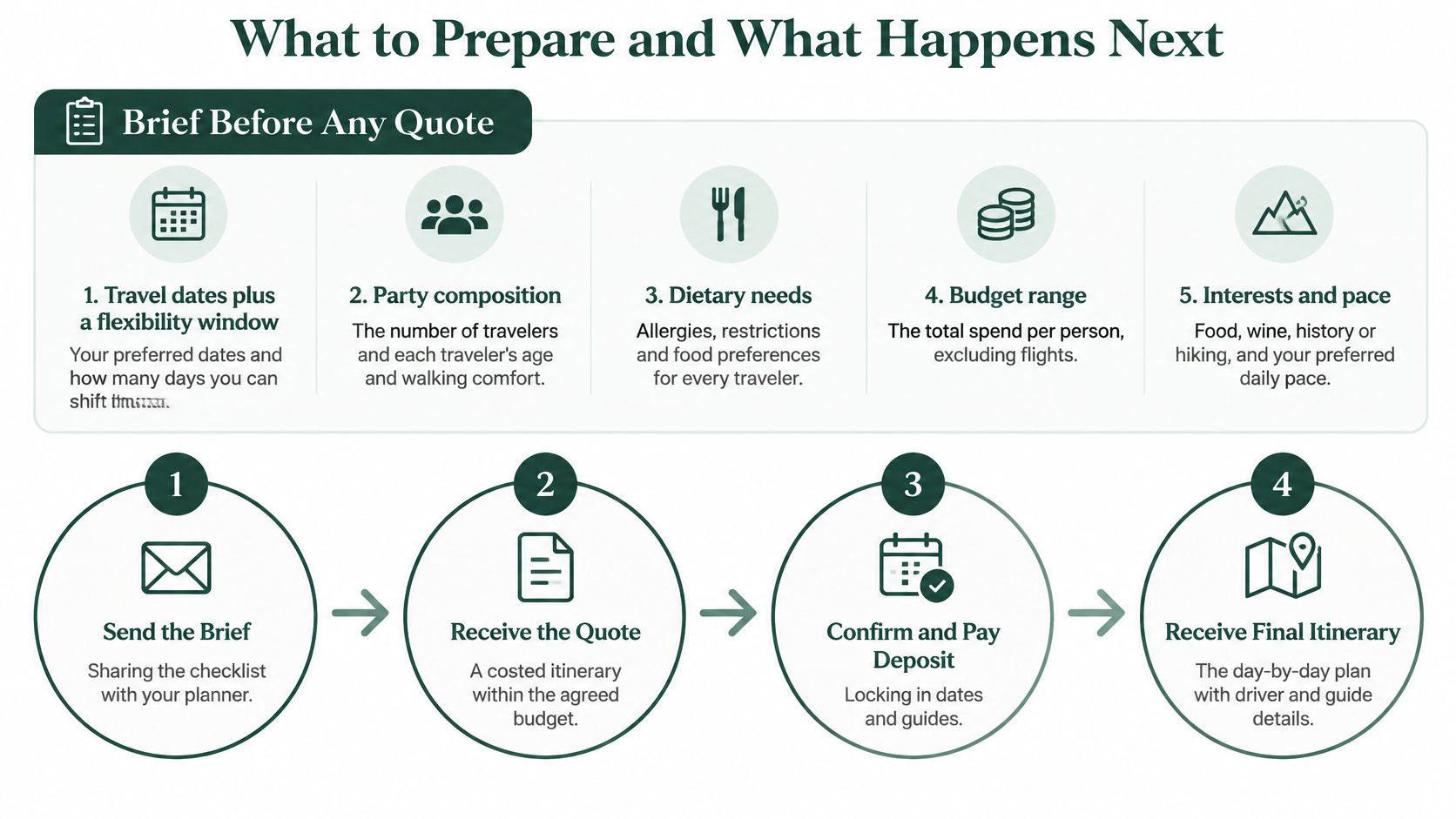
For a journey designed around you across the Basque Country, La Rioja, Navarra, Cantabria, Asturias or Galicia, send Northern Spain Travel your dates, party details, priorities and budget. The team can prepare a planning call, an initial route with weather alternatives, and a quote that sets out inclusions and exclusions. Your first decision is the region and season, because those choices shape availability and cost.