Most advice about a luxury food and wine tour is wrong. It tells you to collect famous cellars, reserve the most celebrated restaurants and fill every day with appointments. That approach produces a polished itinerary on paper and a tiring one in practice.
Northern Spain rewards a different standard. The finest journey is geographically coherent, privately operated and paced around the people traveling, not around a reservation spreadsheet. A serious Rioja tasting needs attention. So does a market in San Sebastián, a coastal walk in Asturias or a long lunch with a producer who has no interest in performing for a crowd.
The right question isn't how many prestigious doors you can enter. It's whether each experience gives the next one more meaning.
Table of Contents
- Redefining the Luxury Food and Wine Tour
- The Economics of Curated Wine Routes
- Choosing Your Regional Culinary Focus
- Designing a Sustainable Daily Rhythm
- Logistics for Multigenerational and Private Groups
- Evaluating Genuine Sustainability and Impact
- Booking Your Bespoke Northern Spain Journey
Redefining the Luxury Food and Wine Tour
Three major tastings in one day may sound impressive. I consider it poor planning. By the final appointment, guests are comparing oak regimes and vineyard elevations through palate fatigue, while the driver is trying to keep an overambitious schedule intact. For travelers in their later forties, fifties and beyond, comfort, digestion and mental space matter more than proving how much ground the itinerary can cover.
Luxury in Northern Spain means fewer, better encounters. Spend a morning with one Rioja producer discussing barrel maturation, soil and blending. Follow it with a proper lunch, a quiet hotel afternoon and perhaps a short walk through a historic town. The following day can move toward Navarra or the Basque Country, where the culinary language changes completely.
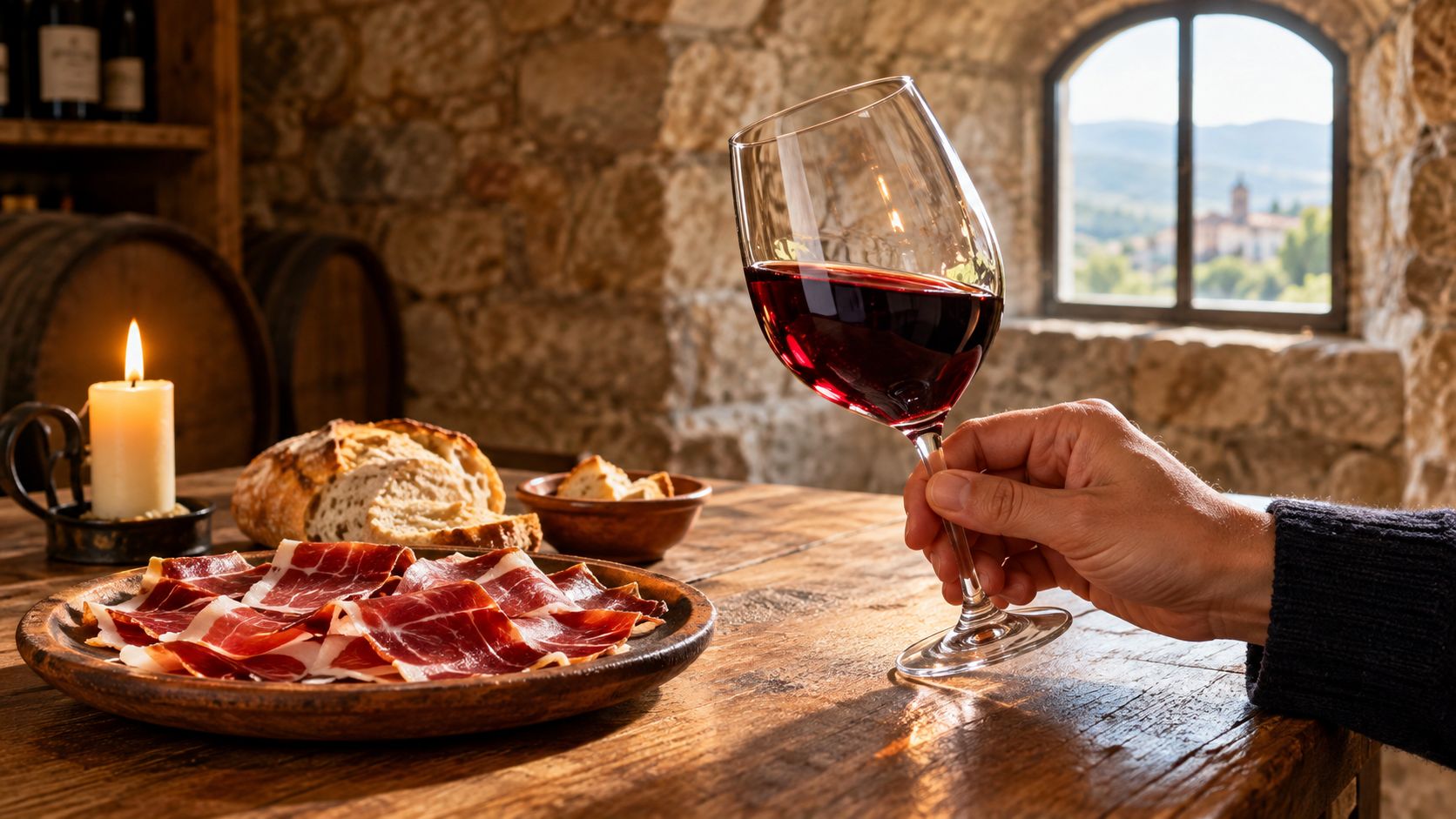
Replace the checklist with a point of view
A private producer conversation has more value than another generic cellar tour. A seasonal market visit can reveal more about a region than a tasting room designed for constant visitor turnover. A fishing-village lunch gives an Atlantic itinerary its sense of place, especially when the menu reflects the day's catch rather than a fixed luxury template.
Build each day around one principal culinary encounter, then add experiences that change the sensory register:
- Morning depth: A vineyard walk, cellar visit or comparative tasting led by someone who can answer technical questions.
- Midday ease: A long regional lunch, not a rushed meal between appointments.
- Afternoon contrast: Architecture, a market, a coastal path, a cooking session or just time at the hotel.
- Evening judgment: One carefully chosen dinner, with no obligation to make it the most elaborate meal of the trip.
The practical rule: Private doesn't mean packed. It means the day can respond to your interests without forcing you through someone else's timetable.
Restaurant logistics deserve the same care as winery access. Studying restaurant table management experiences can help clarify why a well-run dining operation protects pacing, arrival flow and the quality of service. Those details become especially important when a group has dietary restrictions, older travelers or a celebration to coordinate.
Northern Spain's strongest luxury moments often happen between headline reservations. They appear in an unhurried conversation, a producer's personal cellar, a village market or the decision to stop driving before everyone is tired. A well-designed journey leaves room for those moments instead of treating them as gaps in the program.
The Economics of Curated Wine Routes
A strong wine itinerary in Northern Spain is built on geography and access, not on the number of cellars you can fit into a day. The genuine value sits in the regional network around the bottle: estates, small hotels, restaurants, drivers, guides, museums, and cultural sites that belong to the same place and make sense in the same sequence.
That network has grown. Academic analysis of the Wine Routes of Spain, cited by CaixaBank Research provides wider context on Spain's wine industry, found that associated companies increased from 1,871 in 2017 to 2,295 in 2020, a 22.66% rise. The same analysis recorded economic impact from winery and museum visits rising from €75,269,963 in 2017 to €91,799,104 in 2019, an increase of 21.95%. That matters because it confirms wine tourism in Spain functions as a coordinated regional economy, not as a string of isolated tastings.
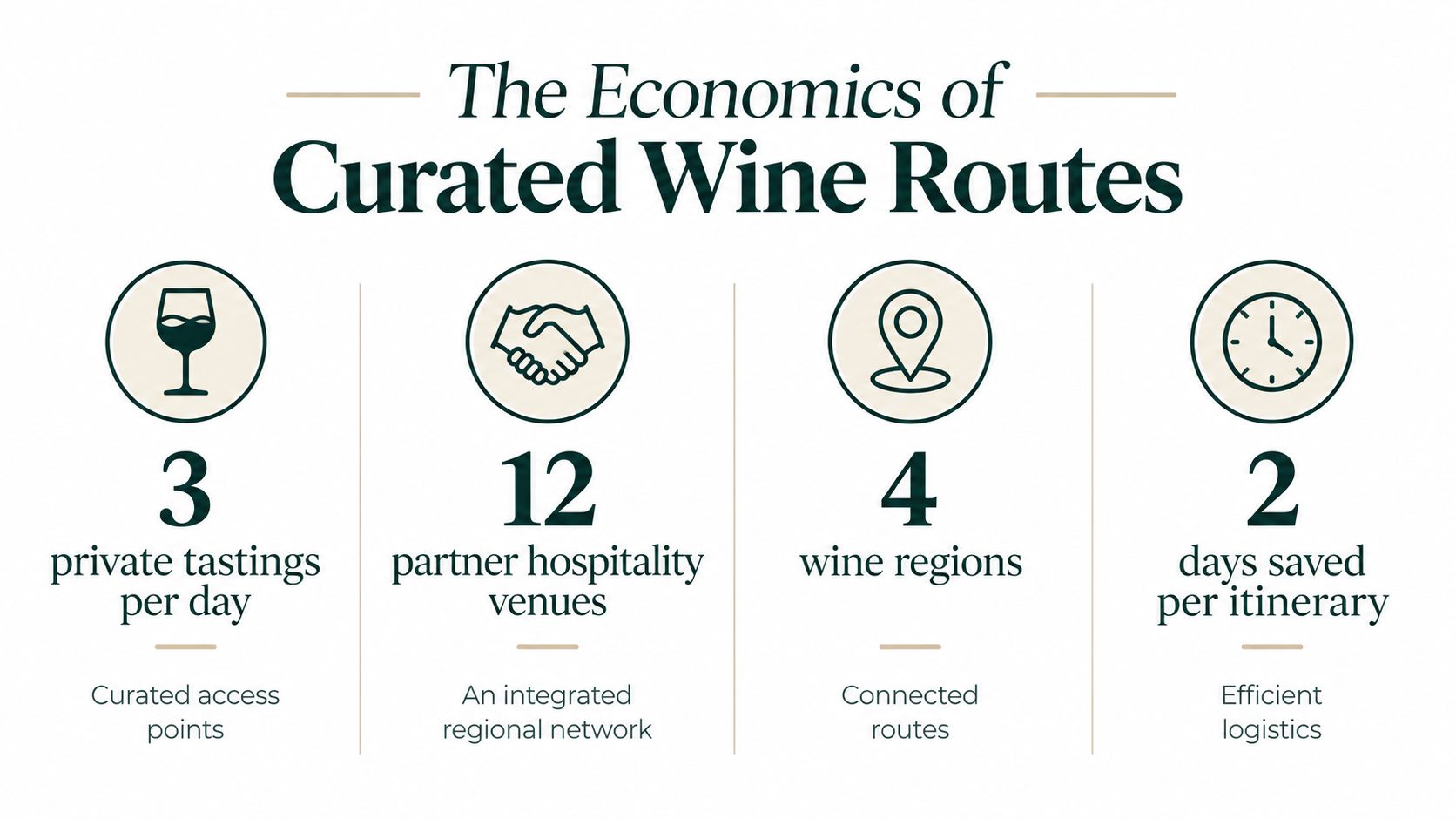
For a private traveler, the implication is straightforward. Spend where the route has depth.
A properly designed route lets each booking reinforce the next one. You might start with a vineyard estate, continue to a lunch that serves the local agricultural tradition rather than a generic fine-dining script, and end at a hotel whose setting keeps you inside the same cultural atmosphere. A good guide then ties together appellation rules, farming choices, architecture, and the way the region eats. The day feels coherent, which is exactly what many expensive wine trips lack.
The scale of that ecosystem is significant. A 2023 estimate from Rutas del Vino de España, cited by Decanter reports on wine's role in Spanish tourism, put annual revenue from winery and wine-museum visits alone at more than €100 million. With accommodation, restaurants, and tour companies included, the estimated impact exceeded €300 million. If you are paying for a high-end journey, that is the model to use. Choose an itinerary that distributes time and spending across the region instead of concentrating everything in one famous cellar and one crowded dining room.
Use a simple filter when judging whether a visit deserves a place in the route. The winery should offer technical substance, such as vineyard geology, blending analysis, or barrel discussion. Access should be controlled enough to avoid the feel of a visitor conveyor belt. The stop should connect naturally to a nearby restaurant, hotel, or cultural site. Timing should protect the day rather than dominate it.
If you want a practical benchmark, this private winery tours guide for Spain helps clarify the difference between a standard tasting and a cellar visit worth building around. That distinction is where money is either well spent or wasted.
There is also a smarter way to spend at the regional level. Include smaller producers, independent guides, and rural hotels where the service is personal and the local knowledge is intact. You support communities that have had to work hard to keep their food and wine traditions economically viable, and you usually get a quieter, more convincing experience in return. In luxury travel, that exchange is the point.
Choosing Your Regional Culinary Focus
Northern Spain contains several distinct culinary and wine identities. Trying to combine all of them in one short trip is a mistake. Choose an anchor first, then add a neighboring region only when the transition strengthens the story.
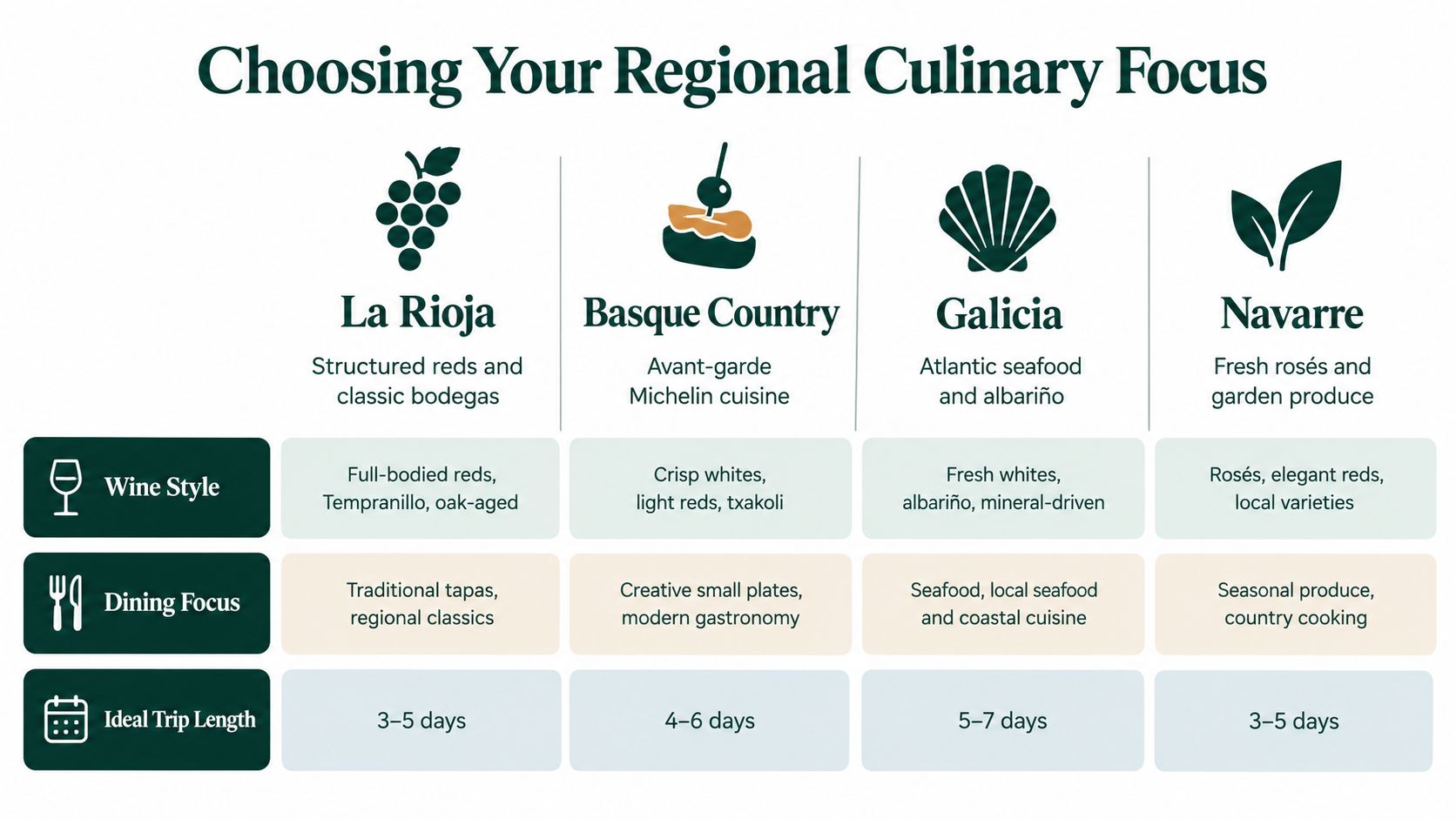
La Rioja is the clearest choice for travelers who want structured red wines, mature vineyard culture and inland gastronomy. Tempranillo, oak, altitude, soil and aging classifications provide a natural framework for a technically serious visit. The food should follow that character, with grilled meats, aged cheeses, mushrooms, peppers and slow-cooked dishes that can stand up to structured reds.
The region has the infrastructure to support a refined private program. In 2024, 214 wineries open to tourism received 912,438 visitors, with international travelers representing 36.37% of the total. Average winery-shop spending reached €40.05 per visitor, and the region's total wine-tourism economic impact reached €197.2 million, including accommodation, restaurants, retail and other local services (Rioja Wine publishes the regional tourism figures).
Match the region to the travelers
The Basque Country suits guests who want food to feel experimental, social and urban. San Sebastián offers an exceptional concentration of culinary talent, but the experience shouldn't be reduced to collecting dining rooms. Add a cider house, a txakoli producer, a market visit or a coastal village, and the region becomes more dimensional. Crisp, saline wines and small-format pintxos create a different rhythm from Rioja's cellar-focused program.
Navarra works well for travelers who want fresh produce, rosé, historic towns and a bridge between inland wine country and Basque culinary culture. Its agricultural identity gives an itinerary room to explore vegetables, peppers, artichokes and market cooking without making every meal heavy.
The Green Coast, encompassing Galicia, Asturias and Cantabria, is the right anchor for travelers drawn to Atlantic seafood, dramatic vistas and alpine-influenced cheeses. Galicia brings a strong seafood culture and Albariño. Asturias adds cider houses, dairy traditions and mountain scenery. Cantabria offers a balanced mix of coast, pasture and refined regional cooking.
| Regional anchor | Culinary and wine personality | Best for |
|---|---|---|
| La Rioja | Structured reds, mature bodegas and inland cuisine | Wine depth and producer access |
| Basque Country | Txakoli, cider, pintxos and avant-garde cooking | Culinary energy and coastal culture |
| Navarra | Fresh rosés, garden produce and historic landscapes | Food-focused travelers seeking variety |
| Green Coast | Atlantic seafood, cider, cheeses and nature | Scenic immersion and lighter pacing |
A coherent journey might pair Rioja with Navarra, or the Basque Country with Cantabria. It shouldn't attempt to make every region a brief stop. The private guide to Northern Spain's wine regions can help travelers decide where the geographic logic is strongest before reservations begin.
Designing a Sustainable Daily Rhythm
Luxury on a food and wine trip is measured in energy. If the day leaves guests dulled by back-to-back pours, long lunches with no pause, and another formal dinner they did not need, the itinerary has failed, no matter how famous the cellar or dining room.
Set the rhythm before you set the reservations. Start late enough that people arrive rested, dressed properly, and ready to pay attention. Give the morning to the senses, not to alcohol. Good guides do this well. They begin with olive oil, local cheeses, cured meats, seasonal vegetables, or bread at a market or private table, so the group understands the region through texture, salt, fat, and aroma before the first glass is poured.
Then make room for one serious wine appointment. One is enough. In Rioja, that may mean a focused tasting around vineyard altitude, oak handling, or blending choices with the producer. The point is concentration, not volume. Guests should have time to ask precise questions, sit with the wine, and notice how the place tastes. If everyone is watching the clock, the schedule is too tight.
Attention improves with contrast.
A long lunch works best when it explains the wines instead of competing with them. A structured Tempranillo shows differently beside grilled meat, aged cheese, and vegetable dishes, because protein, fat, and browned flavors change the feel of tannin and length. Fresher styles make more sense with seafood or produce, where acidity and salinity come forward. Keep the commentary conversational. The the Rioja Wine Tourism Monitor summarizes the visitor profile notes that in 2023, 45.45% of visitors identified as gastronomic tourists interested in wine and regional culinary culture, while 80.5% were amateurs or people interested in wine rather than strictly professional specialists. That is exactly how a private day should be built. Intelligent, relaxed, and grounded in pleasure rather than performance.
By mid-afternoon, split the program without apology. One guest may want a nap and a massage. Another may prefer a market stroll, a quiet old town, a gentle vineyard walk, or a cooking session. That is not a compromise. It is good design, especially for couples or small private groups with mixed levels of wine interest.
Evening is where discipline matters most. Skip the second heavy tasting menu unless the whole trip has been built around it. Dinner should often be lighter, seafood, vegetables, grilled dishes, shared plates, and plenty of water. Protect tomorrow.
Do the same for guests who are not drinking much or at all. Build in thoughtful non-alcoholic pairings, mineral water, regional juices, and food that still feels celebratory. No one should feel like an afterthought on a luxury journey.
Logistics for Multigenerational and Private Groups
A family wine trip rarely fails because the restaurant is disappointing. It fails because the transfers are too long, the paths are uneven, the children are bored, the grandparents are uncomfortable or the group discovers too late that a traditional restaurant can't accommodate a dietary restriction.
Private logistics solve those problems before departure. A dedicated driver understands that a rural estate may require careful timing, that vineyard terrain isn't uniformly accessible and that a scenic route can be worthwhile only when it doesn't compromise the next appointment. A bilingual guide can translate not just language but context, explaining Spanish classifications, serving customs and local etiquette in terms international guests understand.
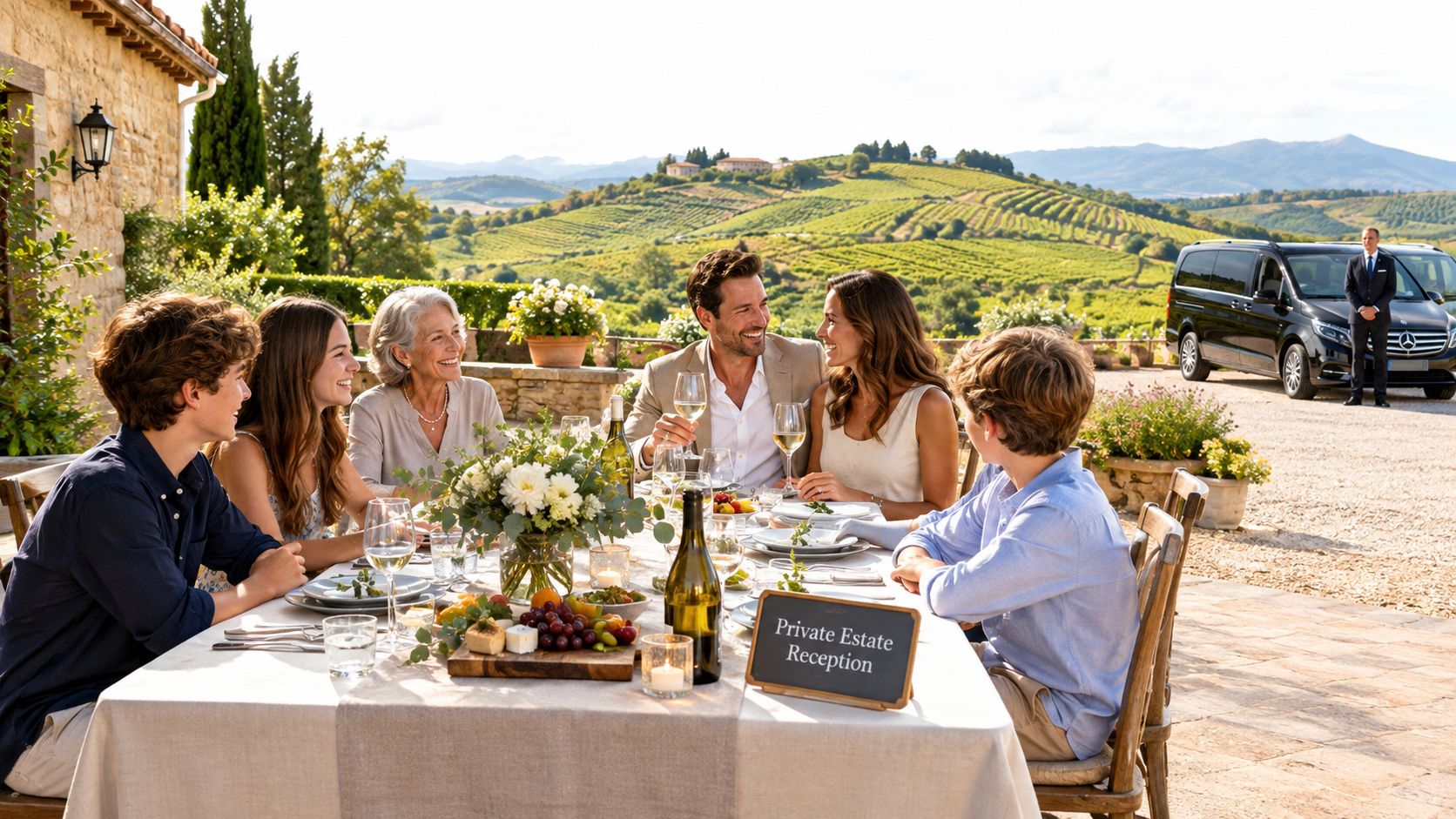
Protect the group's energy
Don't schedule a demanding vineyard walk immediately after a long-haul arrival. Keep the first day simple, arrange an early meal and let the group adjust to local time. For older travelers, specify walking distances, stairs, terrain and restroom access before confirming an experience. For teenagers, pair a winery visit with food, scenery, a hands-on activity or a nearby cultural site.
Dietary planning needs precision. “Vegetarian” can mean different things across kitchens, and traditional sauces or broths may contain ingredients guests avoid. Send the requirements in advance, confirm them with each restaurant and provide the guide with a clear written summary.
Video can also help families understand the atmosphere they want from a private celebration before committing to a style of travel.
Build support around the celebration
A milestone group needs more than bookings. Someone should monitor transfers, reconfirm appointments, manage last-minute changes and know which alternative restaurant or activity can replace a canceled plan. That is the value of on-the-ground support. It keeps the host present with the family instead of turning the celebration into an operations exercise.
The principle applies to other private travel formats too. Travelers comparing the intimacy of a bespoke Spanish journey with experiences such as Key West private sunset sails will recognize the same distinction: privacy has value only when the operator controls the details and adapts the experience to the people aboard.
Shared shuttles and rigid group tours remove that control. A private driver, timed appointments and a flexible guide restore it. For multigenerational travelers, that flexibility isn't an indulgence. It is what makes the trip workable.
Evaluating Genuine Sustainability and Impact
A polished sustainability page proves very little. On a serious food and wine journey, the test is simple: can the people hosting you explain what they do, on the ground, in plain language? A winery should speak clearly about water use, energy, soil health, and biodiversity. A restaurant that claims to represent its region should be able to name its growers, fishers, and meat suppliers, and explain why they were chosen.
That scrutiny matches what travelers are already asking for. Globally, 43% of wine-tourism visitors identify sustainability as important, compared with 42% for culinary experiences. Analysts also note demand for eco-friendly practices at 50%, biodiversity and nature at 48%, and outdoor activities at 27% (the 2025 Global Wine Tourism Report presents these priorities).
Use those priorities to judge the trip design, not just the supplier pitch.
A responsible luxury itinerary usually looks quieter than people expect. Fewer hotel changes. Shorter drives. Longer lunches in one valley instead of rushing across three appellations to collect labels and cellar photos. That approach cuts wasteful transfers, reduces operational strain, and gives you something far more valuable: time to understand the place you came to taste.
Ask direct questions before you book. Does the estate measure water and energy consumption, or only talk about intentions? What is being done to protect habitat, soil life, or surrounding natural areas? Does the kitchen buy from nearby independent producers, or just use the language of locality? Can the route be timed outside the busiest harvest and summer windows? Does your spending reach smaller rural businesses, or stay concentrated in the same famous addresses everyone already knows?
Season matters more than many luxury travelers assume. Going outside peak periods can ease pressure on crowded cellars and dining rooms while supporting steadier employment in wine regions that depend on hospitality. It also improves the experience. Staff have more time, roads are calmer, and access often feels more personal because the destination is not performing for a crowd.
Apply the same discipline to what you consume at home. Travelers who find ethically sourced beans already understand the principle. Traceability matters more than flattering language. Use that standard for wine, food, transport, and accommodation, and sustainability becomes a series of intelligent buying decisions, not a decorative claim.
Booking Your Bespoke Northern Spain Journey
A good proposal begins with a serious conversation. Tell the advisor what you want to feel during the journey, not only which wineries or restaurants you have seen online. “Wine-focused” can mean technical cellar access, views of the vines, private lunches with producers or just better meals with less rushing. Those are different trips.
Before paying a deposit, ask the agency to explain:
- Access: Which experiences are private, and which are standard visits with a private transfer?
- Expertise: Who leads the tasting, and can they discuss geology, production and local classifications at the right level?
- Pacing: How much unstructured time exists each day, and what happens if the group wants to skip an appointment?
- Food planning: How are allergies, medical diets, preferences and non-alcoholic pairings handled?
- Flexibility: What are the cancellation terms, and how are weather or producer changes managed?
- Support: Who is available during the trip if a transfer, reservation or health issue changes?
A specialist such as Northern Spain Travel can design private journeys across the Basque Country, La Rioja, Navarra, Cantabria, Asturias, Galicia and neighboring regions, coordinating boutique hotels, drivers, guides, chefs and winemakers. Treat the agency as a design partner, not a booking portal. Its value lies in judgment, access and the ability to make separate suppliers behave like one cohesive itinerary.
The private journey planning blueprint for a luxury vacation is a useful starting point for organizing your priorities before the consultation. Prepare a short brief covering preferred travel dates, mobility considerations, dietary needs, drinking preferences, celebration details, hotel style and the balance you want between wine, food, nature and culture.
Then insist on geographic logic. Choose one principal region, add only compatible neighbors and keep one meaningful wine encounter at the center of each day. The finished itinerary should feel calm, personal and locally grounded. If it looks exhausting on paper, it will be worse on the ground.
Northern Spain Travel designs fully private, tailor-made journeys that combine Rioja cellars, Basque culinary culture, Atlantic villages, boutique hotels and carefully paced regional experiences. Visit Northern Spain Travel to discuss your preferred pace, culinary interests and the private access you want from a luxury food and wine tour.