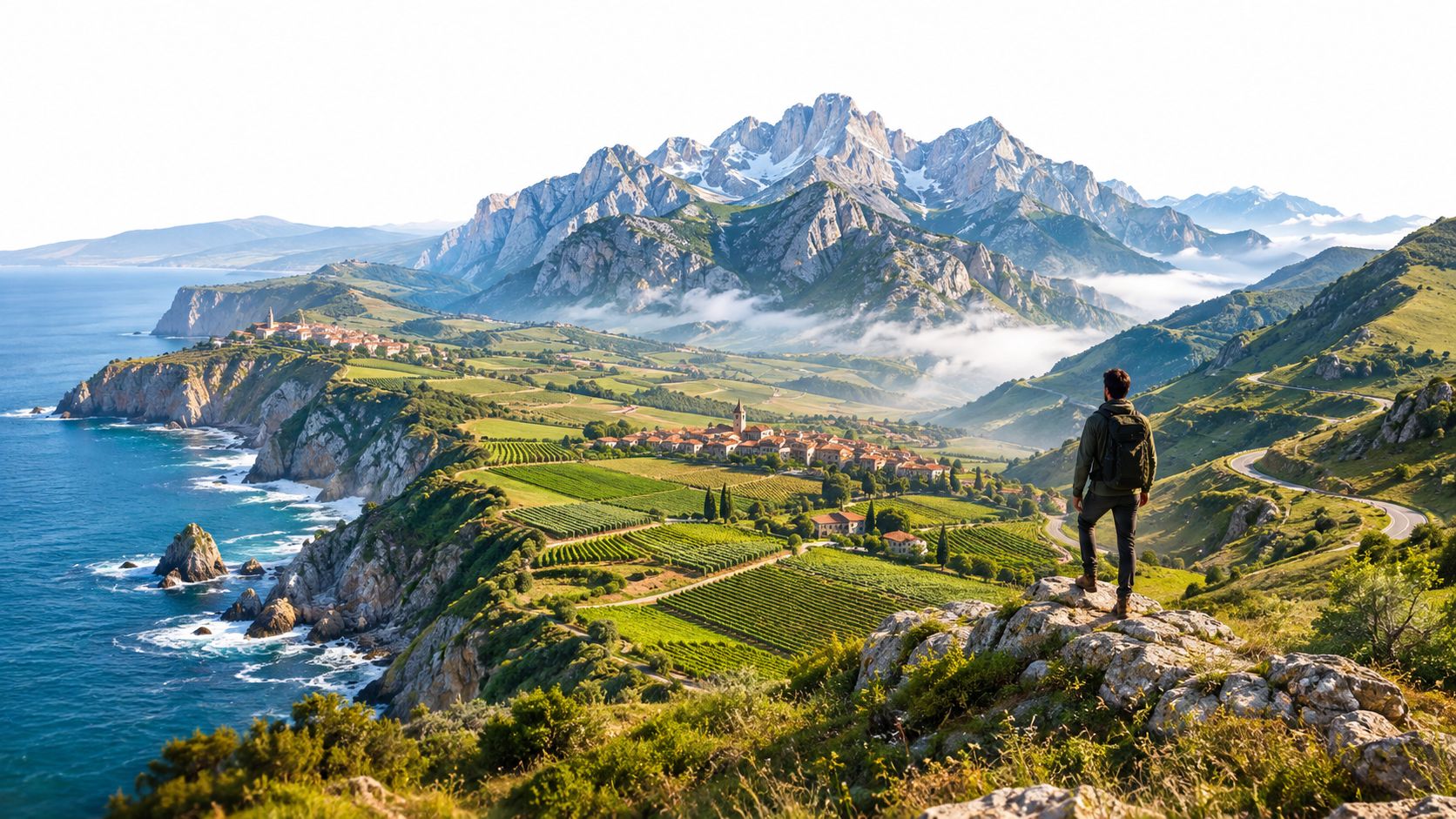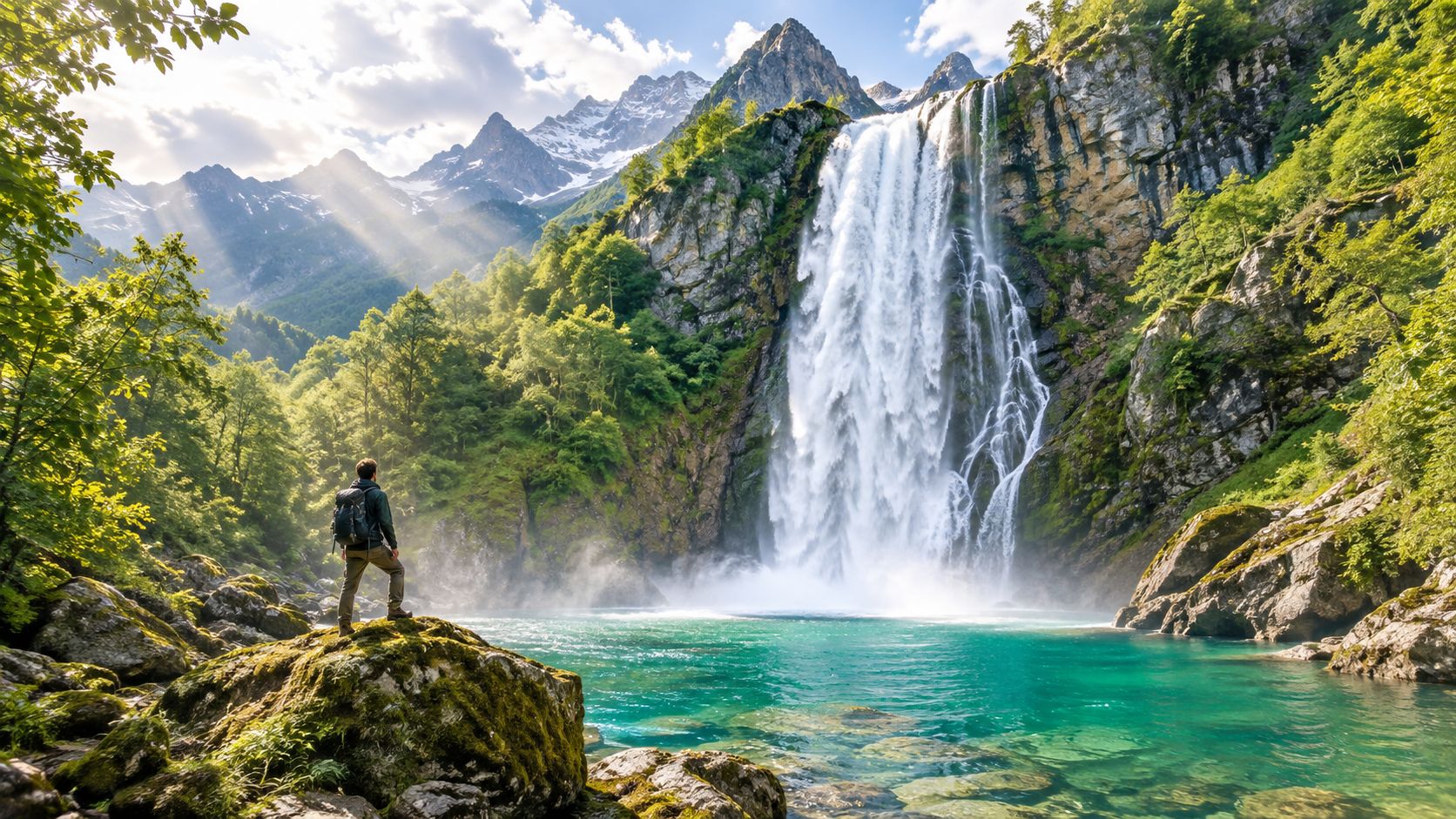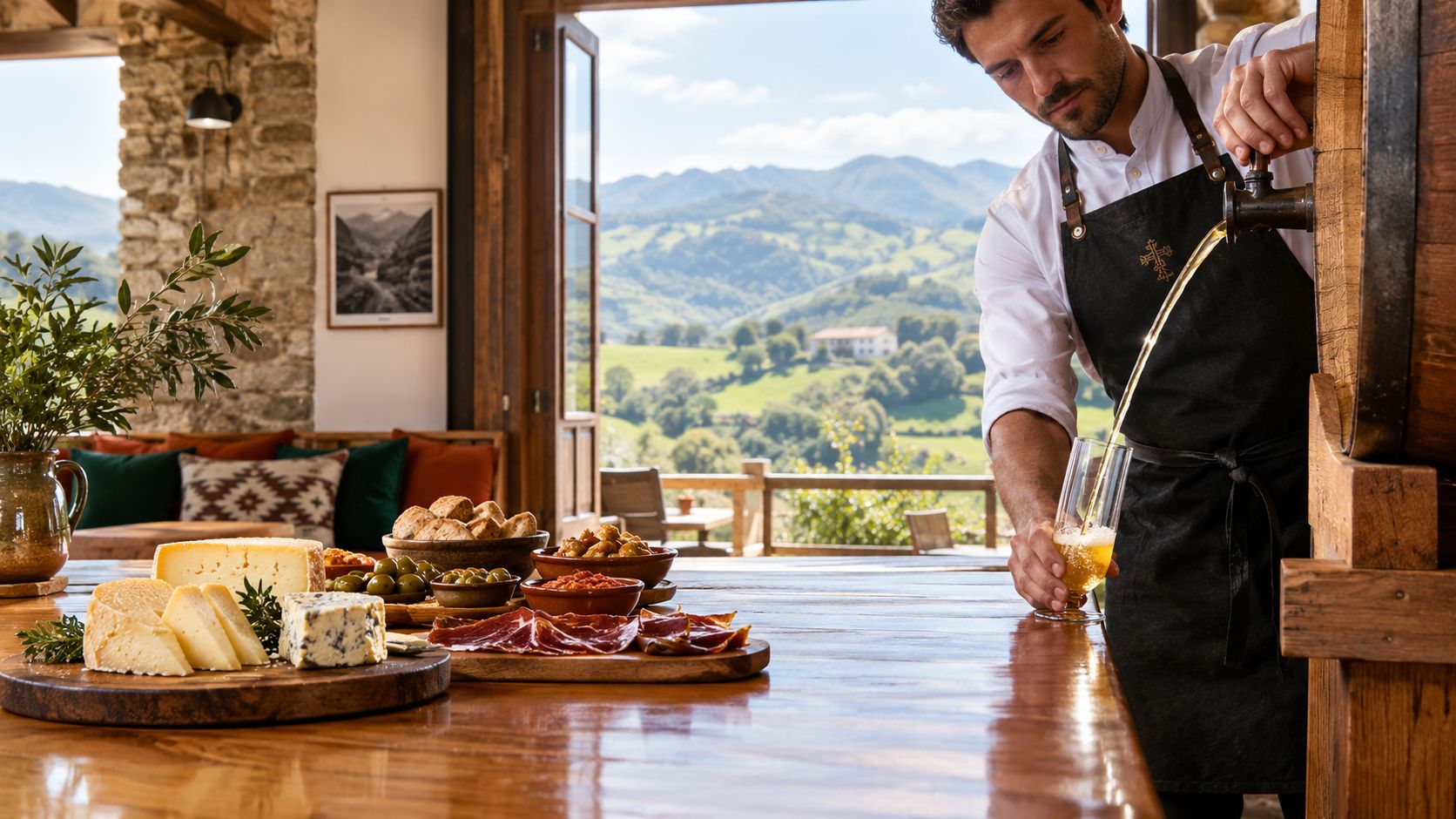
Northern Spain doesn't give you one obvious Roman blockbuster. It gives you a connected Roman landscape instead. In Lugo, you can walk a nearly complete Roman circuit that still encloses a living city, and UNESCO added the Roman Walls of Lugo to the World Heritage List in 2000. In La Rioja, the Ebro corridor preserves the urban afterlife of Roman settlement in a region now better known for vineyards than archaeology. Across Galicia, Asturias, the Basque Country, and Castilla y León, Roman walls, roads, mining landscapes, and port sites still sit close to seafood towns, wine country, mountain routes, and elegant small hotels.
That's what makes the best Roman ruins in Northern Spain so rewarding for a private journey. You're not choosing between culture and comfort. You're choosing which kind of Roman story you want to build your route around: a fortress city, a theater tied to Rioja, a vast engineered mining site, or a maritime site on the Atlantic edge.
For discerning travelers, the difference is logistics. Some sites work best as a half-day stop with a private guide and lunch reservation. Others deserve a slower overnight with a driver, a museum visit, and room for weather. The strongest itineraries also pair archaeology with something lived and regional: wine in Rioja, seafood in Galicia, Basque gastronomy, or León's layered inland heritage.
The list below favors places that deliver meaning on the ground, not just name recognition. Each one can anchor a route when you time it well, stay nearby, and treat the Roman remains as part of a wider Northern Spain journey rather than an isolated stop.
Table of Contents
- 1. Roman Theater of Calagurris (Calahorra, La Rioja)
- 2. Roman Bridge of Alcántara (Salamanca Province, Castilla y León)
- 3. Roman Walls of Lugo (Galicia)
- 4. Roman Gold Mines of Las Médulas (León, Castilla y León)
- 5. Roman Road and Mansio Complex of Iruña-Veleia (Vitoria-Gasteiz, Basque Country)
- 6. Roman Mining and Settlement Complex of Astorga (León)
- 7. Roman Harbor and Maritime Complex of Gijón (Asturias)
- Top 7 Roman Ruins in Northern Spain, Comparison
- Build a Roman Journey Around the Right Base
1. Roman Theater of Calagurris (Calahorra, La Rioja)
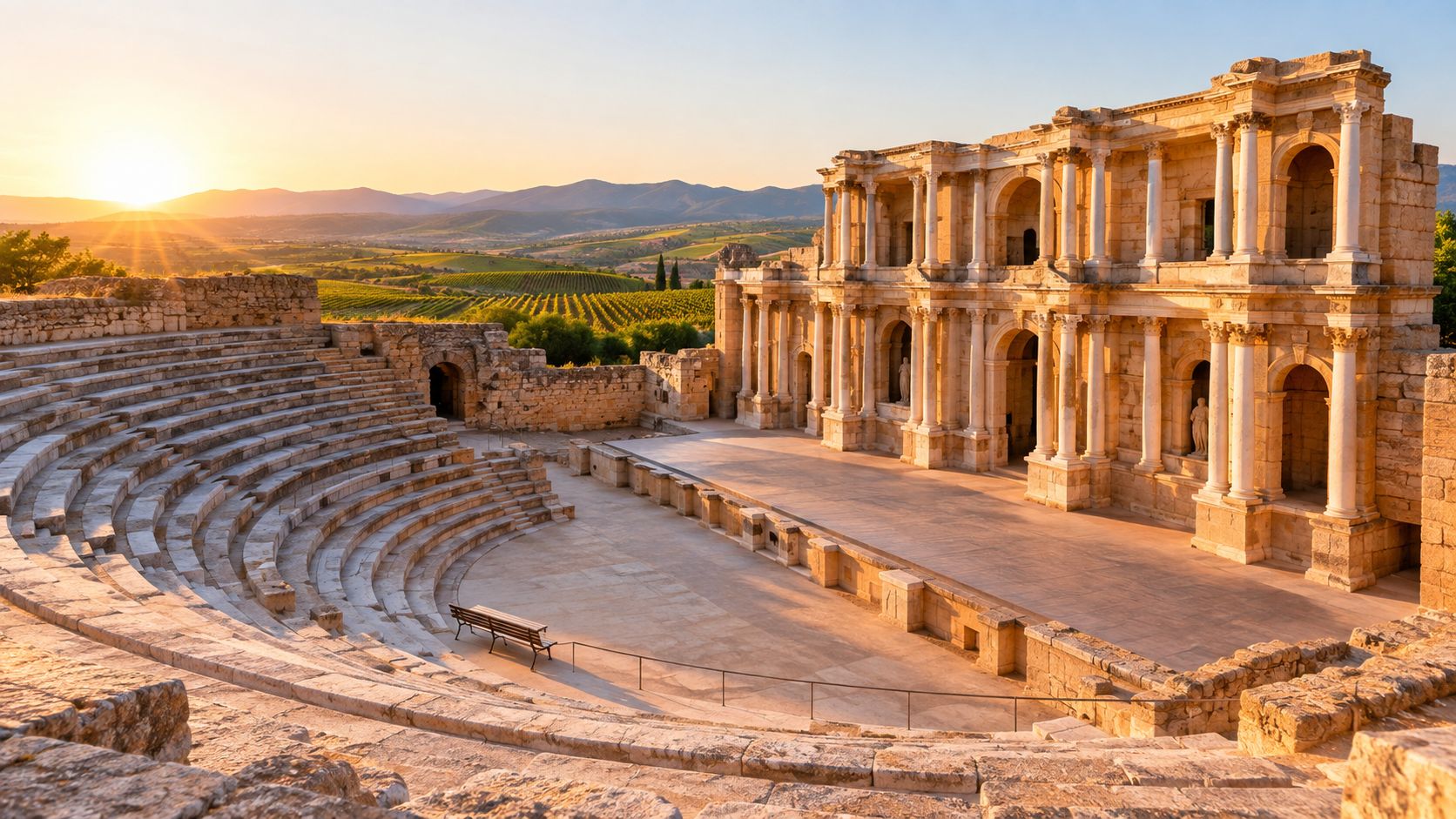
If you want Roman archaeology without giving up the pleasures of wine country, start with Calahorra. The Roman theater of Calagurris is the rare site that works well for travelers who value interpretation, atmosphere, and an easy transition into a refined Rioja stay.
Its appeal isn't only the structure itself. It's the setting. In this part of the Ebro Valley, Roman urban life feels legible in a way many fragmentary sites don't. A good private guide can turn stone seating, circulation patterns, and stage remains into a clear story about civic life, performance, and status in Roman Hispania.
Why it works on a luxury itinerary
Calahorra is best for couples and small private groups who don't want a full archaeology-heavy day but still want substance. Visit in the late afternoon, then continue to a boutique base in Rioja for dinner and a cellar visit the next day. If you're planning a broader wine route, this site adds intellectual depth without slowing the trip down.
A strong version of the day looks like this:
- Private interpretation first: Book a bilingual specialist guide who can explain how theaters expressed Roman power in provincial cities.
- Time the light carefully: Late-day visits tend to feel more atmospheric and photograph better than midday arrivals.
- Pair it with Rioja properly: Follow with a structured tasting or vineyard lunch rather than squeezing in another heritage stop.
- Sleep where the route makes sense: Choose one of the region's polished wine-country bases using this guide to where to stay in Rioja wine region.
Calagurris is one of the best Roman ruins in Northern Spain for travelers who want cultural depth without building the whole trip around ruins.
Best fit
This is the Roman stop I'd recommend when archaeology needs to coexist with comfort, wine, and shorter walking distances. It also suits multigenerational groups because the site can be visited at an unhurried pace, then balanced with food and hotel time rather than another long transfer.
2. Roman Bridge of Alcántara (Salamanca Province, Castilla y León)
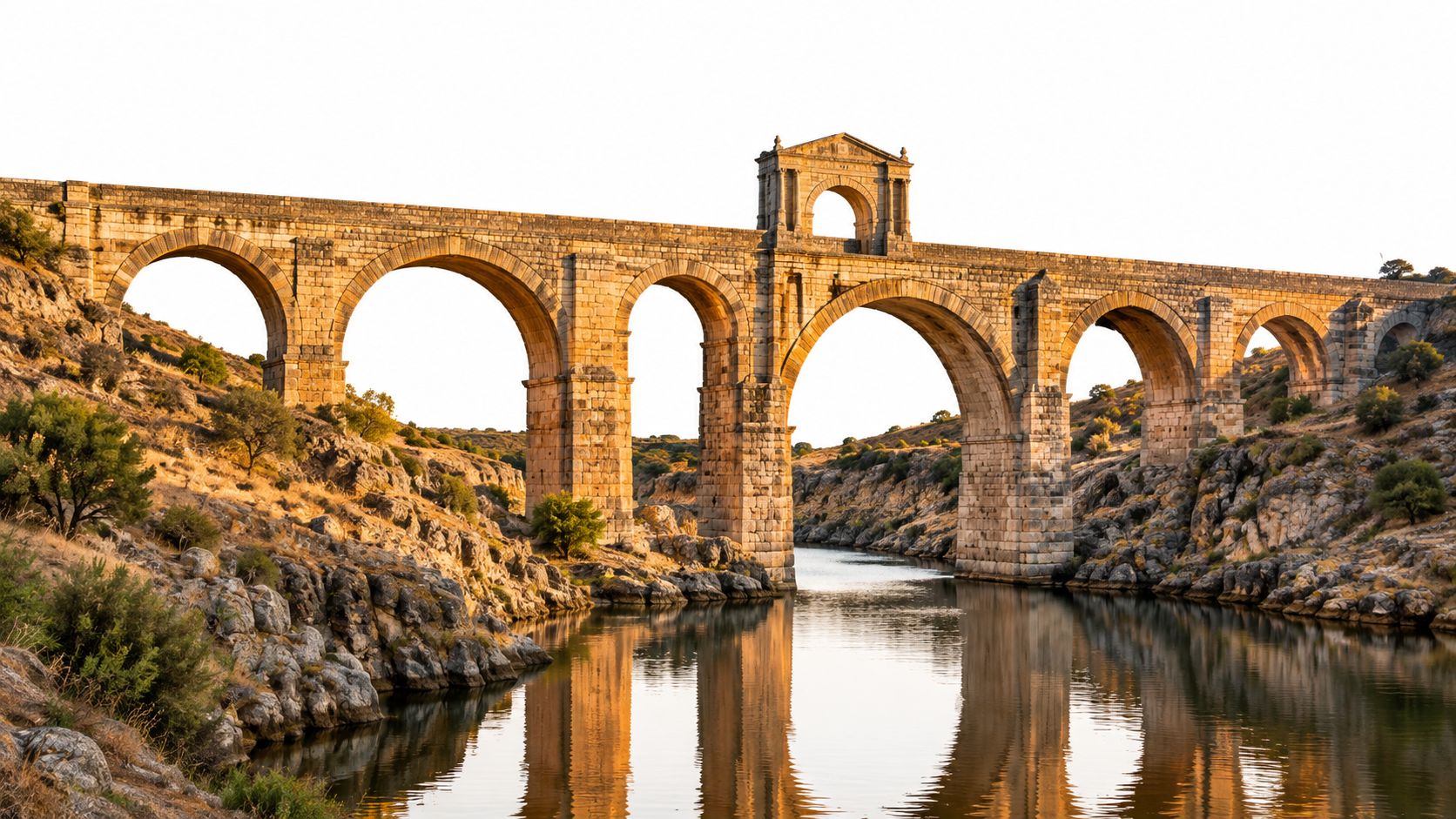
Alcántara is the outlier on this list. It sits outside the tightest definition of Northern Spain, yet it belongs in a serious private Roman itinerary because it delivers something the others don't: pure Roman engineering at monumental scale.
This is not a layered urban site. It's a statement in stone. For travelers who respond to architecture, infrastructure, and setting, the bridge is more moving than many larger archaeological zones because the purpose remains so immediately clear.
Why go out of your way
Alcántara works best as part of a bespoke overland route for clients entering or leaving the north through Castilla y León. It pairs especially well with Salamanca, whose historic core offers the level of accommodation and dining that makes a heritage-focused road journey feel polished rather than strenuous.
Use it if your priorities are these:
- Engineering clarity: You don't need much imagination to grasp why Roman bridge-building still commands attention here.
- Scenic arrival: The approach matters. A private driver allows you to stop for viewpoints and avoid turning the visit into a rushed photo stop.
- Low-friction pacing: The site suits travelers who prefer a compact but memorable visit rather than a museum-heavy day.
For a broader regional base, pair it with time in Salamanca, Spain's golden gem, then continue north.
Best fit
I recommend Alcántara most strongly for milestone trips, anniversary journeys, and architecturally minded travelers. It's also excellent for private groups who enjoy discussion at the site itself. One person sees a bridge. Another sees imperial administration, road networks, labor, and material mastery. A good guide lets all of that surface without overloading the visit.
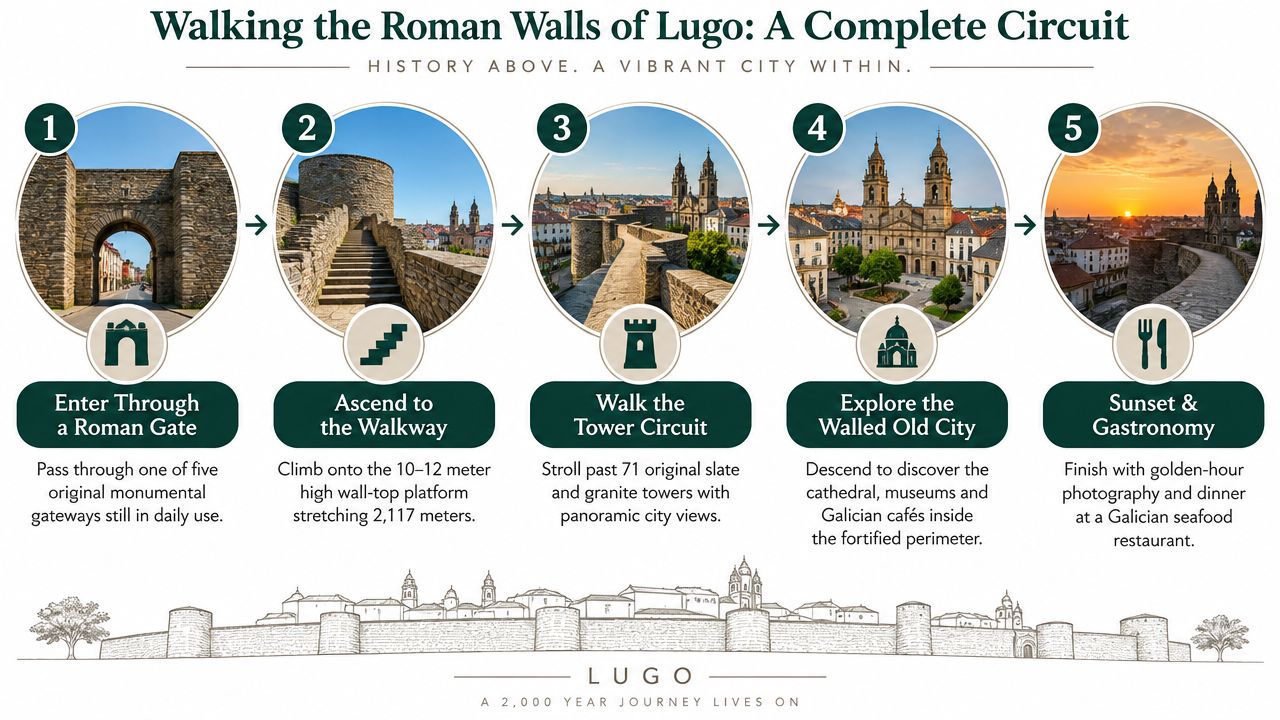
3. Roman Walls of Lugo (Galicia)
If you only choose one Roman monument in the north for ease, legibility, and itinerary value, choose Lugo. The Roman Walls were built in the 3rd century AD to defend Lucus Augusti, and UNESCO added them to the World Heritage List in 2000. That inscription matters because the site isn't a fragment. It's a near-complete urban defense system that still shapes the city you experience today.
Lugo's strongest advantage is that the Roman story is physically walkable. You don't need to piece together scattered remains across a large archaeological park. You arrive, you ascend, and the monument explains itself with unusual clarity.
Why Lugo earns priority
For private travelers, Lugo solves a common problem in Roman itineraries. It offers high historical value without operational friction. Existing coverage often lists Lugo alongside places like Gijón and the Tower of Hercules but doesn't explain how to route them well, even though affluent travelers often need shorter walks, drivers, and smoother pacing, as noted in this analysis of Spain's UNESCO landscape and travel-planning gaps.
That's why Lugo works so well as a base or anchor stop:
- Immediate impact: Walking the walls gives non-specialists a direct understanding of Roman military urbanism.
- Compact luxury logistics: Hotels, restaurants, and the historic center sit close together.
- Cross-generational appeal: Grandparents, parents, and teenagers can all engage with it at different levels.
Practical rule: In Lugo, book one excellent guide and one excellent dinner. You don't need a long checklist of secondary attractions to make the day feel full.
How to pair it well
Lugo combines naturally with inland Galicia, the Rías Baixas, or a westbound route toward A Coruña. It also belongs on curated routes focused on Northern Spain UNESCO sites for luxury travelers. If your trip needs one Roman site that's easy to understand, easy to access, and easy to enjoy, Lugo is the cleanest choice.
4. Roman Gold Mines of Las Médulas (León, Castilla y León)
Las Médulas isn't a ruin in the conventional sense. It's a transformed area. That's exactly why it deserves a place near the top of any list of the best Roman ruins in Northern Spain.
Most Roman sites ask you to imagine what once stood there. Las Médulas asks you to confront what Roman extraction did to an entire territory. The result is more dramatic than many theaters, forums, or bath complexes because the scale is environmental as much as archaeological.
A visual sense of the terrain helps before you arrive.
Why it stands apart
This site is best for travelers who enjoy light walking, and deeper interpretation. It's especially strong in an itinerary that also includes Astorga or León city, because those urban contexts help explain how Roman administration and resource extraction connected.
The practical challenge is pacing. Las Médulas needs time, weather awareness, and a driver who understands rural mountain routes. Don't treat it as a quick detour.
- Give it a full day: The site reveals itself through viewpoints, movement, and explanation.
- Choose the right guide: A mining historian or archaeologically trained guide makes a substantial difference here.
- Dress for terrain: Even a soft-adventure version of the visit still involves uneven ground and variable weather.
- Stay nearby or in León: That keeps the day elegant instead of exhausting.
A short film can also help frame the visit before or after the walk.
Best fit
Las Médulas is the Roman site I'd choose for travelers who are less interested in urban ruins and more interested in systems, labor, water engineering, and visual drama. It also works well for families with older children or teenagers, because the site feels exploratory rather than static.
5. Roman Road and Mansio Complex of Iruña-Veleia (Vitoria-Gasteiz, Basque Country)
Choose Iruña-Veleia for refinement, not spectacle.
Among the seven sites in this article, this is the one that works best inside a polished Basque itinerary where archaeology shares the day with architecture, wine, and serious dining. Its value lies in interpretive depth and placement. You are looking at a Roman settlement tied to movement, administration, and provincial life, with enough surviving context to reward a traveler who wants more than a photo stop.
The road and mansio dimension matters. A site like this helps explain how northern Hispania functioned between major urban centers, not just how it commemorated itself in walls, theaters, or triumphal remains. For travelers building a private journey, that makes Iruña-Veleia unusually useful. It adds connective tissue to the Roman story.
What it offers is a calm, intelligent visit.
You come here for a measured morning with a strong guide, then continue easily to Vitoria-Gasteiz for lunch, a museum stop, or a late-afternoon walk through the city. Rioja Alavesa also sits naturally within reach, which gives this site stronger itinerary flexibility than more isolated Roman ruins. If your trip needs every stop to justify itself both historically and logistically, Iruña-Veleia performs well.
A few practical judgments matter here more than at flashier sites:
- Prioritize private interpretation. The remains make far more sense with a guide who can explain road networks, staging posts, and settlement hierarchy.
- Visit in spring or early autumn if possible. The experience improves in mild weather, when the site feels spacious rather than exposed.
- Base in Vitoria-Gasteiz. It gives you the best combination of comfort, dining, and cultural follow-through.
- Pair it with Basque or Alavese experiences on the same day. That is the smartest use of the site.
I would not rank Iruña-Veleia first for first-time visitors to Roman Spain. I would rank it highly for repeat visitors, culturally ambitious couples, and travelers who want an edited route instead of a greatest-hits checklist. In a luxury journey through northern Spain, it serves as an anchor for the Basque stretch because it connects Roman history to one of the country's most refined present-day regions.
6. Roman Mining and Settlement Complex of Astorga (León)
Astorga earns its place on a high-end Roman itinerary because it does more than show ruins. It explains how Rome organized this part of the northwest, controlled mineral wealth, and kept an inland network functioning long after extraction began. If Las Médulas gives you the theatrical mining area, Astorga gives you the administrative brain behind it.
That distinction matters. Travelers who only chase visual drama often underrate Astorga, then leave realizing it gave them a clearer grasp of Roman León than a more photogenic stop would have done.
Come here for interpretation and position, not spectacle.
The strongest visit starts with the Roman Museum and the surviving urban fabric, then expands outward into the wider mining story. A good private guide can tie together roads, settlement logic, commercial movement, and imperial control of the surrounding territory. Without that layer, Astorga can feel too dispersed. With it, the town becomes one of the smartest Roman stops in northern Spain.
Its luxury value is practical as much as historical. Astorga is easy to absorb without fatigue, works well as a civilized half-day or full-day stop, and sits in a part of León province where route planning matters. You can base nearby, sleep well, and use the town to connect larger experiences rather than treating it as an isolated archaeological errand.
Three judgments will improve the visit:
- Use Astorga to interpret Las Médulas better: See both if your itinerary allows it. The mines impress the eye. Astorga explains the system.
- Choose a guide who can handle urban archaeology: This is a town where context carries the experience.
- Stay selective with timing: Shoulder season suits Astorga best, especially if you want an unhurried walk, a proper lunch, and enough mental space for museum time.
Astorga also suits travelers who care about comfort and variety within the same day. One guest can focus on Roman administration and infrastructure. Another can enjoy the cathedral setting, the historic center, or the town's food traditions without feeling dragged through a specialist site. That breadth makes it especially useful for couples and private family groups with mixed interests.
I would not put Astorga at the top for travelers who want one overwhelming monument and little else. I would rank it highly for those building a route through León, especially if they want Roman history to feel connected to where they sleep, dine, and continue next. In that role, Astorga performs very well.
7. Roman Harbor and Maritime Complex of Gijón (Asturias)
Skip Gijón if you want a single overpowering ruin. Choose it if you want the Roman north to make sense as a lived coastal system rather than a sequence of inland monuments.
That is the case for including it on a private luxury journey. Gijón gives you Roman maritime infrastructure, Atlantic atmosphere, and a city that remains pleasant once the archaeology is over. Few sites on this list handle that combination as well.
The appeal is interpretive range. A harbor complex explains movement: goods, military supply, fishing, and the way Rome used the Cantabrian coast. That makes Gijón especially useful late in an itinerary, once you have already seen walls, roads, mines, or administrative centers elsewhere in northern Spain. It adds a missing dimension.
For travelers who care about comfort, Gijón is practical. Access is straightforward. Walking demands are moderate. Weather matters, but in a constructive way because the sea setting sharpens the visit rather than distracting from it. On a gray day, the site can feel more convincing than under flat summer glare.
Use Gijón in one of two ways.
First, as a polished half-day based in the city itself, with a guided archaeological visit followed by a long seafood lunch, a promenade walk, and a relaxed evening in a strong hotel. That version suits couples and private family groups who want history without turning the day into an endurance exercise.
Second, use it as the Roman anchor within a broader Asturias program. It pairs well with cider houses, coastal scenery, and a slower rhythm than many heritage-heavy routes allow. The site is not the most visually monumental of the seven, but it earns its place through atmosphere, context, and itinerary balance.
The trade-off is clear. Gijón asks for curiosity more than awe. You need a guide who can explain maritime logistics, urban development, and what survives versus what must be reconstructed mentally. Without that, the visit risks feeling partial. With it, the site becomes one of the more compelling Roman stops in the north.
I would rank Gijón highly for travelers who want Roman history integrated with good dining, sea air, and an elegant Asturias base. I would rank it lower for travelers chasing scale alone.
Top 7 Roman Ruins in Northern Spain, Comparison
| Site | Access & Logistics 🔄⚡ | Visitor Requirements / Resources 🔄 | Expected Experience & Impact ⭐📊 | Ideal Use Cases 💡 | Key Advantages ⭐ |
|---|---|---|---|---|---|
| Roman Theater of Calagurris (Calahorra) | Easily reached by car; ticketed site; avg visit 2–3 hrs | Bilingual/private guide for English; possible after-hours arrangements; comfortable footwear | Intimate, high-authenticity theatrical architecture; strong photo potential 📊 | Wine-country luxury days; private evening performances; scholarly group visits 💡 | Exceptionally well‑preserved provincial Roman theater; museum interpretation ⭐ |
| Roman Bridge of Alcántara (Alcántara) | Remote; 2–3 hr drives from major hubs; free viewpoints; small museum | Private transport recommended; guide (engineering focus); pack provisions | Profound engineering insight; dramatic landscape photography; milestone-event settings 📊 | Engineering/architecture tours; romantic sunset events; long-route driving itineraries 💡 | Monumental mortar‑free Roman bridge, UNESCO status; iconic arches ⭐ |
| Roman Walls of Lugo (Lugo) | Urban and highly accessible; continuous walkable circuit (2–4 hrs) | Comfortable shoes; optional private guide for English; flexible entry points | Immersive defensive architecture walk with panoramic city views; integrated urban experience 📊 | Sunset wall walks, family/multi‑gen tours, gastronomy + culture days 💡 | Most complete Roman fortification circuit in Iberia; walkable UNESCO site ⭐ |
| Las Médulas (León) | Remote landscape site across ~40 km²; best as full‑day or multi‑day visit | Experienced guide, private transport, hiking gear; plan for variable weather | Landscape‑scale industrial archaeology; powerful visual/drone photography; environmental narrative 📊 | Photography expeditions, industrial‑heritage tours, academic/engineering programs 💡 | Vast hydraulic mining landscape; unique Roman industrial engineering; UNESCO ⭐ |
| Iruña‑Veleia (Vitoria‑Gasteiz) | 7 km from Vitoria‑Gasteiz; excavation park + separate city museum | Coordinate site + museum visits; archaeological guide recommended | Clear urban planning and artifact context; strong museum interpretation and scholarly depth 📊 | Gastronomy + archaeology combos; family education tours; Basque cultural integration 💡 | Well‑excavated Roman urban complex near a modern gastronomic hub ⭐ |
| Astorga (León) | Historic town center access; 3–4 hr exploratory visit typical | Guide to interpret Roman beneath medieval layers; museum entry fees | Layered Roman→medieval→modern narrative; museum-supported interpretation 📊 | Multi‑day heritage itineraries, Camino de Santiago connections, culinary tours 💡 | Rich historical layering, strong museum collections, complementary medieval attractions ⭐ |
| Roman Harbor of Gijón (Gijón) | Coastal/urban; remains integrated into modern harbor; 2–3 hr site + museums | Maritime archaeology guide advisable; museum visits across institutions | Maritime trade and port infrastructure perspective; pairs with coastal leisure and gastronomy 📊 | Coastal archaeology + beach days; seafood/cider culinary itineraries; soft‑adventure travel 💡 | Unique Atlantic maritime archaeology within a lively contemporary city; good visitor amenities ⭐ |
Build a Roman Journey Around the Right Base
There isn't one universal winner among the best Roman ruins in Northern Spain. There's a right fit for the trip you want to take. Lugo is the strongest all-round anchor if you value accessible fortifications and instant interpretive clarity. Calagurris works best when Roman history needs to sit comfortably inside a Rioja itinerary shaped around wine and relaxed pacing. Las Médulas is the standout for scale engineering and travelers who want Roman ambition expressed through terrain rather than buildings.
Iruña-Veleia suits a Basque route where archaeology should deepen an already refined food and culture journey. Astorga is the choice for layered heritage and travelers who enjoy continuity across Roman, medieval, and Camino histories. Gijón brings in maritime culture and a more relaxed Atlantic rhythm. Alcántara, while geographically peripheral to the north, belongs in the conversation for travelers drawn to monumental bridge engineering and elegant overland routing through Castilla y León.
The smartest way to plan this well is to choose your regional cluster first. Don't try to collect all seven unless you have a long trip and a high tolerance for transfers. A Galicia-focused route might center on Lugo and continue toward the coast. A León and inland Castilla y León route can link Astorga, Las Médulas, and Alcántara with the right pacing. A Basque and Rioja journey works cleanly around Iruña-Veleia and Calagurris.
Then match terrain to the travelers. Lugo and Calagurris are easier for guests who want shorter walking distances and less physical strain. Las Médulas asks more of you. Gijón gives breathing room. Astorga rewards those who like to stroll and pause. This is not a detail to settle late.
Reserve private guides and drivers early. Confirm opening arrangements, access conditions, and how much walking each site involves. That's where a private itinerary becomes the difference between an inspiring Roman journey and a string of disconnected stops.
If you want that route built around boutique stays, local experts, private transport, and on-the-ground support, Northern Spain Travel is one relevant option for designing a fully private journey through these regions.
Northern Spain Travel designs private itineraries that can turn Roman sites like Lugo, Calagurris, Las Médulas, or Gijón into a coherent journey rather than a scattered checklist. If you want boutique hotels, private guides, driver-led routing, and regional pairings with wine, food, and coastal stays, visit Northern Spain Travel.