
The luxury travel concierge market was valued at USD 801.64 million in 2025, rising to USD 859.52 million in 2026 and projected to reach USD 1.32 billion by 2032. A luxury travel concierge does far more than book hotels and restaurants, coordinating privacy, access, transport, experiences, and support across the entire journey.
You may be researching a private trip right now and finding plenty of beautiful hotels, highly rated restaurants, and impressive excursions. The difficult part begins when those pieces need to work together: a late arrival connects with a private transfer, a multigenerational group needs different activity levels, and a fully booked restaurant must fit between a winery visit and a cultural event.
That's where the modern concierge earns its place. The service has evolved from a convenient booking desk into a quiet operations partner who understands how the trip should feel, anticipates weak points, and keeps suppliers moving in the same direction. You're not paying for access alone. You're paying for judgment, discretion, and the ability to adapt without making you manage the disruption.
Table of Contents
- What Is a Luxury Travel Concierge
- Core Services and Benefits of a Luxury Travel Concierge
- How a Luxury Travel Concierge Differs from Other Travel Professionals
- What to Expect When Working with a Luxury Travel Concierge
- Pricing, Booking, and Red Flags to Avoid
- Why Choose a Specialist for Your Next Journey
What Is a Luxury Travel Concierge
A luxury travel concierge is a specialist who designs and manages a private journey from the first conversation through the return home. Rather than presenting a catalogue of hotels, the concierge learns how you travel, what you value, how much activity feels comfortable, and which details matter most to your group.
Consider two travelers planning a week in Northern Spain. The first books a hotel in Bilbao, reserves a restaurant in San Sebastián, and hires separate drivers for a few day trips. Each decision may be perfectly reasonable, but the travelers must still check distances, confirm timings, explain preferences repeatedly, and solve problems if one reservation changes.
The second traveler describes a slower pace, an interest in wine, a preference for boutique hotels, and a need for flexible days because one family member has limited mobility. The concierge might build a route through the Basque Country, La Rioja, and Navarra, coordinate private transport, arrange a cellar visit, reserve carefully chosen dining, and leave space for rest. The difference isn't the number of bookings. It's the relationship between them.
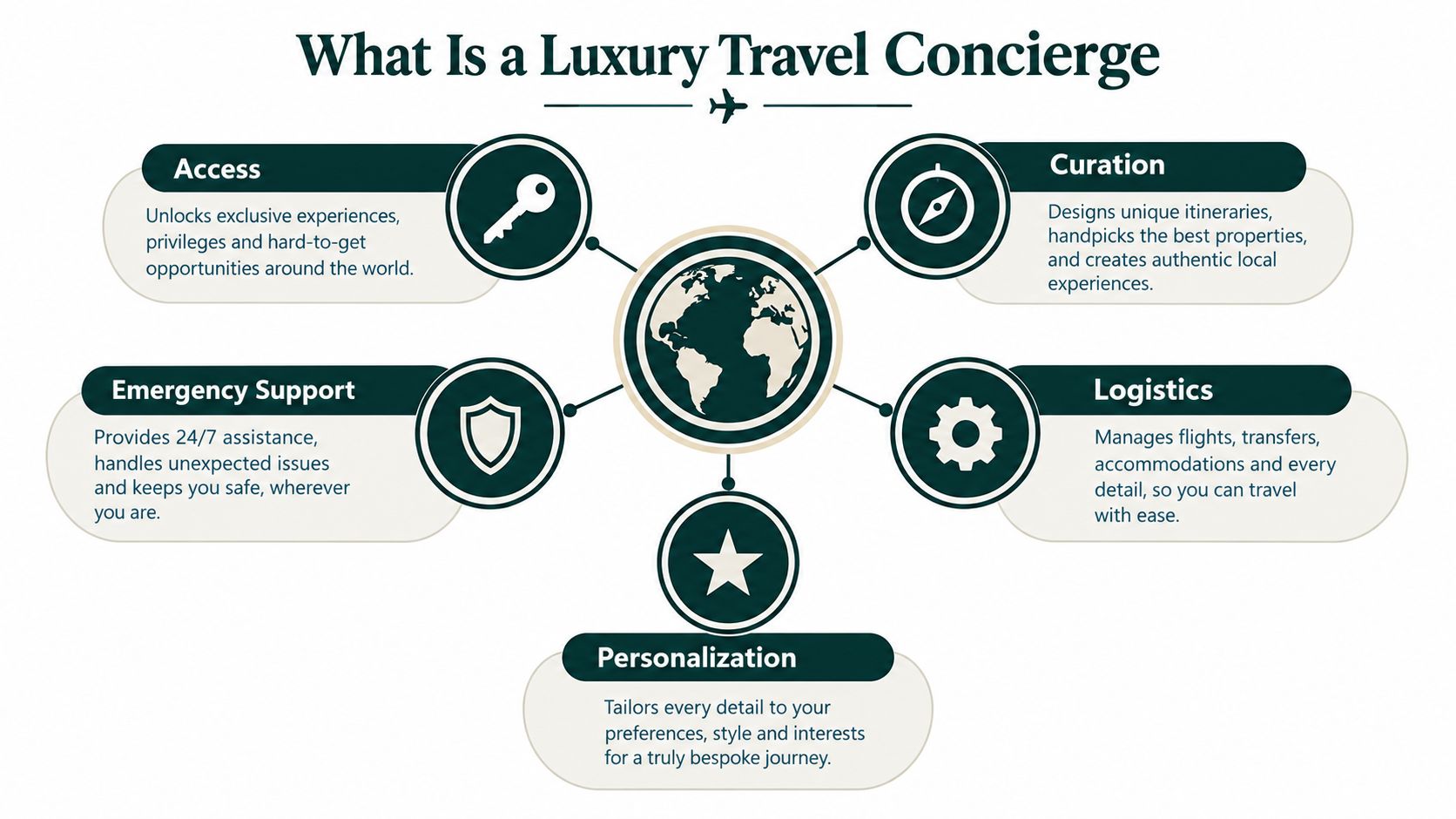
From booking desk to journey orchestrator
Traditional concierge language often suggests restaurant reservations, airport transfers, or last-minute tickets. Those tasks still matter, but they represent only the visible layer of the service. A contemporary concierge coordinates the less visible work that protects the experience:
- Access: Finding the right local host, private guide, winery, chef, or event contact.
- Curation: Selecting fewer, better-fitting experiences instead of filling every available hour.
- Logistics: Aligning hotels, drivers, flights, guides, luggage, meals, and timed entries.
- Personalization: Translating broad wishes such as “authentic” or “relaxed” into practical choices.
- Resilience: Reworking the plan when weather, delays, health needs, or energy levels change.
For readers who want a practical overview of everyday concierge tasks, these examples of concierge at Uptown Rent A show how the term can extend beyond travel reservations. In a travel context, the same principle becomes more complex because the service must operate across destinations and independent suppliers.
The strongest concierge relationships also become more useful over time. Preferences such as room location, dining rhythm, transfer comfort, and tolerance for early starts can inform future planning, allowing the advisor to make sharper decisions without asking you to repeat your entire travel history.
For inspiration on privately designed regional journeys, explore tailor-made vacations in Northern Spain. The central idea is simple: luxury isn't constant activity or visible extravagance. It's having the right things handled behind the scenes, with enough flexibility to remain present.
Core Services and Benefits of a Luxury Travel Concierge
A luxury travel concierge creates value by reducing the number of decisions you must make and improving the quality of the decisions that remain. That matters most when a trip includes several hotels, private transport, special access, dietary requirements, different age groups, or an important celebration.
The service usually begins with discovery. You discuss the purpose of the journey, preferred pace, accommodation style, interests, health or mobility considerations, and the moments you want to remember. A good advisor then filters the market rather than sending you an endless list of possibilities.
Access and informed selection
Concierges may help secure sought-after dining, private tastings, specialist guides, event access, yacht or vehicle arrangements, and experiences that aren't designed for mass tourism. Access alone isn't enough, though. The advisor must decide whether an opportunity fits your timing, privacy expectations, and energy.
Specialist knowledge matters here. One industry summary reports that travelers using specialized luxury advisors report 47% higher trip satisfaction than those booking independently or through general agents, while luxury-focused advisors average 15+ years of experience and more than 100 hours of continuing education annually. These figures appear in Tripzera's overview of luxury travel advisors, and they help explain why experienced judgment can be more valuable than a larger booking inventory.
Coordination and time protection
The concierge connects separate decisions into one operating plan. A private driver needs the correct arrival time. A guide needs to know when the group will finish lunch. A restaurant needs the right dietary information. A hotel must understand whether the stay is a celebration, a family trip, or a quiet retreat.
That coordination protects your attention. Instead of calling each supplier, checking every cancellation condition, and reconfirming every transfer, you have one person who understands the complete picture.
Support when the plan changes
Round-the-clock availability has become a baseline expectation for many luxury travelers. One industry report says 82% of luxury travelers expect 24/7 concierge service, a finding reported in concierge industry statistics from WiFiTalents.
Practical rule: The true test of a concierge is not how smoothly the original plan works. It's how calmly the service responds when the original plan no longer works.
The service can include support with delays, missed connections, weather changes, medical needs, lost belongings, altered dining plans, and last-minute requests. The benefit isn't a guarantee that nothing will go wrong. It's having an informed person who can act without requiring you to become the trip manager.
For food-led journeys, carefully coordinated fine dining reservations can be integrated with market visits, cooking sessions, wine estates, and realistic travel times. That produces a coherent day rather than a collection of impressive but disconnected bookings.
How a Luxury Travel Concierge Differs from Other Travel Professionals
Travel titles overlap, so confusion is understandable. A travel agent, DMC, private guide, hotel concierge, and luxury travel concierge may all arrange something for you, but they don't carry the same responsibility.
| Role | Primary Focus | Scope |
|---|---|---|
| Travel agent | Booking flights, hotels, cruises, or packaged travel | Often transaction-led, with involvement varying before and during the trip |
| Destination Management Company | Local suppliers, transport, guides, venues, and destination operations | Usually focused on one destination or region |
| Private guide | Interpretation, context, access, and company during an activity or day | Usually limited to defined visits, routes, or excursions |
| Hotel concierge | Guest requests, local reservations, and services during a hotel stay | Primarily the property and its surrounding destination |
| Luxury travel concierge | Personal strategy, curation, supplier coordination, and active trip management | End-to-end, often across several destinations and service providers |
The agent handles the transaction
A traditional travel agent may be exactly what you need for a straightforward flight, resort, or cruise. The agent compares availability, confirms the reservation, and manages the commercial details. Some agents also provide substantial advice and support, so the distinction isn't about quality. It's about the breadth of responsibility.
If your needs begin and end with selecting a suitable hotel and arranging flights, a full concierge relationship may be unnecessary.
The DMC operates locally
A Destination Management Company, or DMC, is a local operations specialist. It may arrange private vehicles, guides, venues, activities, restaurant support, and event production within a particular region. DMCs are especially valuable for complex local programs and for travel advisors who need a trusted partner on the ground.
The DMC may not be the person shaping your entire journey from the first idea. It may receive a brief from an overseas advisor or agency and execute the regional elements.
The guide brings a destination to life
A private guide offers expertise and presence during a specific experience. A historian can make a monument meaningful. A food specialist can lead you through a market. A mountain guide can manage a route safely. The guide is essential to the quality of that moment, but usually doesn't coordinate every other part of the itinerary.
The luxury travel concierge sits above these individual roles as the central choreographer. They might work with an agent for air travel, a DMC for local operations, a guide for cultural visits, and a hotel concierge for property-level requests. Their job is to ensure those specialists understand the wider rhythm of your trip.
That structure becomes particularly useful when you cross regions, combine different travel styles, or need one accountable contact. The concierge doesn't replace every professional. They make the professionals work as one team.
What to Expect When Working with a Luxury Travel Concierge
A well-designed journey starts with questions that may seem personal but have practical consequences. Do you prefer a late breakfast or an early departure? Should a family day include a grandparent who walks slowly and teenagers who want independence? Is privacy more important than proximity to a famous attraction? Would you rather spend an entire afternoon at one exceptional winery than visit several quickly?
Northern Spain offers a useful example because the region rewards thoughtful pacing. A private journey might connect Bilbao's architecture, San Sebastián's culinary culture, Rioja's vineyards, Navarra's traditions, and Atlantic villages. The route should feel like a story, not a series of pins on a map.

Turning preferences into an itinerary
Suppose a couple wants food and wine but doesn't want every day to revolve around formal dining. The concierge might balance a private Rioja cellar tasting with an unhurried village lunch, a coastal drive, and a free evening. A family celebrating a milestone may need a memorable dinner, but also flexible mornings and activities that work for different generations.
A good itinerary shows its intelligence through what it leaves out. Too many timed reservations create pressure, even when every booking is luxurious. The concierge protects breathing room so the group can linger, change direction, or enjoy the hotel.
The operational layer
The finished itinerary is only the guest-facing version of a deeper plan. Behind it, the concierge confirms room configurations, arrival details, dietary needs, guide language, vehicle suitability, luggage movement, and supplier communication. Those details become especially important when a trip includes children, older travelers, different mobility levels, or several separate arrival times.
A multigenerational itinerary shouldn't force everyone to do the same thing every day. One group might share breakfast, divide for a gentle cultural visit and a more active outing, then reunite for dinner. The concierge coordinates the split without making the family manage separate travel arrangements.
The modern demand for this kind of planning reflects a broader shift in luxury travel toward purpose, privacy, family, time, wellness, and cultural immersion, as described in 2026 luxury travel trend coverage. The point isn't to chase every trend. It's to recognize that high-end travelers increasingly want meaningful experiences that fit real lives.
A visual introduction to Northern Spain's atmosphere can help you assess whether the region matches your expectations:
Support during the journey
Before departure, you should know who to contact, how urgent requests are handled, and what happens if a supplier changes something. During the trip, the concierge should be able to adjust the plan without exposing you to a chain of calls and messages.
That support may mean moving an outdoor activity indoors, changing a restaurant, adapting a walking route, or finding a suitable alternative when a reservation disappears. Resilience is not an emergency-only feature. It's the flexibility that lets a carefully planned trip remain enjoyable when reality intervenes.
Pricing, Booking, and Red Flags to Avoid
Luxury travel concierge pricing doesn't follow one universal model. Some businesses earn commissions from suppliers, some charge planning or design fees, some use membership structures, and some combine a fee with commission. A villa, private group, or highly complex itinerary may be priced differently from hotel-only assistance.
Ask for the commercial model before sharing payment details. You should understand what the fee covers, which services are optional, whether supplier commissions affect recommendations, and what happens if you cancel or change the itinerary.
Questions to ask before engaging
Use the first consultation to test both expertise and fit:
- What does the service include? Ask whether planning, booking, reconfirmation, on-trip assistance, and changes are covered.
- Who will manage the trip? Confirm whether you'll have one named contact or be transferred between departments.
- Where is the specialist strongest? Regional knowledge matters when you want authentic access, reliable suppliers, and realistic routing.
- How are preferences recorded? A capable concierge should ask about pace, privacy, food, mobility, celebrations, and communication.
- What happens during disruption? Request a clear explanation of support for delays, illness, weather, supplier failure, or last-minute changes.
- What are the cancellation terms? Read the conditions for hotels, guides, transport, experiences, planning fees, and deposits.
For a Northern Spain journey, review the agency's booking conditions before committing. Clear written terms protect both sides and make the relationship easier when plans evolve.
Red flags that deserve attention
A generic itinerary can look polished while revealing little about the person traveling. Watch for a proposal that uses the same sequence of hotels and activities for every client, avoids questions about your priorities, or promises access without explaining what is possible.
Lack of transparency is another warning sign. Be cautious if the provider won't identify the responsible contact, explain supplier relationships, describe support hours, or separate included services from extras.
A polished PDF isn't proof of thoughtful planning. The quality lies in the decisions, the coordination, and the person who answers when circumstances change.
You should also question speed without substance. A rapid proposal may be useful, but it shouldn't replace a proper discovery conversation. The right concierge does not merely sell a destination. They explain trade-offs, challenge unsuitable ideas, and show how the journey will work in practice.
Why Choose a Specialist for Your Next Journey
A specialist gives you more than destination familiarity. They understand how a region feels at different times of day, which routes are comfortable, which experiences remain private, and which suppliers can deliver consistently for demanding travelers.
That knowledge is particularly valuable in Northern Spain, where food, wine, scenery, heritage, and local identity are closely connected. A Rioja visit can be a tasting, but it can also become a conversation with a winemaker, a slower countryside day, or part of a wider route through Navarra and the Basque Country. The distinction comes from interpretation and relationships, not from adding more stops.
The commercial case for specialist support is also clear. One market estimate places the global luxury concierge service market at about USD 2.86 billion in 2025, projecting USD 5.48 billion by 2034, with travel and hospitality representing 48% of 2025 value, according to DataHorizzon Research's luxury concierge market overview. Travel remains the dominant use case because affluent clients need more than isolated reservations. They need private transport, curated access, and reliable coordination.

Northern Spain Travel is one example of a regional specialist offering fully private, tailor-made journeys across the Basque Country, La Rioja, Navarra, Cantabria, Asturias, Galicia, the Pyrenees, and neighboring areas. Its planning model brings together boutique hotels, private guides, drivers, chefs, winemakers, local insiders, and on-the-ground support around each traveler's pace and interests.
The strongest reason to choose a specialist is simple: you want fewer decisions to make and greater confidence in the decisions that shape the trip. A luxury travel concierge should protect your time, privacy, and attention while making the destination feel more personal, not more programmed.
Northern Spain Travel designs fully private luxury journeys shaped around food, wine, culture, nature, exclusive events, and carefully paced exploration. Visit Northern Spain Travel to discuss your priorities, travel dates, and the kind of Northern Spain experience you want the concierge team to coordinate.