You've found a coastal ride, chosen a hotel and started thinking about lunch. Then you open the elevation profile and realize the sea views come with a succession of climbs. Your partner wants scenery rather than a training camp, someone in the family isn't comfortable descending in rain, and the restaurant booking suddenly looks ambitious.
Basque Country cycling works best when you plan the climbing first and the weather alternative alongside it. Distance matters, but it won't tell you whether everyone will enjoy the afternoon. A well-chosen bike, a realistic route and a driver who knows where to meet you matter more than completing every kilometer.
Table of Contents
- Who Basque Cycling Suits and Why It Is Harder Than It Looks
- Basque Routes Ranked by Climbing Rather Than Distance
- E-Bike or Road Bike for Basque Climbs
- Guided, Supported or Self-Guided Rides Compared
- How to Plan Transfers, Luggage and Bike Logistics
- Weather, Safety and Bad-Day Fallbacks
- Lock In Ride Days, Stays and Tables Before Peak Season
Who Basque Cycling Suits and Why It Is Harder Than It Looks
This trip suits couples who've already explored Madrid, Barcelona and Andalusia and want a more intimate journey. It also works for multigenerational families, food-led travelers and active guests who want hills without making discomfort the purpose of the holiday.
The cycling heritage is substantial. By 2021, Basque riders had won 21 Tour de France stages, nearly a third of Spanish cyclists' 66 victories, despite the region accounting for just under 5% of Spain's population, according to the Tour de France's account of Basque cycling history. That's cultural context, not a fitness requirement for visitors.
Check your group before choosing a route
- Look at recent climbing. Write down the accumulated ascent of your longest recent rides, rather than just their distance.
- Be honest about flat-road fitness. If you rarely climb, start with a principal-climb day and book vehicle support from the outset.
- Plan for the slowest rider. Ask what they enjoy climbing, not what they could endure to keep everyone else happy.
For preparation, the endurance training tips from Tecton Ketones™ offer an additional resource to consider alongside riding practice. Don't treat any supplement as a substitute for relevant training.
Choose the route, bike and riding format before resolving bags, transfers and dining. Carry one personal benchmark into those decisions: the climbing your tired rider can still enjoy late in the day, not the distance your freshest rider can manage before lunch.
Basque Routes Ranked by Climbing Rather Than Distance
| Route | Distance and climbing | Steepest gradient | Best for |
|---|---|---|---|
| Bilbao to Lekeitio | 113 km, +1,809 m, in the official Euskadi cycling guide | Maximum not specified here | Experienced riders, or e-bike riders with support |
| Lekeitio to Zarautz | 81 km, +1,281 m, from the same guide | Maximum not specified here | Confident riders wanting coastal scenery |
| Orduña climb | 5.6 km, from the same guide | 8.3% average, final section reaching 14%, from the same guide | Strong riders; approach it rested |
| Bizkaia greenways | Varies by selected segment | Practically no hills in Euskadi's greenway guidance | Relaxed, multigenerational and mixed-ability groups |
| Izki mountain-bike centre | 15 routes totaling 506 km in 2025, reported by El País Cinco Días | Route-dependent; check the chosen trail | Mountain bikers wanting off-road riding |
Read this as a climbing-led comparison, not a complete difficulty ranking. The road stages have accumulated-ascent figures; Orduña is an individual climb; Izki is a network rather than a single outing. Missing gradient information means you need to inspect the route file, not assume the road is gentle.
Bilbao to Lekeitio asks for sustained effort across the day. Lekeitio to Zarautz is shorter, but its ascent still makes it a substantial ride rather than an easy seaside transfer. Orduña presents a different problem: a short distance can conceal a steep finish that demands suitable gearing and confident handling at low speed.
Set distance last
- Total the ascent. Check the full route file, including the approach from your accommodation and the return.
- Inspect the hardest climb. Find the longest continuous ascent and the steepest ramp. Average gradient can disguise the section that forces someone off the bike.
- Choose the distance afterward. Shorten the route if the climbing exceeds the group's comfortable effort.
Using the guide's profiles, a sensible planning threshold is to reserve an e-bike or support vehicle above roughly 1,000 to 1,500 m of climbing. That's a conservative itinerary-design recommendation, not an official performance standard.
Build the day around a principal climb, with a café or cultural pause before the summit. A stop provides breathing room, but it doesn't cancel the effort still ahead. Don't let a pleasant lunch persuade the group to add an unplanned pass.
Route-selection rule: Choose the climbing your slowest rider can enjoy, then find the scenery around it.
For broader itinerary ideas, use this guide to cycling the Northern Spain coast as a starting point, then examine individual sections. Following the coastline doesn't make a route flat.
Before confirming, check gradient spikes, road surface and bailout points. Give the descent as much attention as the ascent, particularly if the forecast suggests wet roads. Finishing the climb isn't the same as finishing the difficult riding.
E-Bike or Road Bike for Basque Climbs
| Factor | E-bike | Road bike |
|---|---|---|
| Steep ramp such as Orduña | Assistance helps moderate climbing effort | Requires suitable low gearing and strong climbing comfort |
| Day above the climbing threshold | Useful if battery capacity suits the full route | Consider vehicle support and a shorter alternative |
| Wet coastal descent | Allow extra braking margin; weight and handling need practice | Still requires restrained speed and confident cornering |
| Transport and luggage | Confirm the vehicle rack accepts the bike's weight and dimensions | Generally easier to handle when loading |
| Battery range on a long route | Assess climbing, distance and assistance use together | Not applicable |
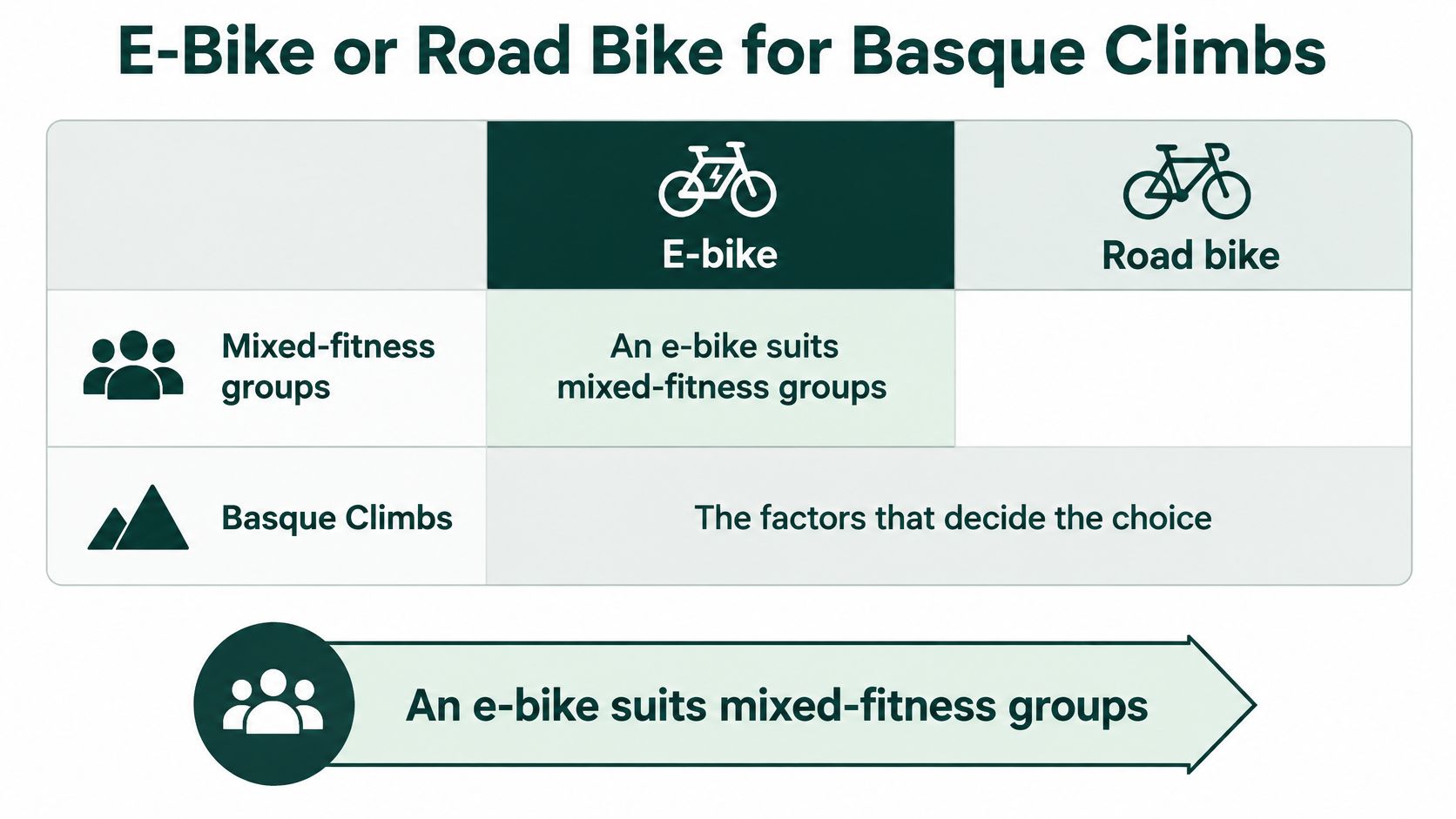
An e-bike is usually the practical choice for mixed-fitness groups. It lets riders adjust assistance rather than asking the strongest person to crawl uphill while the least experienced person struggles. It doesn't remove the need for balance, braking judgment or confidence on a descent.
A road bike suits riders who actively enjoy climbing and already know how to pace themselves over repeated hills. Choose it because you want that riding experience, not because accepting assistance feels like cheating. For a food-and-culture holiday, arriving comfortable is a perfectly sensible objective.
Mix bikes without splitting the holiday
Different bikes can work on the same route. Agree on regrouping points at a summit or café, and let riders climb at their own sustainable effort. Don't require everyone to maintain the same speed just because they started together.
Ask the rental provider to assess battery suitability against the actual route, including ascent, rider needs and likely assistance settings. A flat-road range claim isn't a useful promise for a hilly itinerary. Confirm charging arrangements and what happens if the planned battery margin disappears.
On descents, practice with the specific rental bike before committing to exposed roads. With a heavier e-bike, allow more stopping margin, brake earlier and reduce speed before bends. Don't assume assistance uphill makes the return journey easier.
Book the fit with the bike
Send the provider your usual frame size, saddle height and relevant fit measurements before arrival. Clarify pedals and cleats, and request a fitting discussion if you have a back or knee issue rather than expecting an unfamiliar bike to resolve it.
Take a short test climb and controlled descent before departure. Check that you can select the easiest gear, operate assistance without looking down and brake comfortably from your normal hand position. Bike type belongs in the route booking, not in a last-minute conversation outside the hotel.
Guided, Supported or Self-Guided Rides Compared
- Private guided riding gives you someone to manage navigation, pacing and local interpretation.
- Supported riding adds a vehicle for bags, water, spares and a planned exit from the ride.
- Self-guided riding offers independence, with route decisions and roadside problems remaining your responsibility.
- Short rental outings suit straightforward urban or coastal segments after checking access and return arrangements.
A guide and a support vehicle solve different problems. A guide riding beside you can help judge a junction or change the pace, but can't automatically transport a rider who stops. A driver can collect someone at an agreed location, but may not be able to follow a path or stop safely beside a narrow climb.
Match support to the difficult day
Consider a hypothetical couple who want independence but haven't ridden locally. They might begin with a guided outing, use a self-guided route once they're familiar with the bikes and navigation, then reserve a driver for the demanding pass day. That's a planning example, not a claim that every visitor should follow the same sequence.
Choose the format according to:
- The spread of ability. A substantial gap between riders makes vehicle support more useful than adding a guide alone.
- The character of the hard days. Remote or awkward-to-exit sections deserve more logistical attention.
- Your appetite for local context. A guide adds most when conversation, cultural stops and interpretation matter.
- Your willingness to troubleshoot. Self-guided means accepting responsibility when navigation, equipment or conditions change.
Private guided and supported arrangements can sit within a tailor-made journey with drivers and on-the-ground assistance. Before booking any operator, ask what happens if someone stops halfway up a climb: who stays with them, where collection happens and whether the remaining riders continue.
Ask for the dropout procedure, not just confirmation that “support is available.”
Request the answer in practical terms. A vehicle somewhere in the region isn't the same as a driver assigned to your riding block.
How to Plan Transfers, Luggage and Bike Logistics
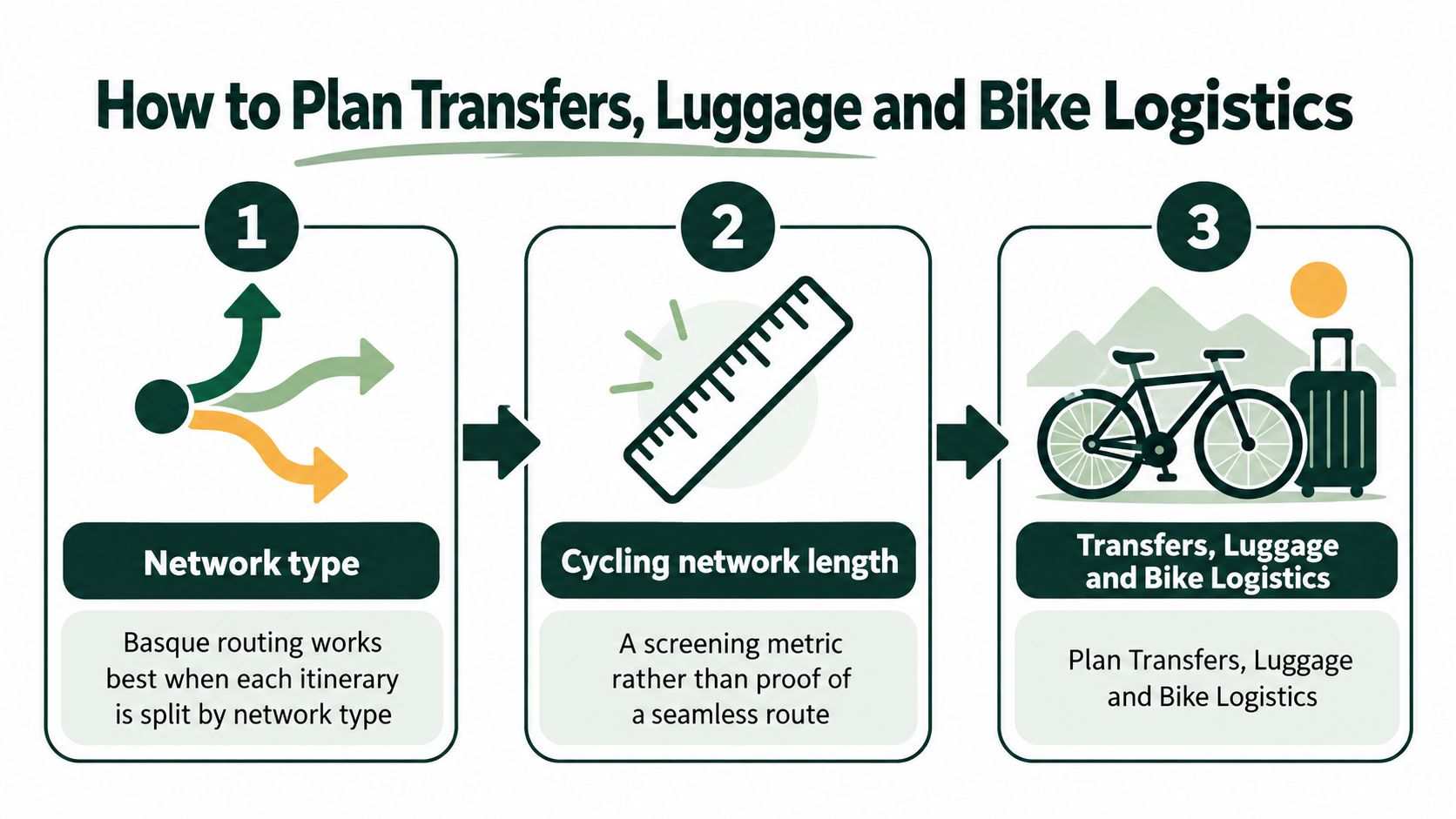
A published network map isn't proof of a well-connected ride. A 2025 academic analysis of Bizkaia's cycling infrastructure reported more than 439 km of adapted routes by late 2022, including 338.5 km separated from motor traffic, while identifying concerns about connections between municipal and intermunicipal routes.
Treat network length as a screening measure. The important question is what happens at the end of the protected section, especially when a confident adult and a nervous family member are following the same directions.
Audit the connections
- Classify each leg. Mark it as a protected urban connector, low-traffic rural road or recreational greenway. Each needs a different suitability check.
- Use protected connectors for arrivals, departures and family transfers wherever the actual route allows. Don't assume protection continues through every junction.
- Inspect rural exposure. Check traffic, junction density and places where riders must merge or turn across vehicles.
- Reserve greenways for relaxed riding unless through-access is confirmed. For city hops, elDiario.es described a planned July 2025 BizkaiBizi network of 824 electric bicycles, 86 stations and 1,189 docking points. Treat those as dated planning figures, and verify current rental rules and availability rather than building a touring day around them.
- Mark an extraction location for each riding block. It must be somewhere a vehicle can legally and safely collect a rider.
- Confirm vehicle access separately. A path open to bicycles may not permit your driver to reach the same meeting point.
- Download offline navigation. Save the confirmed route and collection locations before departure.
Move the bags independently
For a comfort-led journey, arrange luggage transfers on riding days instead of loading overnight bags onto the bikes. Confirm who collects them, when they reach the next accommodation and where medication, rainwear and other day essentials stay.
Use a written movement plan covering people, bikes and luggage. This guide to transportation coordination for luxury travel in Northern Spain provides useful context for coordinating those separate movements.
Avoid approving a ride from its elevation profile alone. Surface, access restrictions, pedestrian density and vehicle rendezvous points can make an apparently manageable route unsuitable for your group.
Weather, Safety and Bad-Day Fallbacks
Variable Atlantic weather doesn't make cycling a poor fit. It makes rigid, mileage-driven itineraries a poor fit. Official Euskadi cycling guidance tells riders to check weather and route conditions before departure. Build the holiday around that decision, not around an obligation to complete a prebooked distance.
A modular day might combine a shorter ride with a market, cider house or winery visit. The alternative should be selected before departure, with opening arrangements and transport checked. A vague promise to find something indoors isn't a fallback plan.
| Condition | Main risk | Fallback that keeps the day |
|---|---|---|
| Rain and wet descents | Reduced grip and difficult braking | Use a checked valley alternative or arrange a vehicle descent |
| Strong wind on exposed coast | Gusts and unstable handling | Choose a sheltered inland section or suitable greenway |
| Low cloud on passes | Poor visibility and difficult navigation | Return to the valley for a market or winery visit |
| Rider falls behind on a climb | Someone riding alone on an unsuitable road | Use vehicle leapfrogging and the agreed extraction location |
| Group split by confidence | Less-confident riders feeling pressured | Separate suitable routes with a shared meeting point and coordinated support |
Make the go/no-go call twice
Check the official forecast, warnings and route conditions the evening before. Make a provisional decision with the guide or driver: proceed, shorten, relocate or replace the ride. Use this overview of weather in Northern Spain for destination context, not as a substitute for the departure forecast.
Confirm again at breakfast. Ask whether the descent remains suitable, whether visibility and wind affect exposed sections, and whether every rider still wants to participate. No-go is the right call when the available route exceeds the least-confident rider's safe handling ability.
Don't invent a universal wind or rainfall cutoff for every group. The bike, road exposure, rider experience and guide's assessment all matter. Establish who makes the final decision before anyone feels pressured by a reservation.
Grade confidence separately from fitness
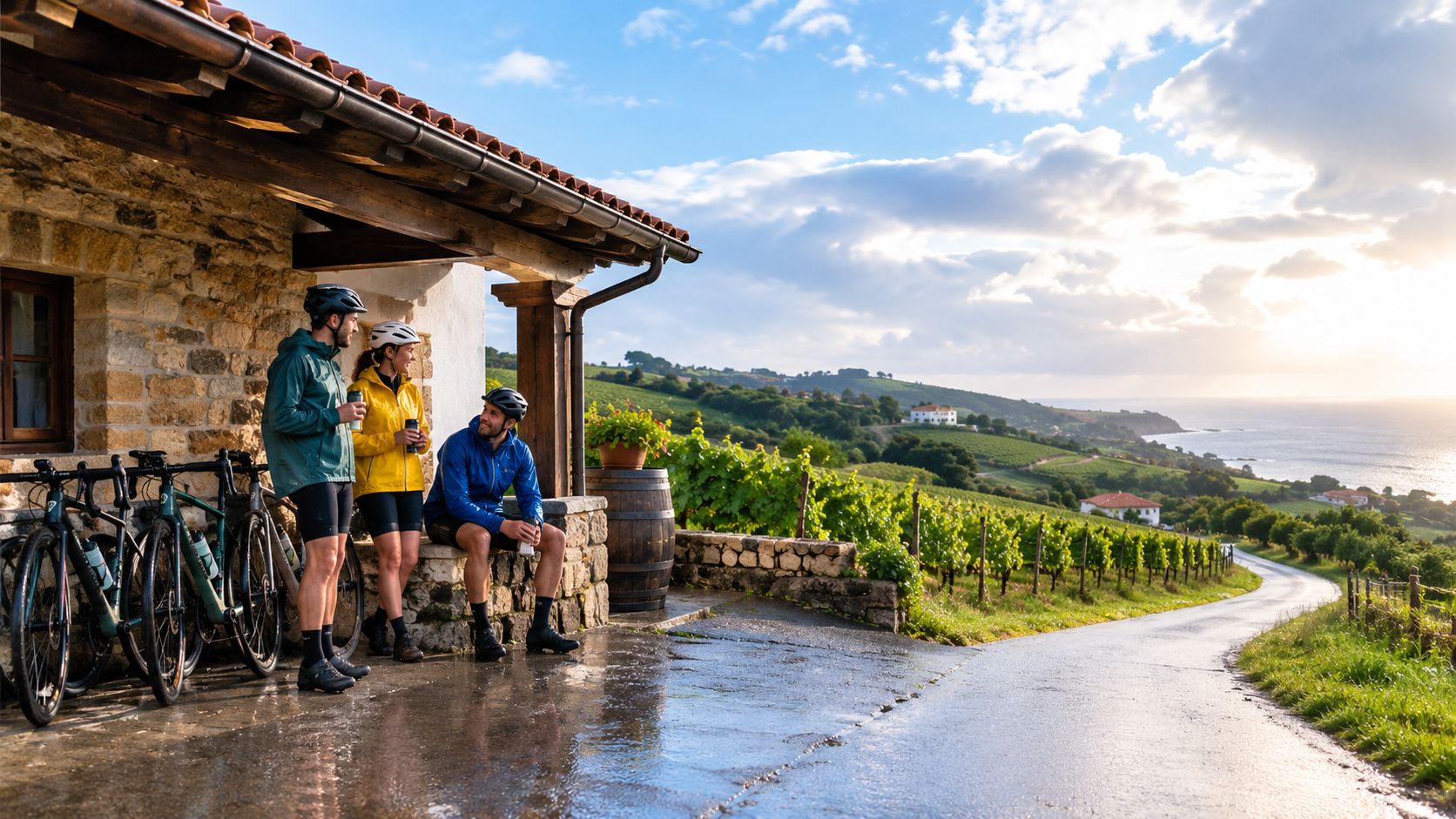
- Protected-path riders may prefer checked promenades and greenways, regardless of age or aerobic fitness.
- Road-confident riders should be comfortable holding a predictable line, negotiating junctions and controlling speed on bends.
- Support-dependent riders need a specific collection plan rather than encouragement to keep going.
Yield to pedestrians, follow signs and make sure everyone understands regrouping arrangements. For climbs beyond the group's comfort, arrange trailing support where lawful and practical, without having a vehicle obstruct other traffic.
Pack familiar food for delays; the ride fueling tips from Gym Snack offer ideas for that preparation. Keep alcohol tastings until the riding is finished.
A shorter ride followed by a relaxed vineyard lunch is a successful holiday day, not a failed summit attempt.
Lock In Ride Days, Stays and Tables Before Peak Season
| Ride day | Base to stay | Pairing after the ride |
|---|---|---|
| Bilbao to Lekeitio coastal ride | Bilbao boutique hotel | Seafood lunch in a coastal village |
| Lekeitio to Zarautz ride | San Sebastián | Pintxos and txakoli in Zarautz or Getaria |
| Greenway family morning | Bizkaia or Gipuzkoa | Cider house dinner |
| Izki mountain-bike day | Vitoria-Gasteiz | Winery lunch in Rioja Alavesa |
These are suggested pairings, not promises that the ride finishes beside your hotel or restaurant. A Bilbao base for a ride ending in Lekeitio, for example, requires a return-transfer decision. Likewise, a winery meal after mountain biking needs transport and enough time to change comfortably.
Book the moving parts together. Securing a restaurant first and forcing a demanding route into the remaining morning creates pressure where you want flexibility.
Protect the meal from the ride
Don't place a steep pass immediately before a timed winery visit or fine-dining reservation. Allow room for slower climbing, a mechanical problem, collection, changing and travel to the table. Agree the buffer with the planner and restaurant rather than treating the navigation app's arrival estimate as a reservation time.
If lunch is the priority, shorten the ride to protect it. If the ride is the priority, choose a more flexible meal afterward. Trying to maximize both usually leaves the least-confident rider feeling responsible for everyone's schedule.
Book in a workable order
- Confirm the accommodation. Check bike storage, charging permission, breakfast arrangements and pickup access, not just the room category.
- Lock in the guide, driver and bike choice against the selected terrain. Make sure the vehicle can carry the actual bikes and everyone who might stop riding.
- Reserve the tables with recovery time included. Tell the planner whether you want a quick change or a relaxed return to the hotel.
- Set the evening review and breakfast confirmation arrangements. Everyone should know when the route can change and who communicates the decision.
- Agree an alternative activity and meal plan. Confirm cancellation terms and whether the fallback requires its own advance reservation.
A single-base stay with driver repositioning often suits families and private groups. It avoids repeated packing and allows non-riders to follow a different morning program. The trade-off is more time in the vehicle and the need to check transfer practicality for each outing.
A multi-base journey suits couples who want to move through the region rather than return to the same hotel. It creates progression, but requires tighter luggage coordination and makes a spontaneous rest day more complicated.
Choose the structure that protects your group's comfort, then reserve around it. Send your planner the dates, group profile, slowest rider's climbing comfort and dining priorities, and ask for a proposal that shows both the intended ride and its workable alternative.
Northern Spain Travel designs private, tailor-made journeys combining guided or supported cycling with boutique stays, drivers and food-and-wine experiences. Send your dates, riding backgrounds and dining priorities to start a Basque Country cycling plan with realistic climbing, coordinated transfers and weather fallbacks built in.