
You've booked three nights in San Sebastián and made a list at home. Pintxos, salt cod, the cheesecake everyone photographs, maybe a cider house out in the hills. Then you reach the old town at eight in the evening, find forty bars with counters packed two deep and chalkboards written in Basque, and the list stops being useful.
What that list can't tell you is how literal the seasonality is here. The sheep's cheese belongs to spring. Wild mushrooms arrive in autumn. Winter brings beans and long, dark stews. Cod is a Bizkaia obsession more than a Gipuzkoa one, and serious beef belongs inland, in the valleys where the cider houses stand.
This guide explains Basque Country Spain food the way a local guide would over a glass of txakoli: what to eat, where each dish is strongest, and which month to plan around. By the end you'll have dishes tied to regions and seasons, plus a route you can book.
Table of Contents
- Signature Basque Dishes and Where to Find Them
- How Pintxos Work and How to Order Them
- Cider Houses and the Txotx Ritual
- Idiazabal Cheese and Txakoli to Taste
- When to Eat What Across the Basque Country
- Michelin Kitchens Versus Traditional Food Culture
- Booking Your Basque Food Route
Signature Basque Dishes and Where to Find Them
The first thing most visitors meet is the counter itself. A bar in San Sebastián's old town at eight in the evening, platters running its full length, a crowd two deep, no menu in sight. Those plates are pintxos, the everyday format of Basque eating, and they're the doorway rather than the whole house. Behind them sits a set of dishes tied to particular coastlines, valleys and months.
| Dish or product | Where to find it | Best time | What to know |
|---|---|---|---|
| Pintxos | San Sebastián old town bars | Year-round, especially evenings | Eaten standing at the bar, one piece at a time |
| Gilda | Pintxos bars across the region | Year-round | Anchovy, olive and pickled chilli or pepper on a stick |
| Bacalao (cod) | Bizkaia and coastal restaurants | Year-round | Bizkaia is especially linked with cod |
| Cod omelette and grilled ribs | Cider houses (sagardotegiak) | January to April cider season | Classic cider-house menu items |
| Chuletón (beef) | Inland cider-house areas | Cider season | Substantial beef dishes are associated with these areas |
| Sardines | Bizkaia coastal bars | Seasonal | Check the menu for availability |
| Idiazabal cheese | Cheese platters and shops | Spring | Raw sheep's milk cheese with a firm, sliceable texture |
| Txakoli | Bars and wineries | Served young and fresh | Pairs with seafood, shellfish and fried fish |
Read that grid as a routing tool rather than a ranking. Cod is the clearest example of why. In Bizkaia it carries real weight, and a kitchen worth its salt will offer it more than one way: bacalao al pil-pil, where the cooking oil is worked into a pale emulsion with the fish's own gelatin, and bacalao a la vizcaína, a rust-red sauce built on dried peppers and onion. Ask which styles are on that day and you'll learn more about the kitchen than any menu description gives you.
Fish on the Gipuzkoa coast follows the season and the boats, so hake in green sauce or a fisherman's stew of tuna, potato and pepper can be superb in one month and ordinary in another. Inland, the register changes: beans, beef, peppers and stews that reward cold weather.
The working rule: choose one dish from each subregion you plan to visit, then check that it's actually in season before you fix the dates.
That last point catches people out. A restaurant may list a dish all year in its marketing and serve it only when the product is good. Ask what came in this week, not what's famous.
How Pintxos Work and How to Order Them
You step into a busy bar in San Sebastián. The counter is lined with small plates, people are talking over their drinks, and there is no obvious menu. Start by looking: pintxos are ordered from what the bar has prepared, and the selection can change from day to day.
Pintxos began as small bites served with drinks. Their name comes from the Spanish verb meaning “to pierce,” a reference to the toothpick that traditionally held food to bread, as the Basque Government's explanation of pintxos describes. The custom of moving between bars with friends is called txikiteo. It makes a pintxos evening feel more like a series of short visits than a meal in one place.
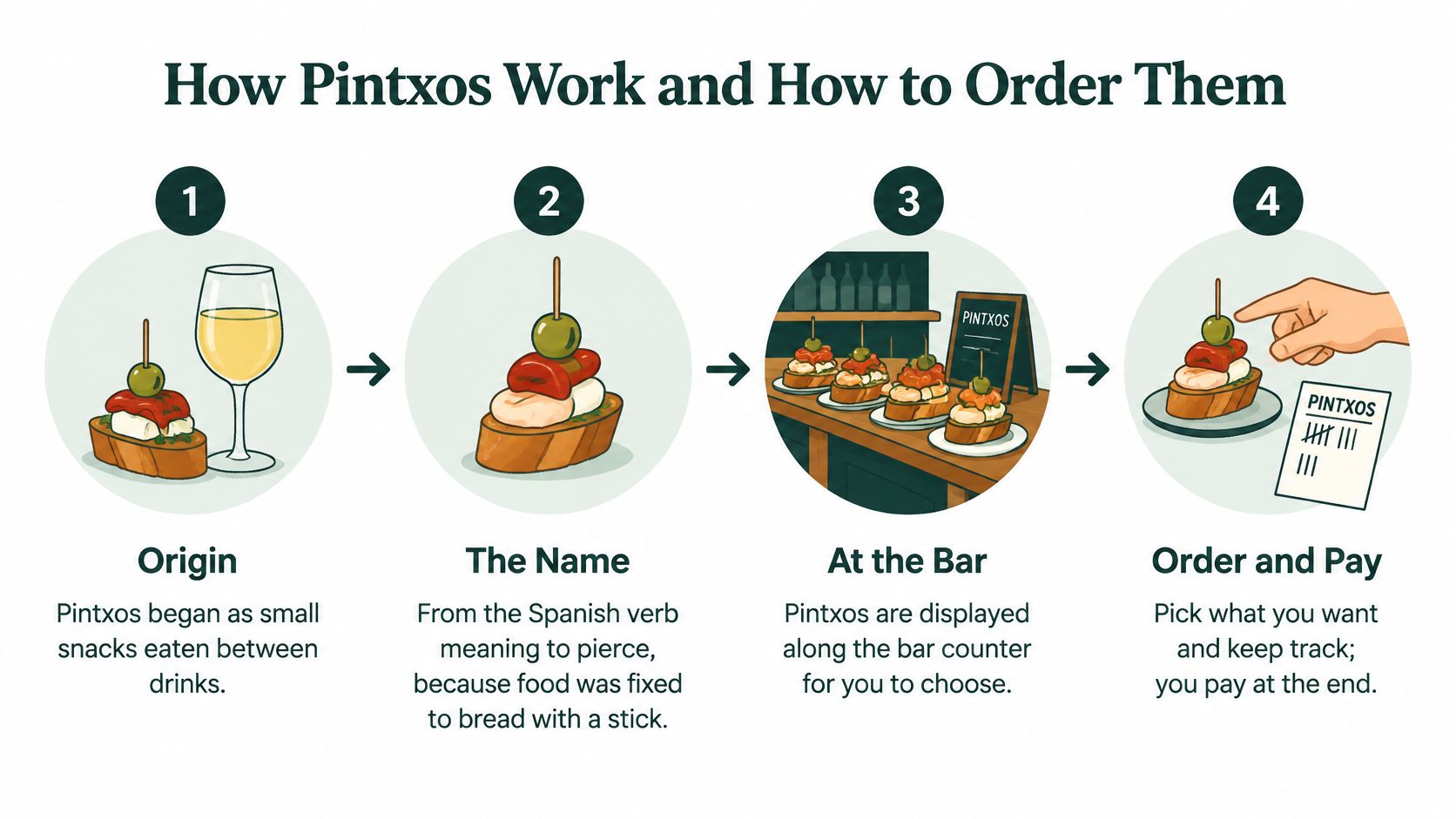
Follow the rhythm of the bar:
- Look over the counter first. The display is your menu. Check what is available before choosing a bar's specialities.
- Choose a couple of pieces. Point to what you want; you do not need to ask for a written list.
- Order a drink with your food. Txakoli, beer and red wine are familiar choices. Ask what the bar serves if you are unsure.
- Eat at the counter. Many pintxos are designed for a quick stop. A table may have a different ordering routine, so check before sitting down.
- Keep any toothpicks or sticks. Some bars use them to count what you have eaten when settling the bill.
- Move on when you are ready. A few bites at each stop leave room to sample different bars and dishes.
A useful way to pace the evening is to begin with something small and sharp, then choose a warmer or richer pintxo if it appeals. A gilda, with anchovy, olive and pickled chilli, is one example. The counter may also offer mushrooms, seafood, cod or peppers, but the choice depends on the bar and the day. Pintxos are not a fixed checklist: let the display guide you.
If you would rather have someone plan the route, a San Sebastián pintxos guide is one way to explore the city's bar culture. For a gilda at home, the olive should be firm and briny rather than mild. You can shop Azouro olives in the UK and pair them with anchovy and pickled guindilla.
Cider Houses and the Txotx Ritual
It's a Saturday in February, and the cider house is one long room of shared tables, jugs of water, bread and a fixed price agreed when you booked. Nobody hands you a menu.
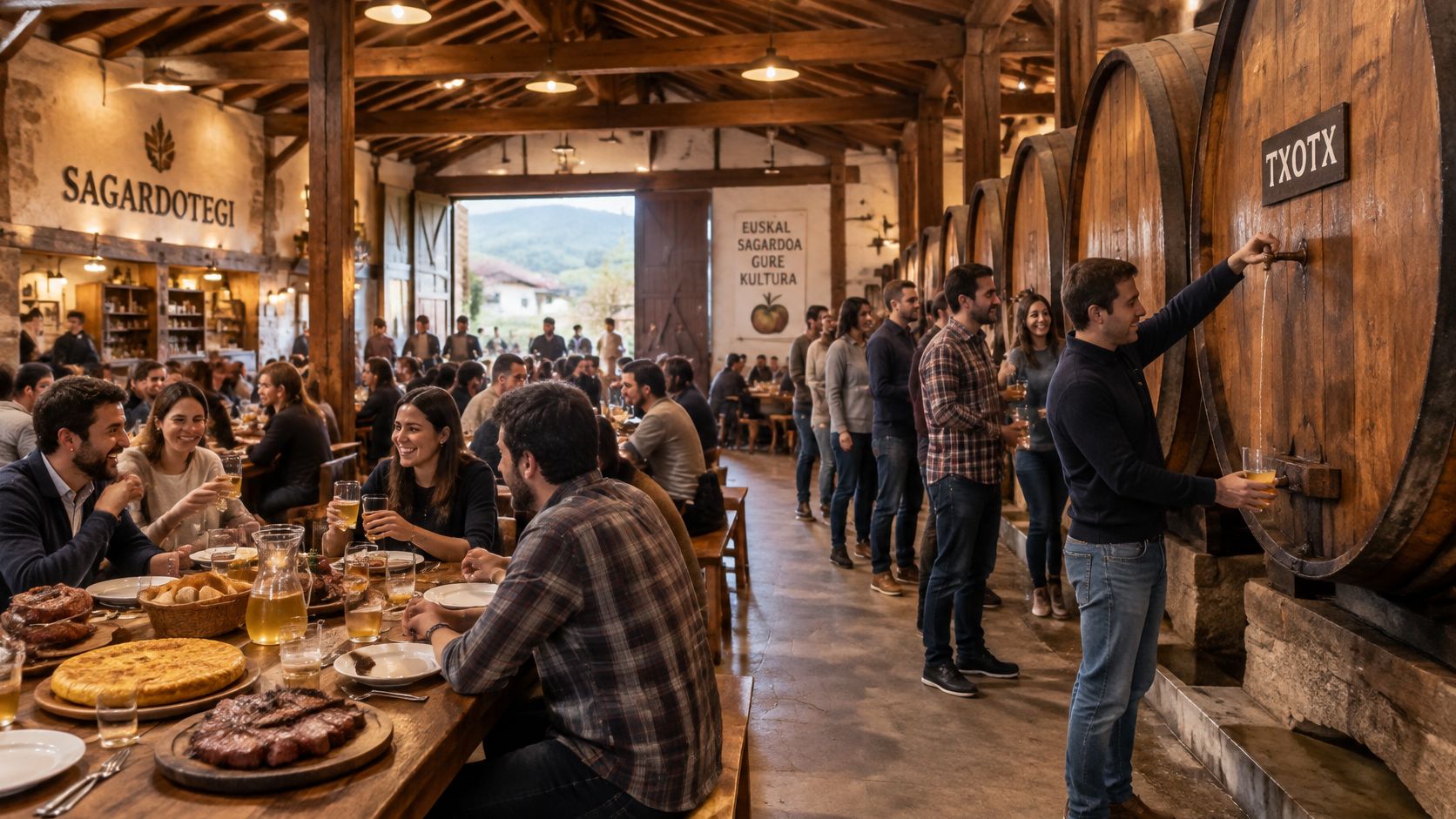
The meal arrives in courses and in order. First a cod omelette, soft and barely set. Then grilled ribs and, in inland houses especially, a thick chuletón carved at the table. The last course is cheese with quince jelly, which is the point at which everyone slows down. These houses are called sagardotegiak, and they keep a short season in the colder months rather than trading all year.
Between courses comes the ritual. Someone calls txotx, the room gets up, and cider is poured in a thin arc from a large wooden barrel into a wide glass, a few fingers at a time, to be drunk immediately. The practice began as a way for customers to compare ciders before buying them. It became the reason people come.
Pace yourself by the glass, not the barrel. Short pours keep the cider fresh and the evening long.
Practical points worth knowing before you book. Reserve ahead, because the season is short and weekend tables go early. Arrive hungry, since the menu is fixed and generous. Ask about dietary needs when you book, not on the night, because the kitchen cooks one menu for the whole room. Outside the season, some houses run limited hours or close altogether, so confirm before you build a day around one.
If you want to see the pour before committing to a table, this clip shows the txotx ritual in a working cider house.
A good evening ends the way it should: a table too loud to talk across, a second trip to the barrel, and cheese left on the board because nobody wants to be the first to stop.
Idiazabal Cheese and Txakoli to Taste
Two products explain the Basque table faster than any menu: a sheep's cheese with a legal rulebook and a white wine built for fish.
Idiazabal carries a protected designation of origin and is made only from the raw milk of Latxa or Carranzana sheep. It is pressed but not cooked, coagulated with rennet, matured for a minimum of 60 days, and smoking is permitted, as the published PDO specification sets out. The same document fixes the technical frame: at least 55% dry matter, a minimum of 45% fat and at least 25% protein in dry matter, with a pH between 4.9 and 5.5.
Those numbers are why the cheese behaves the way it does. Pressing and ripening drive moisture out, concentrating solids into the firm, sliceable paste, while enzymatic breakdown develops aroma and softens the texture over months.
Taste a traditionally unsmoked and a smoked version of the same age side by side, both at room temperature. The unsmoked one leans on sheep's milk, nuts and lactic tang. The smoked one adds toasted, phenolic notes without changing the underlying PDO composition. Serve them with quince paste, a pickle or a guindilla so the palate resets between bites rather than being coated.
Txakoli is a young, high-acid Atlantic white rather than one fixed flavour. Official regional material reports that around 98% of Bizkaiko Txakolina production is fresh white wine without aging, a choice that preserves primary grape aromas and sharp natural acidity, per Visit Biscay's Txakoli guide. The same specification sets a minimum acquired alcohol of 9.5% for the standard wine, 11% for white wine fermented in barrel, and caps volatile acidity at 0.8 mg/L.
That profile is why it works so well with seafood, shellfish, fried fish and pintxos carrying salt or fat: the acidity cuts through. If a bar has both, compare a young stainless-steel example with a barrel-fermented one. The second shows how oxygen and wood add texture and spice while quietening the citrus. Drink it fresh, don't cellar it.
| Factor | Idiazabal PDO | Txakoli (Bizkaiko Txakolina) |
|---|---|---|
| Production rule | Pressed, not cooked; rennet-coagulated; raw milk of Latxa or Carranzana sheep | About 98% fresh white wine without aging |
| Maturity or alcohol limit | Matured at least 60 days; smoking allowed | Standard wine at least 9.5% acquired alcohol; barrel-fermented white at least 11% |
| Key specification | At least 55% dry matter, at least 45% fat and at least 25% protein in dry matter, pH 4.9 to 5.5 | Volatile acidity no more than 0.8 mg/L |
| Best partner | Fruit paste or pickle served at room temperature | Seafood, shellfish, fried fish and salty or fatty pintxos |
Both belong on a Basque Country wine itinerary as a pair, because the cheese and the wine answer the same question: what does this coast taste like in spring.
When to Eat What Across the Basque Country
The menu depends on the month, and the region is not one menu. Basque cooking rests on locally raised seasonal produce, and the differences between subregions are real: coastal Gipuzkoa emphasises fresh fish, inland cider-house country is associated with substantial beef dishes, and Bizkaia is linked with cod and sardines, as the Basque Government's gastronomy guide describes.
| Season | What peaks | Best setting | Planning note |
|---|---|---|---|
| Winter | Beans and hearty stews | Inland and mountain kitchens | Good for cider season overlap in January |
| Spring | Idiazabal cheese, cider season (to April) | Cider houses and cheese shops | Cider houses are busiest January to April |
| Summer | Garden produce and fresh fish | Coastal Gipuzkoa and the seafront | Book seafood restaurants ahead for peak months |
| Autumn | Wild mushrooms | Inland and village restaurants | Menus change with the mushroom harvest |
Plan in three steps, in this order.
First, pick the season. A February trip is a cider-house and stew trip. August is a coastal trip, built on fish, peppers and tomatoes. November is a mushroom trip, and inland villages do it better than the city does.
Second, choose the subregion that matches. Gipuzkoa's coast for fish and shellfish, Bizkaia for cod and sardines, inland valleys for beef, beans and cider houses. San Sebastián is a superb base, but it isn't the whole food culture, and a trip that never leaves the city misses the point.
Third, book against the season, not against a brochure. Ask each restaurant for its current menu before you fix dates. A dish promised in a spring brochure may not exist in October.
Look for certification when you shop or order. The Basque Government's Eusko Label identifies products with controlled origin, variety and production standards, which separates authentic regional sourcing from dishes that are only marketed as Basque. In 2024 the government recognised 545 companies for their contribution to the region's gastronomy destination, including 309 restaurants, 147 visitable food industries and 47 shops, according to the Basque Government's announcement, so a visit to a working producer is easy to arrange. If you're weighing dates, this guide to the best time to visit San Sebastián sets the weather against the food calendar.
Michelin Kitchens Versus Traditional Food Culture
A starred dinner and an evening of pintxos answer different questions about Basque food. The first shows how a chef can reinterpret regional ingredients; the second lets you sample a wider range of everyday cooking at your own pace.
The Basque Country is known for its concentration of Michelin-starred restaurants, including kitchens in and around San Sebastián. A star can help you choose a special meal, but it does not define the region's food culture. The same ingredients and local traditions appear in very different settings, from formal tasting menus to simple bar counters.
- A tasting menu usually means one long, carefully paced dinner. It offers a chef's creative interpretation of regional ingredients, with more technique and a higher cost than a casual meal. Choose it for a special occasion or to see how familiar products can be transformed.
- Pintxos bars and cider houses offer a more informal way to eat. Small portions make it easy to try several dishes, while the setting encourages conversation and spontaneous choices. These meals show another side of Basque food, shaped by local habits as well as ingredients.
For many visitors, one starred dinner is enough to make the contrast clear. Leave other evenings open to traditional bars and village restaurants, where menus and routines vary from place to place.
The region's food culture extends beyond destination restaurants. The Basque food sector contributed 9.37% of regional GDP and 13.58% of employment, with more than 137,000 direct jobs, according to Basque Food Cluster figures published in 2024. Hospitality turnover reached €4.486 billion in 2024, up 5.6% on 2023, according to Eustat's report on the hospitality sector. Those figures point to a broad food economy, not a culture limited to high-end dining.
Both styles draw on regional ingredients. The difference lies in how they are prepared and served: a tasting menu may place one product in a sequence of inventive courses, while a bar serves a small bite alongside a drink. Neither is the single “real” version of Basque food. Together, they show how tradition and experimentation can sit at the same table.
Booking Your Basque Food Route
A food route works best when the month, subregion and pace fit together. Choose two bases rather than four, so travel between places does not consume the day.
Start with the dishes you most want to try, then check when and where they are typically served. Coastal Gipuzkoa is a natural stop for fish and shellfish; Bizkaia is associated with cod and sardines. Ask restaurants about their current menus before settling on dates, since seasonal dishes change through the year.
Build each day around its setting. In San Sebastián, leave an evening for pintxos bars and short stops. Add a starred restaurant if you want one formal dinner, and leave room for village restaurants and local food along the way.
Northern Spain Travel designs private journeys across the Basque Lands, including Gipuzkoa, Bizkaia and the French Basque Country. Its Culinary Journeys can include cooking with Michelin-starred chefs. Share your travel dates and the dishes you most want to taste, and the route can be shaped around the season. Northern Spain Travel also offers bespoke journeys across the Basque Lands, La Rioja and Navarra, with tables at starred restaurants, winemaker tastings and cooking sessions with Michelin-starred chefs. Start the conversation at Northern Spain Travel.