Spain welcomed approximately 1.4 million golf tourists in 2022, up about 17% from 1,195,000 in 2018, according to a study by IE University with the Spanish Golf Course Association and the Royal Spanish Golf Federation. The study also estimated golf's annual economic impact at €12.769 billion and linked it to 121,393 direct and indirect jobs. In 2018, 98.6% of golf tourists visiting Spain came from other European countries.
Those figures show the scale of Spain's golf tourism, but they do not tell you where to play. For a multi-course trip, course density and transfer times matter more than a sunny forecast or a famous name. Water stress also belongs in the decision: the best route balances playing conditions, season and the distances between rounds.
Table of Contents
- Compare Spain's Golf Regions at a Glance
- Choose the Best Months to Play and Book
- How to Build a Multi-Course Itinerary Step by Step
- Matching Courses and Stays to Your Group
- Pairing Golf with Food, Wine and Culture
- Water-Smart Course Choices for a Responsible Trip
- Request a Private Draft Itinerary
Compare Spain's Golf Regions at a Glance
Spain has many courses, but they are not spread evenly, so the region you choose decides how many rounds you can play without long drives. A 2017 Costa del Sol industry snapshot puts the national stock at roughly 349 courses. Andalusia accounts for about 20%, Madrid and Barcelona each about 10.5%, and the Basque Country about 4.6%.
| Region | Share of Spain's courses | Best for | Main trade-off |
|---|---|---|---|
| Andalusia (Costa del Sol) | About 20% | Multi-course rounds with short transfers | Busiest summer resorts |
| Madrid | About 10.5% | Golf with city culture and short day trips | Rounds need day trips out of the city |
| Barcelona (Catalonia) | About 10.5% | Golf with food, architecture and coast | Courses sit outside the city, so transfers add time |
| Basque Country (Gipuzkoa, Bizkaia) | About 4.6% | Golf with pintxos and coastal scenery | Dispersed courses need careful routing |
| Navarra, La Rioja and Cantabria | Not itemised in that snapshot | Wine-led trips with golf | Fewer courses, so rounds and cellar visits need separate drives |
| Galicia and Asturias | Not itemised in that snapshot | Atlantic landscapes and quieter courses | Cooler, wetter weather outside summer |
How to read the shares
A region's share signals route density, not course quality. A high share means you can stack rounds from one base. A low share means every extra round costs a longer drive, so you should pick fewer courses and spend the saved hours on food or a town.
Andalusia is the practical choice when the brief is four rounds and short hops. Madrid and Barcelona suit a couple who want one or two rounds beside museums, restaurants and a city hotel, with the course as a day trip rather than the lodging. The Basque Country is thinner on the ground, yet it pairs a coastal round with pintxos and short urban access if you route it on purpose. Navarra, La Rioja and Cantabria work when wine leads and golf follows. Galicia and Asturias suit quieter Atlantic courses, with the weather as the trade-off.
Tee-time release and club rules differ by province, which is why a northern routing needs its own check against golf courses, regions and tee times in northern Spain.
Planning rule: Pick one cluster for the rounds, and use a neighbouring region only for non-golf days, so transfers stay short.
Choose the Best Months to Play and Book
The two windows I would book first are April to June and September to October. Golf demand in Spain concentrates in spring and autumn, while conventional leisure tourism peaks in July and August. A follow-up from the Royal Spanish Golf Federation puts direct visitor spending at €5.872 billion, and that spend is spread across more months than a beach season. Private trips fit those shoulder months because playing conditions stay favourable while coastal towns are less jammed.
| Period | Golf demand | Coastal crowding | Good pairings |
|---|---|---|---|
| April to June | Strong, favourable playing conditions | Lower than peak summer | Winery visits and scenic drives |
| July to August | Strong, but hot | Peak congestion | Early tee times with coastal dining in the evening |
| September to October | Strong, favourable playing conditions | Lower than peak summer | Harvest-season wine visits and gastronomy |
| November to March | Lower, variable | Quieter | Cellar visits and city culture on non-golf days |
What each window is actually for
April to June is the cleanest mix of green fairways, open roads and cellar appointments that are not yet in harvest crush. July and August still fill tee sheets, but heat and resort traffic make a late morning start a poor bet. Play early, then keep the afternoon for shade and an evening table. September to October brings harvest tastings and strong gastronomic reservations without the August queue. November to March is quieter and cooler, with fewer fights for a tee time in some regions, and it suits a city day or a cellar more than a four-round card.
Shoulder-season tee times and boutique hotels are the tightest inventory. Reserve those first. Restaurants, guides and cultural visits are less squeezed than in peak summer, so the rest of the trip books more cleanly once the golf is locked. Northern weather shifts faster than the south, so match dates against a seasonal guide to northern Spain before you hold a hotel.
Match the dates to one window, then confirm the tee times before you fix the hotels.
How to Build a Multi-Course Itinerary Step by Step
A workable card is a short list, one region and a hard cap on driving. Six steps keep a private group from booking two famous courses that sit a full day apart.
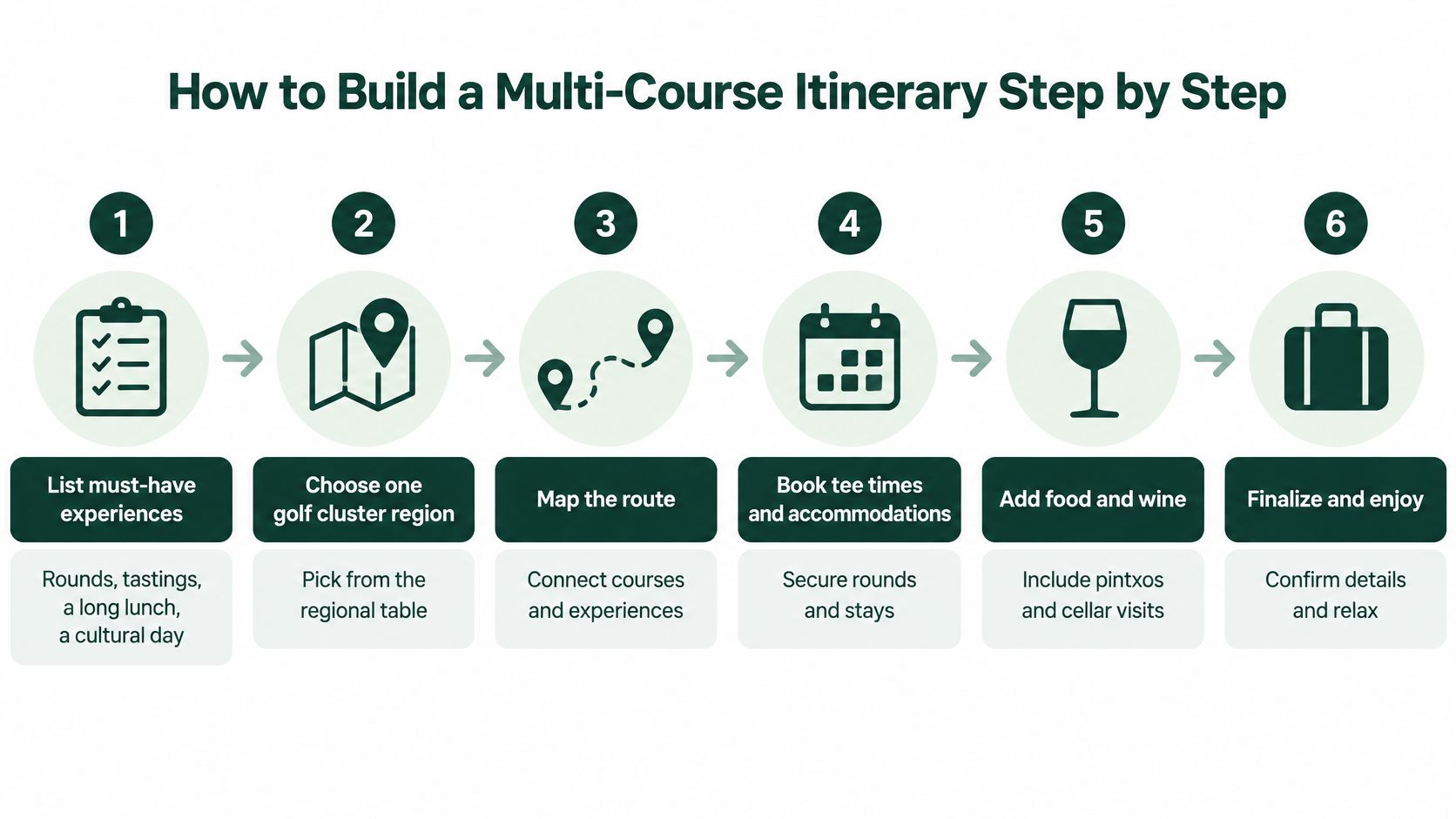
- List the must-haves. Write rounds, tastings, one long lunch and one cultural day before you open a course map. The slip is starting with a famous name and then forcing food around it.
- Choose one golf cluster. Take it from the regional table so every round sits within reach of the same base. Booking Andalusia on Monday and the Basque Country on Wednesday is the mistake that wrecks the week.
- Set the round count. Two or three rounds in a spread-out region, up to four where supply is dense, with at least one non-golf day for every two rounds. Adding a fifth round only to "use the trip" usually means a tired group and a late dinner.
- Route for short days. Keep daily driving short, stay in one base when you can, and put a private driver on the longer leg. Hopping hotels between courses looks efficient on a map and fails once golf bags and a late lunch enter the day.
- Book scarce inventory first. Shoulder-season tee times and boutique hotels go before restaurants and guides. The slip is holding a pretty hotel that sits 90 minutes from every course you want.
- Confirm the handoff. Transfers, luggage, golf-bag handling and guide bookings should be named before you fly. We manage accommodation, transport, logistics, luggage, guides and experiences from first contact until you are home, because a missed bag is what ruins a morning tee time.
A sample week that holds together
Say a couple wants depth, not a course checklist. One base on the Basque coast, a Tuesday round, a Wednesday food day in San Sebastián, a Thursday round within a short drive, and a Friday in a historic town. Two rounds, one food day, one culture day. Nothing crosses the country.
Matching Courses and Stays to Your Group
Fix the dates and the traveller type before you fall for a course photo. The season window decides which tee sheets still have space. Then choose the course and the base together, not as two separate shopping lists.
| Traveller | Main priority | Stay style | Course criteria |
|---|---|---|---|
| Couples seeking depth | Privacy and slow pacing | Boutique hotel | Two-round rhythm with tasting-led days |
| Families with teenagers | Flexible tee times | Comfortable hotel with pool or activities | Accessible courses with non-golf options |
| Multigenerational groups | Accessibility and flexibility | Spacious private accommodation | Shorter rounds and easy transfers |
| Food and wine lovers | Access to restaurants and wineries | City base or winery stay | Courses close to dining and tastings |
| Milestone groups | Privacy and shared experiences | Group-friendly boutique hotel | Reserved group tee-time block |
What to check on each shortlist
Couples do better with a two-round rhythm and a tasting on the off day than with a packed card. Families with teenagers need a pool or a town they can use while one parent plays, plus a tee time that can move if the morning falls apart. Multigenerational groups need shorter rounds, flat walks to the first tee and a private house or suite layout, not a standard twin. Food-led travellers often sleep better in a city or a winery than on the course itself, as long as the drive to the first tee stays reasonable. Milestone groups need a reserved block, private transfers and one dining room the whole party can share.
On every shortlisted course, check distance from the base, a practice facility, how tee times are released, and whether a group block is even possible. Our expert private guides handle caddie questions, course notes and dress codes so the group is not guessing at the bag drop.
Booking sequence: Dates first, then the scarce tee times, then the base within a reasonable drive of those courses.
Pairing Golf with Food, Wine and Culture
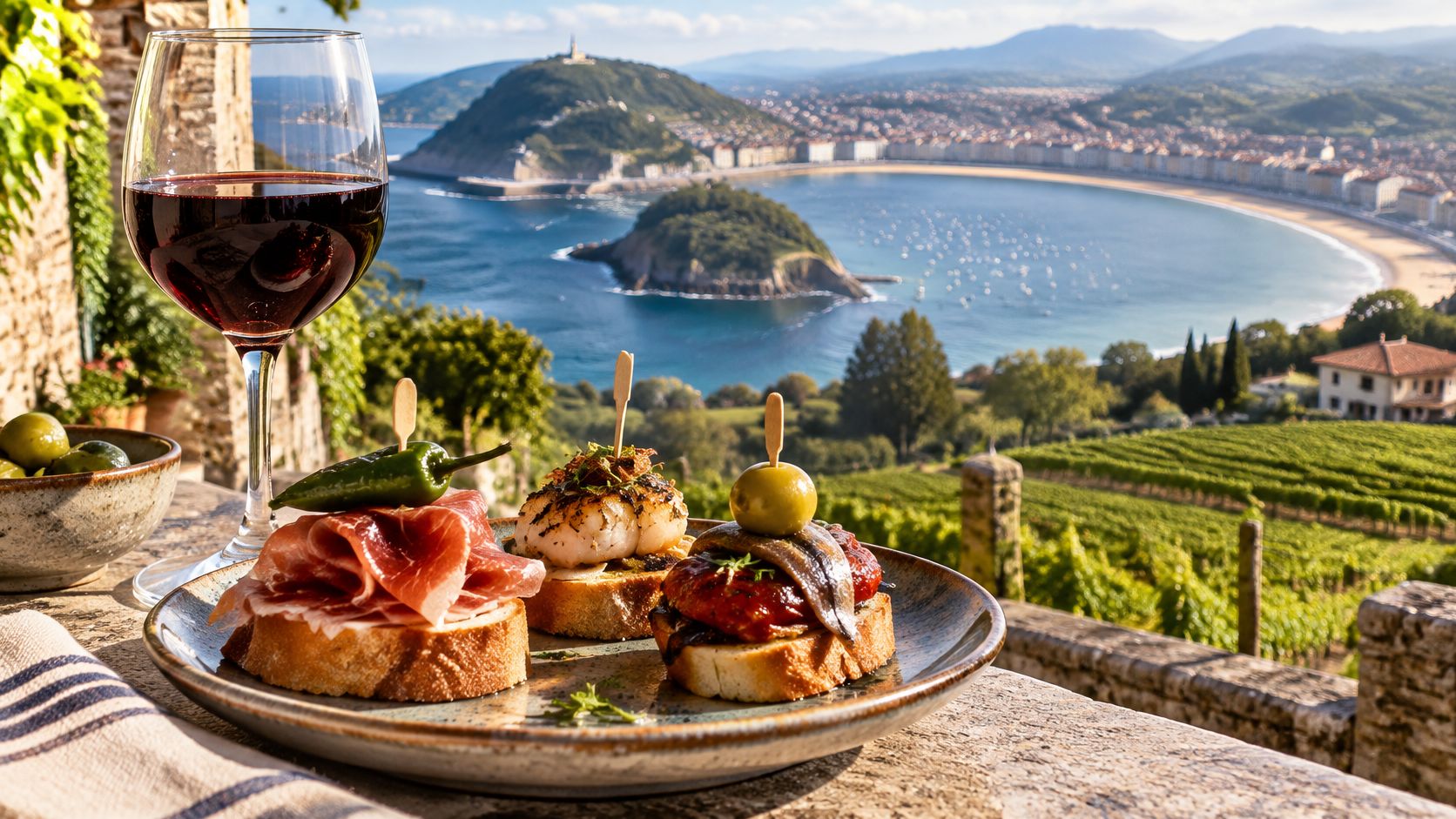
One round, one region and an unhurried meal make a stronger day than adding another course and a long transfer. Near San Sebastián, for example, a coastal round can lead into pintxos and an evening in the old town without a drive to another province. In La Rioja or Navarra, pair a morning round with a cellar visit and time in a historic town. The golf sets the day's pace.
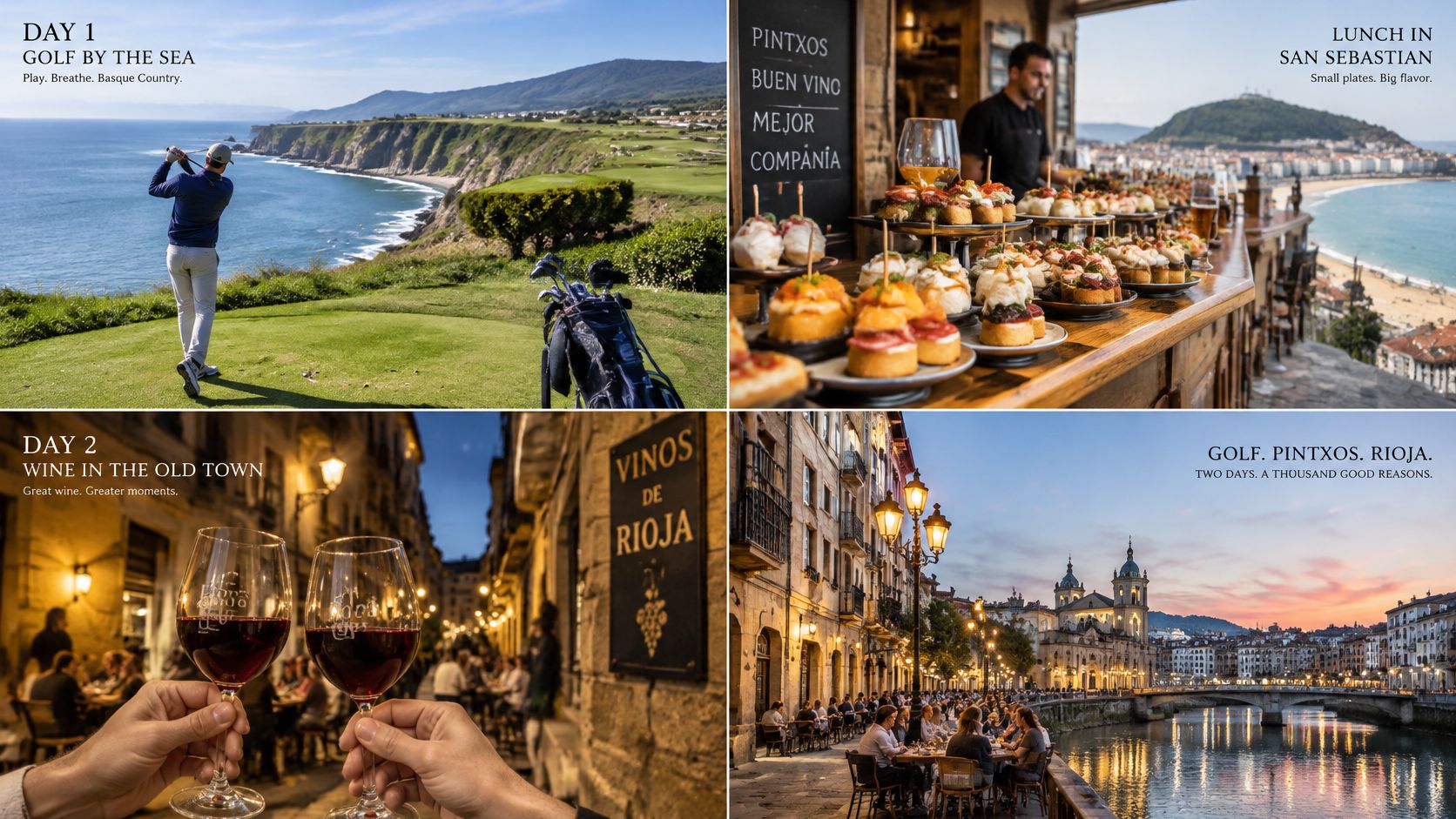
Andalusia's Costa del Sol has a dense concentration of courses, with restaurants, cellars and towns close enough to pair with a round. Northern Spain has a thinner spread of courses, so plan the course, meal and overnight base as one route rather than assuming they will be close together. For ideas on regional food and wine, see this guide to culinary journeys in northern Spain.
Three rules that keep the day intact
- Play in the morning: An early tee time leaves room for lunch and an afternoon visit.
- Eat well after the round: A long meal before 18 holes can slow the day and leave little time for play.
- Give culture its own day: Schedule a museum, fishing village or old town on a non-golf day instead of squeezing it between rounds.
Four combinations work particularly well: a coastal fishing village after a nearby course, a cider house after one round, a winery and course in the same valley, or a city museum day between golf days. The practical test is the transfer: if getting from course to table and back to the hotel eats into the afternoon, choose a closer pairing.
Water-Smart Course Choices for a Responsible Trip
The sunniest, most famous routing is not automatically the best golf routing. Spain faces high or extremely high water stress across 67.7% of its territory, according to a 2024 Springer chapter on golf and water. Course water use changes with size, climate and irrigation source, and drought rules can change what you are allowed to play.
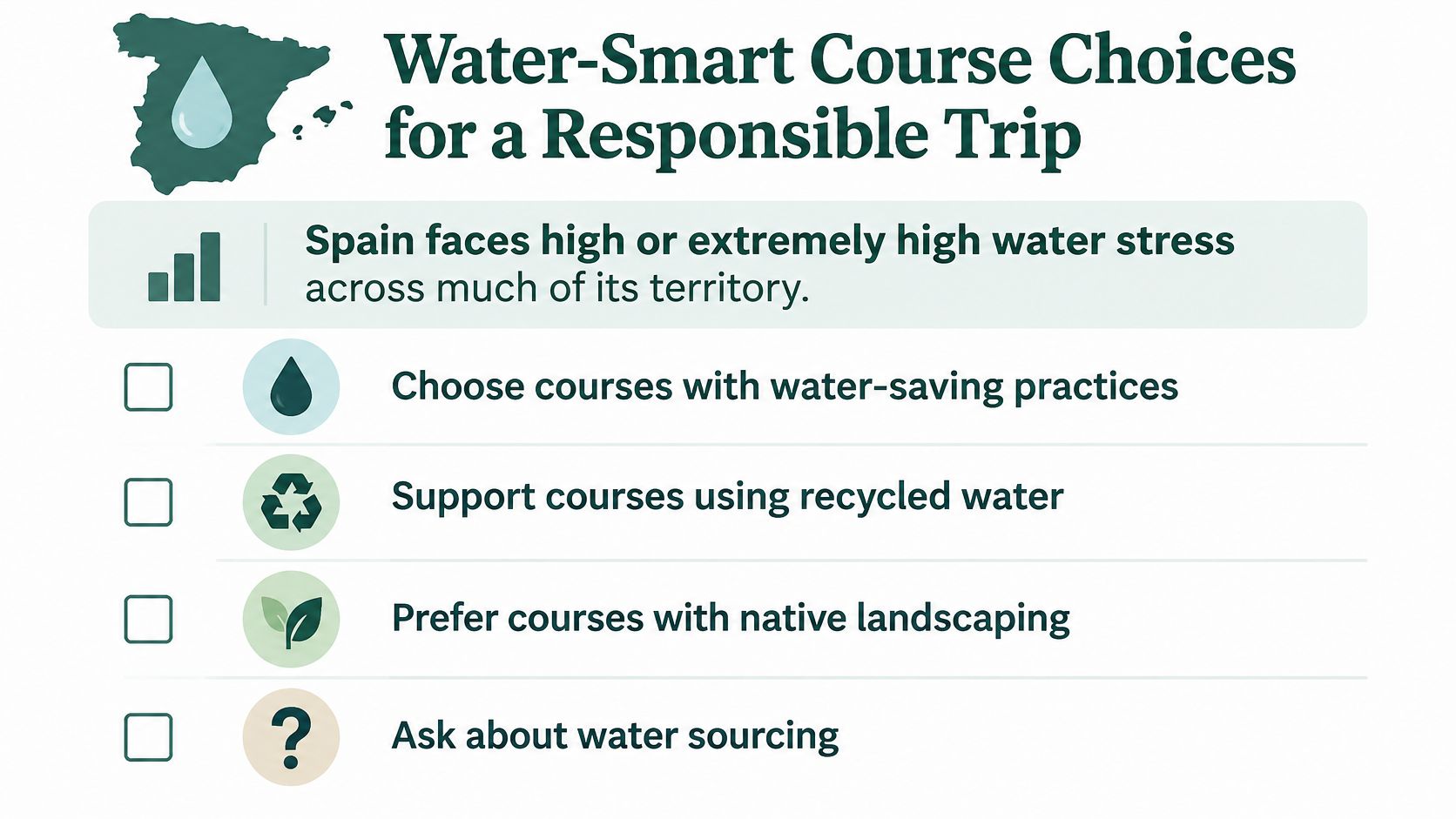
Benchmarks worth asking about
Available estimates in that chapter put annual consumption at roughly 100,000–200,000 m³ for smaller courses and 100,000–300,000 m³ for 18-hole courses. Reclaimed water accounts for approximately 72% of use on smaller courses and 57.3% on larger ones. A separate 2024 report in the same source found that 59% of Spanish courses use reclaimed water and that 92% apply water-saving practices.
Those shares are not a free pass. Standardised consumption figures are still limited, so a brochure line about being eco-friendly is not evidence. Ask for the document.
Screening checklist before you hold a tee time
- Source of water: Does the course irrigate with reclaimed or desalinated water, or with potable supply?
- Drought plan: What happens to the course, and to your tee time, if restrictions tighten?
- Published figures: Will the club share recent consumption, or only a slogan?
- Region swap: In a dry year, can a northern or Atlantic course replace a Mediterranean one without breaking the rest of the trip?
Affluent travellers from the United States, the United Kingdom, Canada and Australia increasingly expect that check. I would rather play a well-run Atlantic course in a good shoulder month than chase a famous Mediterranean name in a drought week. A lower-water-risk route through the north, timed with food and wine, is often the stronger private trip.
Request a Private Draft Itinerary
Build the week yourself when it is one region, two or three rounds and a single base. Hand it over when the dates are tight, the party is mixed, or someone wants wine valleys plus a coastal round without living in the car. The second case is where self-booking usually fails, because tee sheets, boutique rooms and private drivers do not free up in the same week.
Share four things and stop rewriting the map. Your traveller type, the must-have experiences, the dream places, and the style of journey you imagine. We design a personalised draft from that checklist, with a no-obligation quote, across the Basque Country, La Rioja, Navarra, Cantabria, Asturias, Galicia and the Pyrenees. Once you are on the road, support stays on the ground around the clock, including the morning a transfer or a bag needs a human, not an app.
Ask each shortlisted club for its water documents before you treat a green logo as a promise. Then send the dates. The shoulder windows are short, and a pretty draft that is not tied to real tee times is only a brochure.
Fix the dates first. Book the tee times next. Everything else, hotel included, should follow those two decisions.
Northern Spain Travel designs fully private golf, food and culture journeys across northern Spain, with boutique stays, drivers and local access shaped to your pace. If you want a route built around short transfers, shoulder-season play and a real water check, start with your dates and the rounds that matter. Visit Northern Spain Travel and ask for a personalised draft.