The most popular advice for a Spain culinary tour is to travel in spring or autumn and book the famous restaurants first. That's too broad to build a good trip. A Navarra vegetable lunch, a Rioja cellar visit and an Asturian cider-house meal depend on different calendars, and a celebrated dining room isn't automatically your best encounter with local food.
Start with what you want to taste, then choose the region and month. Northern Spain is especially rewarding when you resist the urge to cover the whole coast. Stay long enough to recognize the ingredients, meet the people behind them and enjoy a meal without watching the clock.
Table of Contents
- Northern Spain Regions and Their Signature Flavors
- Why Northern Spain Rewards a Food-First Trip
- Sample Private Itineraries for Five to Nine Days
- Month-by-Month Timing Across Northern Spain
- Reading Rioja Ageing Labels for Cellar Visits
- Judging Sustainability and Provenance at the Table
- Dining Formats, Booking Lead Times and Next Steps
Northern Spain Regions and Their Signature Flavors
| Region | Signature Foods and Drinks | Defining Experience | Best Base Town |
|---|---|---|---|
| Basque Country | Pintxos, grilled hake, txakoli | Pintxo crawl through the Parte Vieja | San Sebastian |
| La Rioja | Rioja reds, roasted vegetables | Private cellar tastings and vineyard lunches | Logrono or Haro |
| Navarra | Navarrese vegetables, Navarra wines | Pamplona pintxo walk with a local chef | Pamplona |
| Galicia | Atlantic seafood, octopus, Albarino | Harbor lunches and Rias Baixas tastings | Santiago or A Coruna |
| Asturias | Sidra, fabada, Cabrales cheese | Cider-house meals in winter and spring | Oviedo or the coast |
| Cantabria | Santona anchovies, coastal produce | Fishing villages and anchovy tasting | Santander |
Read this Northern Spain culinary regions at a glance comparison by appetite, not geography. If you want lively bars and precise seafood cooking, start in the Basque Country. If the pleasure lies in discussing a bottle over lunch, give La Rioja a proper stay rather than treating it as a tasting stop.
The Basque Country and La Rioja are the strongest anchors for most first food-led journeys. They offer a useful contrast between coastal cooking and inland wine culture. San Sebastian suits travelers who want to walk between restaurants and bars; Haro or Logrono suits those who want their days organized around cellars and vineyards.
Choose contrast rather than coverage
Navarra deserves attention if vegetables interest you as much as protein. Pamplona also works well for travelers who want a city with its own food identity rather than another coastal stop. Cantabria is the quieter choice for anchovies, fishing villages and lunches that don't need an elaborate evening attached.
Galicia and Asturias add Atlantic depth, but they aren't interchangeable. Choose Galicia for seafood and the contrast between coastal Albarino and inland Ribeira Sacra wines. Choose Asturias for cider, substantial village cooking and cheese.
Use our guide to Northern Spain's regional specialties to refine that shortlist. For a useful ingredient-level companion, Learn Olive Oil's guide to Spain provides context for paying closer attention to the oil served with bread, vegetables and finished dishes.
Pacing rule: In a hypothetical itinerary, allow an anchor region roughly four to five nights before adding another. Repeated meals in the same place help you notice differences that a quick circuit conceals.
Shortlist the regions by the ingredient or drink you care about most. Then check the timing before fixing your dates.
Why Northern Spain Rewards a Food-First Trip
A food-first trip works better than a city circuit because the places worth visiting aren't always the places with the largest monuments. If you've already explored Madrid, Barcelona and Andalusia, another succession of major sights may add less than a conversation with a cheesemaker or lunch in a fishing village.
The cultural foundation matters. UNESCO's Mediterranean diet inscription recognizes skills, knowledge, rituals and traditions extending from cultivation and fishing to cooking and shared consumption. That's a better model for culinary travel than treating every meal as an isolated restaurant booking.
A pintxo illustrates the distinction. You stand at a bar, order a small bite, perhaps on bread or a skewer, enjoy it with a drink and move on. The appeal isn't just eating miniature dishes. It's participating in a social rhythm, with each bar contributing something different.
Restaurant-led or producer-led
A restaurant-led journey starts with chefs and dining rooms. It suits travelers who enjoy composed menus, attentive service and a clear evening centerpiece. Its weakness is repetition: successive tasting menus can become tiring, even when each kitchen is excellent.
A producer-led journey starts with markets, vineyards, dairies and village kitchens. It asks for more flexibility because the people you're visiting have working businesses, not theatrical sets. In return, you learn why the food tastes the way it does.
Consider a possible Basque day: a morning fish-market visit with a guide who can explain the catch, a txakoli lunch in a fishing town, then an evening pintxo walk. The progression gives you ingredients, local character and social context without making every stop formal.
- Choose restaurant-led travel if a particular chef or dining room is your main reason for coming.
- Choose producer-led travel if you'd rather understand the catch, harvest or fermentation.
- Choose a mix if you want polished evenings balanced by informal daytime encounters.
Kitchen and cellar access must be arranged, never assumed. Decide which mode appeals before choosing the rest of the route.
Sample Private Itineraries for Five to Nine Days
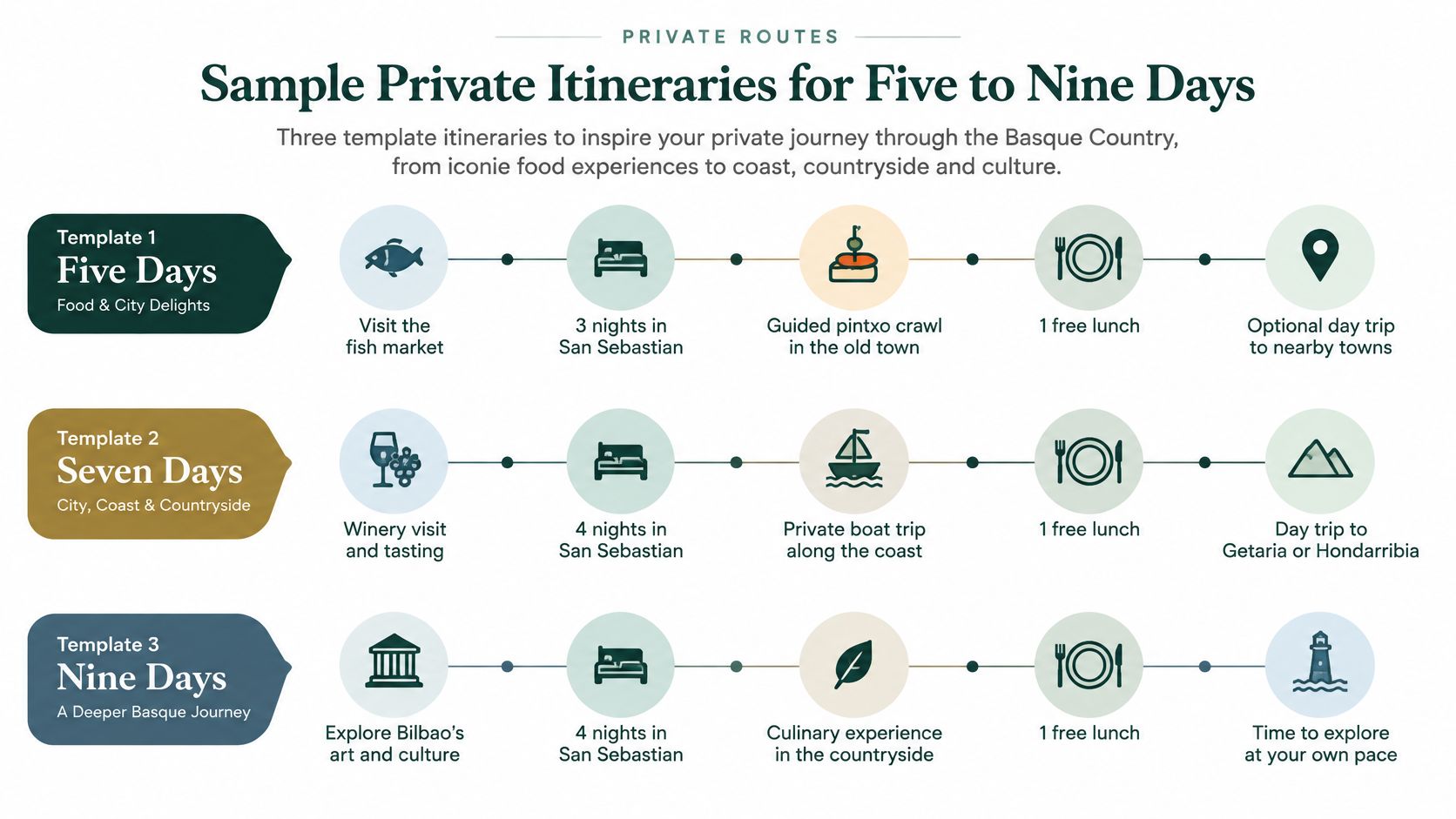
Choose a compact Basque and Rioja journey, a longer eastern route through Bilbao and Navarra, or an extended trip that includes Galicia. Treat the following as hypothetical planning templates, not fixed packages; count hotel nights separately from sightseeing days and departure arrangements.
Five-day planning template
For example, build the core stay around three nights in San Sebastian and two in La Rioja, with departure after the final night. That's a five-night arrangement, so don't mistake the shorthand for five calendar days including arrival and departure.
Begin with a fish-market visit and a guided Parte Vieja pintxo crawl. Keep lunch unreserved and an afternoon free for the waterfront, shopping, or resting. Move to Haro or Logrono with a private driver, then arrange a cellar tasting and vineyard lunch on separate occasions so neither feels rushed.
Seven-day planning template
A hypothetical seven-night eastern route could use four nights in San Sebastian and three in Rioja, with Bilbao and Pamplona included as carefully chosen excursions or transfer stops. This avoids changing hotels just to eat dinner.
Use Bilbao for a special restaurant meal if its location fits your arrival route. Include a Pamplona pintxo walk with a local chef when moving through Navarra, rather than forcing it into an already full coastal day. Preserve an unplanned afternoon in San Sebastian and avoid a substantial lunch before the special dinner.
Nine-day planning template
For example, a nine-night version could allocate three nights to San Sebastian, three to Rioja and three to Galicia, including at least two nights in Santiago de Compostela. Give Galicia an Albarino tasting in Rias Baixas, a harbor seafood lunch and an afternoon without appointments.
The honest trade-off is distance. Galicia isn't a casual extension from Rioja: it needs a dedicated travel day or a suitable flight connection. If that consumes too much of your holiday, substitute Asturias or save Galicia for a separate journey.
A longer itinerary should buy you breathing room, not permission to add a destination every morning.
For these sample plans, cap a short trip at two base changes. Break a long road transfer with a proper rest and meal rather than another appointment. Protect a free afternoon within each five-day stretch.
Choose the closest template, then remove a base if your available time shrinks.
Month-by-Month Timing Across Northern Spain
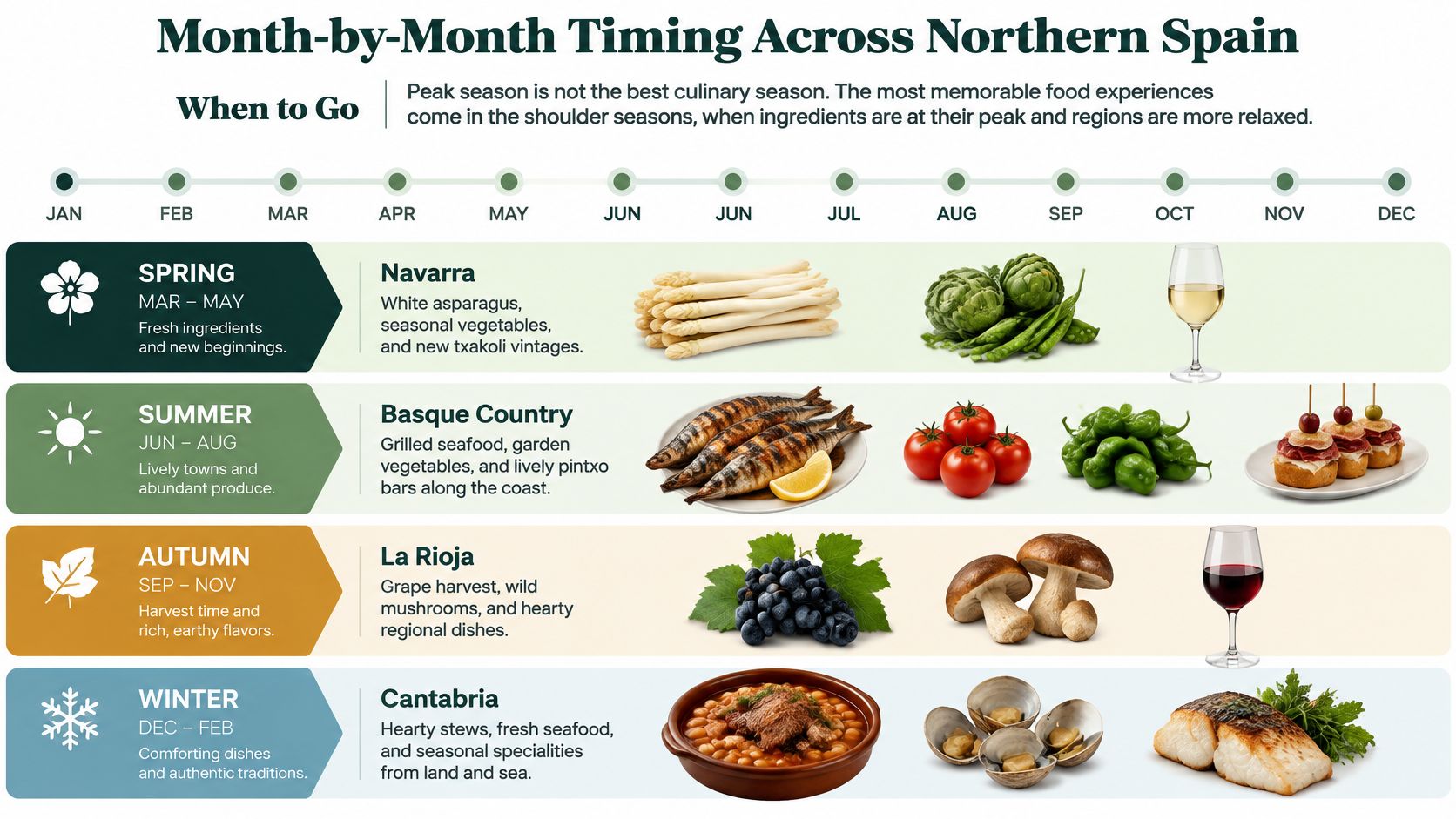
Peak season isn't automatically the best culinary season. According to CaixaBank Research's tourism report, 40.5% of the average Spanish restaurant's annual turnover is concentrated between June and September. That describes commercial concentration, not a guarantee that your preferred experience will be better then.
Match the month to the experience
March, April and May are useful planning candidates for Navarra's vegetable cooking and Basque market visits. Ask what's fresh rather than demanding a particular asparagus dish before the kitchen confirms availability. On the coast, combine txakoli with a fishing-town lunch, keeping an indoor alternative to a terrace reservation.
For June, July and August, favor coastal stays only if you're comfortable organizing the important meals ahead. Galicia's seafood and Basque beach villages make an appealing combination of eating and outdoor time, but don't expect spontaneous access to every sought-after table.
September, October and November suit a wine-focused conversation, provided you distinguish a cellar visit from harvest participation. Rioja vineyard work follows the growing season, not your hotel dates; confirm actual harvest activity before making it the centerpiece. In Galicia, ask kitchens about mushrooms and game as their menus change.
During December, January and February, consider Asturias for cider-house meals and Rioja for quieter cellar appointments. Don't confuse quieter with universally available: reduced hours, annual breaks and closed dining rooms can narrow your choices.
Northern Spain culinary calendar by region and season
| Region | Spring | Summer | Autumn | Winter |
|---|---|---|---|---|
| Basque Country | New txakoli releases and market visits | Coastal villages and beach dining | Pintxo walks and changing market produce | Check reduced hours and closing days |
| La Rioja | Vineyard walks and cellar visits | Book tastings around midday heat | Confirm harvest activity directly | Quieter cellar appointments |
| Navarra | White asparagus and seasonal vegetables | Market-led lunches and pintxo walks | Ask for the current vegetable menu | Confirm market and restaurant schedules |
| Galicia | Seasonal coastal menus | Atlantic seafood and Rias Baixas tastings | Ask about mushrooms and game | Consider inland Lugo and Ourense |
| Asturias | Cider-house meals | Coastal lunches and cheese visits | Village cooking and cider-focused visits | Cider houses, with service confirmed |
Galicia also deserves an inland option, not just a coastal one. Add Lugo or Ourense when you want village cooking and wine regions rather than another harbor lunch.
Low-season travel trades choice for potential access. There may be fewer open tables, but a confirmed appointment can allow a less hurried conversation. Choose your region-month pairing, verify closure dates and secure private producers and destination restaurants before filling the flexible gaps.
Reading Rioja Ageing Labels for Cellar Visits
| Label | Minimum Total Ageing | Minimum Oak Ageing | Typical Tasting Profile |
|---|---|---|---|
| Crianza | Two years | At least one year in oak | Fresh red fruit with early spice and vanilla |
| Reserva | Three years | At least one year in oak | Dried fruit, spice and developing leather |
| Gran Reserva | Five years | At least two years in oak, followed by bottle ageing | Dried fruit, leather and savory depth |
These red-wine minimums come from the Rioja designation's official classification: Crianza requires at least two years' ageing, including one year in 225-liter oak barrels; Reserva requires at least three years total, including one in oak; Gran Reserva requires at least five years total, including two in oak and subsequent bottle ageing.
Use this Rioja ageing labels and what to taste reference to organize questions, not to rank wines automatically. Longer maturation generally shifts the emphasis from primary fruit toward dried fruit, spice and leather. Grape selection, vintage, oak choices and the producer's intentions still matter, so the profiles are expectations rather than promises.
Design comparisons that teach you something
Start with a same-producer classification flight of Crianza, Reserva and Gran Reserva. It's an accessible way to discuss maturation, but it doesn't isolate ageing completely: the producer may use different vineyard parcels, blends or vintages for each wine.
For a true vertical tasting, compare the same wine across different vintages. Ask the host to explain growing conditions and storage as well as age. Otherwise, it's easy to attribute every difference to time in bottle.
A horizontal tasting compares wines from the same vintage across producers. Reservas make a useful starting point, allowing you to explore differences in fruit, oak handling and house style while holding the vintage constant.
The label reflects the whole ageing path, barrel and bottle, not simply the release date.
Don't fill your notebook with aromas alone. Record whether the wine feels fresh, how the tannins sit against food and which style you'd want to drink over lunch.
Questions for the cellar
- Barrel format: Was this wine matured in the regulated barrel format, and what oak did the producer choose?
- Oak duration: How long did this particular bottling spend in wood beyond the classification minimum?
- Bottle maturation: What happened after barrel ageing, and when does the producer recommend opening it?
Our traveler's guide to Rioja wine adds destination context for choosing the cellar base. Request a focused comparison flight and a vintage comparison before arrival, then write down the questions you most want answered.
Judging Sustainability and Provenance at the Table
Stars and farm-to-table labels don't prove local impact. They may help you shortlist restaurants, but they don't tell you who caught the fish, how the vegetables were purchased or what happens to unused ingredients.
The USDA's Spain foodservice report notes 57 Green Star restaurants in Michelin's 2025 Spain selection. Treat that recognition as a reason to investigate specific practices, not as a substitute for asking questions.
Ask for names and practices
- Seafood sourcing: Does the restaurant buy from nearby small-scale fisheries, and can staff identify the supplier and fishing method?
- Direct purchasing: Who supplies the cider apples, grapes, cheese and vegetables? Which products come directly from producers?
- Vineyard stewardship: Does the winery measure water use or biodiversity, and can the host explain what has changed?
- Dietary adaptation: Can the kitchen accommodate your needs using regional ingredients rather than defaulting to imported substitutes?
A high-end tasting menu can feature local produce while relying on distant luxury ingredients, generating substantial preparation waste or requiring lengthy private transfers. That doesn't make it worthless. It means the whole experience deserves scrutiny, not just the menu's most photogenic ingredient.
Compare where your spending goes
Michelin-led dining can support skilled kitchen teams and demanding sourcing standards. The difficulty is visibility: diners rarely see purchasing arrangements or waste handling. Ask for a concrete example rather than a general sustainability statement.
Markets and fishermen's cooperatives can bring you closer to the transaction, but a market stall doesn't guarantee local origin. Read labels and ask where the product was landed or grown. At family-run cider houses and village kitchens, a short menu may reveal seasonal discipline, though family ownership alone proves little about sourcing.
A vineyard described as regenerative should offer more than attractive cover crops. Ask the grower to explain soil management, water decisions and how progress is checked.
Our guide to farm-to-table dining in Northern Spain helps separate an ingredient claim from a purchasing relationship.
The strongest value is checkable: a named producer, a clear place of origin and a transparent price for the experience. Ask about sourcing and waste at each reservation, and keep the venues that answer clearly on your shortlist.
Dining Formats, Booking Lead Times and Next Steps
Choose the dining format by your group's energy, not by prestige. A standing pintxo evening can be perfect for an adventurous couple and exhausting for a multigenerational group that needs seats, accessible entrances and predictable meal times.
Pintxo bars suit flexible evenings. Arrive before the busiest service if you want more room, order according to the bar's system and check whether you're paying by item or settling a running tab. Don't assume everything on display is self-service; hot specialties often need to be ordered.
Asturian cider houses suit a sociable, substantial meal. Cider poured from height is intended to aerate it, and the food offering can range from informal plates to an extensive menu. Confirm the actual menu, seating arrangements and cider service rather than expecting every venue to follow an identical format.
Book according to how difficult it is to change
Destination restaurants need priority, especially when your dates depend on a particular chef. Check the menu format, cancellation terms and dietary arrangements before committing. For children or lighter appetites, ask whether the kitchen offers an appropriate alternative instead of assuming everyone must take the longest menu.
Winery appointments need a different conversation. Confirm whether you're booking a cellar tour, a tasting, a vineyard walk or lunch, because these aren't interchangeable. A private group should arrange the full visit ahead rather than relying on short notice.
| Dining Format | Booking Priority | What to Confirm |
|---|---|---|
| Destination or Michelin restaurant | First, once travel dates are workable | Release calendar, closing days, menu and dietary needs |
| Winery visit with lunch | Alongside the main restaurant booking | Private access, tour content, lunch and transport |
| Cider house | Ahead for groups or a specific seating | Menu, seats, service format and opening schedule |
| Pintxo evening | Keep individual bar choices flexible | Walking pace, seating needs and ordering etiquette |
| Market or harbor lunch | Leave room for discovery | Trading day, catch and kitchen service |
Use this lead-time table as a booking order, not a universal deadline. Restaurants and wineries set their own calendars; a blanket promise about months or days would be misleading.
Turn preferences into a workable journey
We begin with your must-have experiences, dream destinations, preferred dates and the style of journey you imagine, then design a personalized draft itinerary. Our Local Heroes include Ángel for culinary journeys in La Rioja and Nacho, a Local Hero Chef in Pamplona.
We manage accommodation, transport, logistics, luggage, guides and experiences from first contact until you return home. Your next step is simpler: gather your must-have meals, preferred regions and travel month, and explain what you don't want rushed.
Northern Spain Travel designs fully private culinary journeys around the kitchens, cellars and regional food traditions that interest you, with the practical details managed end to end. Visit Northern Spain Travel with your meal wishlist, preferred destinations and dates to request a personalized draft itinerary that leaves room to enjoy what you've come to taste.