The best northern Spain golf trips begin with the weather forecast, not a course ranking. The coast is cooler and greener than the Costa del Sol, but Atlantic wind and rain can change how a round plays. Choose each course, base and tee window for its conditions, rather than treating the north as a sunnier alternative to southern resorts.
Northern Spain has far fewer courses than the Costa del Sol, and its coastal layouts are typically exposed and demanding. That makes a flexible schedule more useful than trying to fit in as many famous names as possible. Keep room to adjust tee times around the forecast, and be prepared to shorten the golf portion of a day if wind or rain makes a round unpleasant.
Plan around course character as well as weather. An exposed coastal course calls for a different approach from a sheltered inland round, and the right base can reduce the pressure to drive between regions. The sections ahead explain which courses to book first, how to choose a base, and how to secure private tee times.
Table of Contents
- Best Golf Courses in Northern Spain to Book First
- Choosing a Base Region and Matching It to Your Stay
- Planning Around Atlantic Weather and Seasons
- How to Secure Private Tee Times Step by Step
- Three Sample Golf Itineraries for Different Travelers
- Book Your Private Golf Trip With a Local Planner
Best Golf Courses in Northern Spain to Book First
| Course | Region | Layout character | Best fit |
|---|---|---|---|
| Real Sociedad de Golf de Neguri | Basque Country (Bizkaia) | Cliff-edge coastal | Confident players seeking drama |
| Real Pedreña | Cantabria | Exposed coastal | Players comfortable managing wind |
| Real La Coruña | Galicia | Exposed coastal | Scenic Atlantic rounds |
| La Toja | Galicia | Island coastal setting | Golfers combining golf with a spa stay |
| Real Golf Club Zarauz | Basque Country (Gipuzkoa) | Heritage coastal, opened 1916 | Heritage-focused couples and groups |
| San Sebastián Royal Golf Club | Basque Country (Gipuzkoa) | Centenary club | First-time visitors seeking history |
Read that as a playing-style filter, not a ranking. Neguri is the purest expression of the northern idea: a cliff-edge design where trajectory control matters more than distance, and a low, boring three-wood often beats a hopeful driver. Pedreña in Cantabria and Real La Coruña out on the Galician coast are exposed enough that wind, not yardage, decides club selection on the day. La Toja gives you the island setting and a reason to stay two nights rather than drive in and out.
The Royal Spanish Golf Federation's club directory lists these northern entries club by club, including Real Golf Club Zarauz in Guipúzcoa and Paderne Golf Club in A Coruña, and that directory is the right place to confirm a layout before you commit a day of a short trip to it.
Matching the course to the group
The common mistake is booking the four most famous names and discovering that all four punish the same weakness in the same wind. Coastal holes reward players who enjoy scenic drama and can flight the ball down. Inland parkland layouts put the emphasis on uneven lies, strategic positioning and approach accuracy, which suits groups who want a gentler round without giving up interest.
Zarauz Royal Golf Club carries real historical weight: it opened on 31 July 1916 in the presence of King Alfonso XIII and Queen María Cristina and remains on its original site, described by the Basque tourism authority as the oldest surviving golf course in the region in its original setting. Three clubs hold centenary status, San Sebastián Royal, Neguri Royal and Zarauz Royal.
Booking rule: one dramatic coastal round and one forgiving day per trip, with both tee times held as flexible windows rather than fixed slots.
For the forgiving half, Real Club de Golf San Sebastián is the one club that does double duty, centenary heritage on one hand and a gentler inland round on the other, and it's worth confirming its current layout against the federation directory before you build a day around it.
Tee sheets here are working members' sheets, not open resort inventory. The Basque Country counted 18,233 registered golfers in 2024, up 0.6% on the previous year, according to the Royal Spanish Golf Federation. Visitor windows are finite, and the good mid-morning ones go first.
Choosing a Base Region and Matching It to Your Stay
| Region | Course band (KPMG 2017) | Base city | Role in an itinerary |
|---|---|---|---|
| Basque Country | 11-20 courses | San Sebastián | Anchor for coastal and heritage golf |
| Cantabria | 11-20 courses | Santander | Coastal rounds at Pedreña and beyond |
| Asturias | 11-20 courses | Oviedo | Quieter inland and coastal play |
| Galicia | 11-20 courses | Santiago de Compostela | Atlantic golf and La Toja pairing |
| Navarra | 0-10 courses | Pamplona | Single-day golf with wine pairing |
| La Rioja | 0-10 courses | Logroño | Golf combined with cellar visits |
The base city should follow the playing plan, not the other way round. A KPMG country snapshot based on 2017 data places the Basque Country, Cantabria, Asturias and Galicia in the 11 to 20 course band each, with Navarra and La Rioja in the 0 to 10 band. Treat that as a shape rather than a current count, because it is dated and predates most of the directory churn since.
Recent directories also disagree with each other, and not because the courses moved. One counts clubs, another counts facilities, another counts individual courses. Compare destinations on one counting unit only, or you'll build a route around a spreadsheet artefact.
San Sebastián earns the anchor role for pintxos evenings within walking distance of the hotel and coastal courses within a short drive. Logroño is the base for cellar days between rounds, with Navarra reachable as a single golf day. Santiago de Compostela gives you Atlantic golf inside a cathedral city, and the La Toja crossing fits naturally as an overnight rather than a day trip. Our own itineraries group these areas as the Basque Lands, Wine & Heritage, Atlantic Green and Pyrenees & Northern Frontiers, which maps closely onto how the golf distributes.
Asturias and Cantabria sit next to each other and get confused constantly. If you're weighing the two, this comparison of Asturias versus Cantabria is the honest starting point before you decide which one gets two nights.
Routing rule: a multi-stop golf itinerary works only while the drive between bases stays comfortable. Two bases in seven nights is generous. Three is the practical ceiling.
Planning Around Atlantic Weather and Seasons
A golf trip to northern Spain should be planned around Atlantic conditions, not around the assumption of reliable sunshine. Weather can change quickly, with intermittent drizzle and morning fog affecting coastal and inland rounds. May, October and November can be attractive windows for comfortable temperatures and playable conditions, but none guarantees a dry day. For a broader seasonal view, see this guide to the best time to visit northern Spain.

| Period | Typical conditions | Planning note |
|---|---|---|
| May | Comfortable temperatures, with changeable spells | A good window for a golf-focused trip |
| June to August | Warmer, busier months | Book tee times early and keep the schedule flexible |
| September | Mild, with changeable spells | A useful shoulder period for a relaxed pace |
| October | Comfortable temperatures, with changeable spells | A good window; pack waterproof layers |
| November | Comfortable temperatures, with changeable spells | Allow for shorter days when setting tee times |
| December to March | Cooler, wetter and more changeable | Keep the schedule flexible and allow for a backup day |
Plan for conditions, not a fixed forecast
A later tee window can reduce the chance that morning fog disrupts the round. Ask for flexible times when booking, and avoid placing a fixed tasting or long transfer immediately after golf. Wind and soft ground affect club choice and can slow play, so factor both into the day rather than treating them as minor inconveniences.
Wet-weather logistics matter too. Waterproof layers, spare gloves and room for damp gear make the return journey easier. If the forecast turns poor, a cultural day can be a better use of time than pressing on with a round in persistent rain.
Practical rule: keep one day flexible enough to absorb a rain-affected round or switch to a cultural visit.
Before leaving home, pack waterproof outer layers and two pairs of gloves. Confirm that your tee time has some flexibility, and keep a backup cultural day available. These small decisions help preserve the trip when Atlantic weather changes.
How to Secure Private Tee Times Step by Step
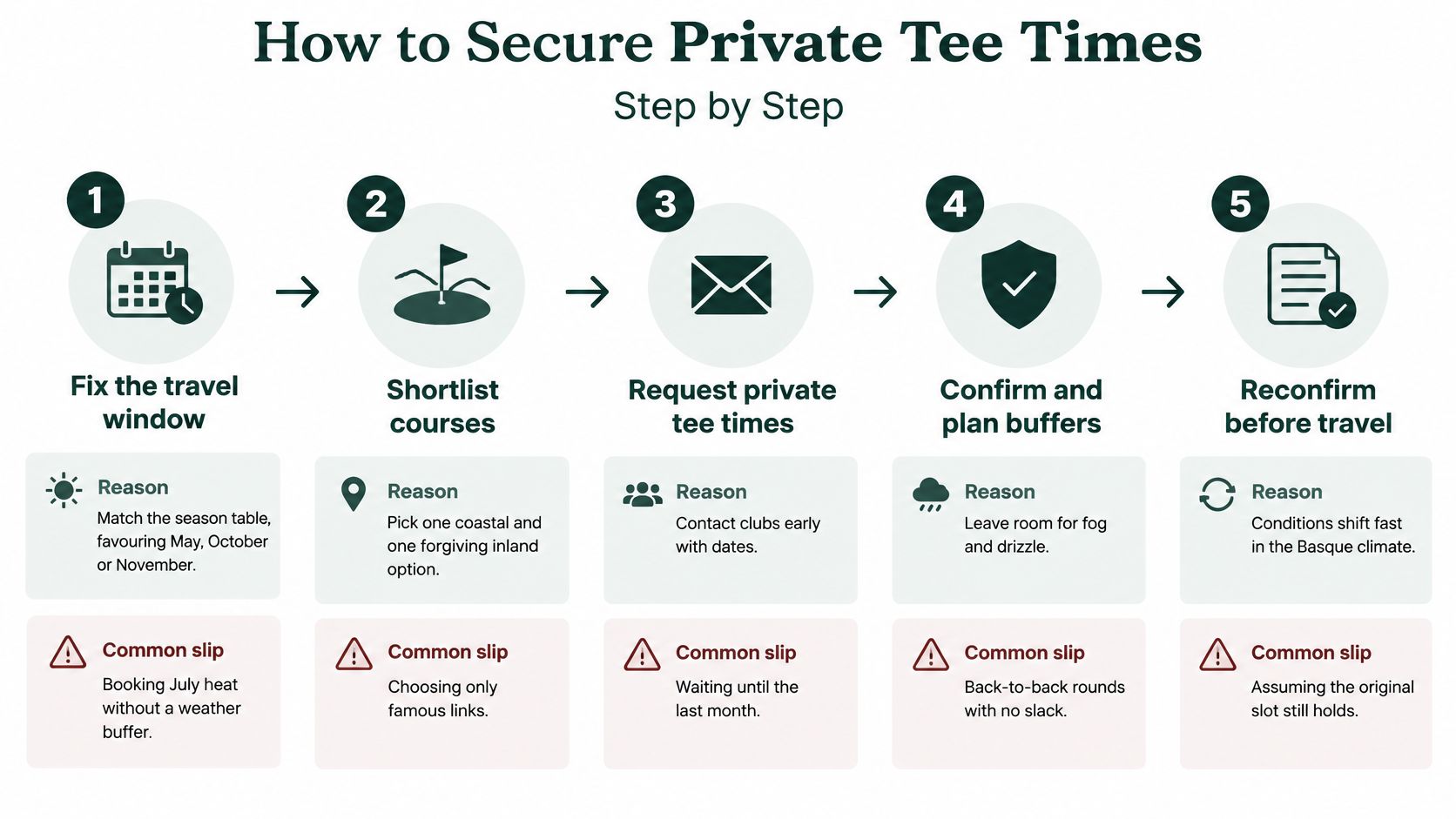
Secure the parts that limit your options first: travel dates, course choices and tee-time flexibility. Then confirm club rules and transport before paying for a round. This sequence helps avoid an early fog-bound start or arriving at the first tee without your clubs.
-
Set the travel window. Use the season guidance to choose dates, then check that the courses and stays you want are available. A popular month can mean fewer tee-time options, so leave room to adjust.
-
Choose contrasting courses. Pair a coastal course with a more forgiving inland option. That gives the trip variety and a practical alternative if wind or wet ground makes a more exposed course less appealing.
-
Request flexible tee windows. Give each club a preferred time and a second choice, rather than asking for one fixed slot. Golf tourism in Spain generated €5.872 billion in direct spending in 2022, 27.61% more than in 2019, according to the Royal Spanish Golf Federation's economic-impact study. Leave requests until the final month and your preferred windows may be harder to secure.
-
Get club requirements in writing. Confirm handicap, dress and booking rules, along with the green fee and booking lead time. Requirements vary by club. Treat any detail the club has not confirmed as unknown.
-
Arrange equipment and transport. Agree how golf bags will travel between the airport, hotel and courses, especially if you are changing bases mid-trip. Confirming this before the first round avoids a last-minute scramble.
-
Ask about local course support. For a windy or soft-ground day, check whether a caddie or local professional is available. Course-specific advice can help with club selection and unfamiliar playing conditions.
-
Keep a backup day open. A cultural visit or tasting gives the itinerary a useful alternative if poor weather makes a round impractical.
Three Sample Golf Itineraries for Different Travelers

Each of these keeps to two or three rounds over seven nights, because the driving and the weather do more damage to a packed schedule than a light one. All three assume a private driver and a hotel that will hold bags securely between rounds.
Heritage couple, seven nights in San Sebastián. Arrive, settle into a seaside hotel, and spend the first evening on pintxos in the Old Town rather than at a range. Day two is Zarauz Royal Golf Club on a flexible late-morning tee, with lunch in Getaria on the way back. Day three stays open, deliberately, for the coast. Day five is Real Club de Golf San Sebastián, the gentler inland round, and day six is Bilbao and the Guggenheim if the legs want a break. Two rounds, one movable day, one clear weather buffer.
Three generations, five nights in Santander. One coastal round at Real Pedreña, booked for late morning so the fog isn't a factor, and one shorter inland round or a rest day depending on how the grandparents are travelling. The teenagers get a surf lesson or a boat trip while the golfers play. Private drivers make the whole thing work, since three generations rarely want to leave at the same time. Two rounds maximum, and the spare afternoon is the buffer.
Wine and golf, six nights in Logroño. One Navarra round reached by a day drive from Logroño and booked as a fixed transfer day, with the cellar visit scheduled for a later-start morning rather than the day after an early tee. A fixed tasting day follows, then a rest day for anyone who wants balanced pacing. Two rounds, one fixed tasting, one loose day.
Walking with a trolley rather than taking a buggy is often the better call on soft ground where buggies get restricted, and pro-tested trolleys at Fayrway are worth sorting before you fly rather than hiring whatever the club has left.
Two rules that hold across all three: one round per day, and at least one day with no fixed booking so rain or fog can be absorbed without cancelling a tasting.
Book Your Private Golf Trip With a Local Planner
Here's the decision in one line: one coastal round and one forgiving round, in a playable window, on flexible tee times, based in the region you chose for the golf you want to play.
The parts that are hard to coordinate from abroad are the ones with local hands on them. A private driver tour means the clubs, the luggage and the wet gear move with you rather than meeting you two hours later. Expert private guides turn a rain-lost morning into a Rioja cellar or a Guggenheim visit worth the trip on its own. And the handoff between transfers, bookings and the weather has to sit with someone who can rebook a tee time at 7am without waking you.
Northern Spain Travel runs private driver tours and expert private guides across the Basque Lands, Wine & Heritage, Atlantic Green and Pyrenees regions, and manages a trip from first contact until the client returns home, including accommodation, transport, logistics, luggage, guides and experiences. The company is a licensed Spanish travel company, so the coordination sits with a business that can be held to it.
If you'd rather run the plan yourself, use the weather checklist and the seven-step booking sequence and you'll do well. If you want the managed version, start here:
- Share the essentials: travel dates, group size, handicaps, and whether this is a couple, a family or a private group.
- Ask for a private consultation through the Enquire Now or Request a Private Consultation button on the site, or call +34 747 473 529.
- Choose the shape of the trip: a guided, fully managed round with a backup day built in, or independent planning against the checklist.
The private travel designer approach is the difference between a booking and an itinerary that survives a change in the weather, and it's the version I'd choose for a first trip to the north.
Northern Spain Travel builds private, tailor-made journeys around the courses, coastlines and cellars in this guide, with tee times, drivers, guides and backup days handled as one plan rather than five separate bookings. Their planners work the Basque Country, La Rioja, Navarra, Cantabria, Asturias and Galicia year round, and they'll tell you when a course isn't worth the drive in the forecast you've been given. Start with Northern Spain Travel and ask for a golf itinerary built around playable windows instead of a list of famous names.