
A private chef dinner for two in the United States typically runs about $360–$500 in total, or $180–$250 per guest, when the quote covers menu planning, groceries, cooking, table service and cleanup. That's the standard tier, before wine, rentals, taxes or gratuity get added.
The number surprises couples in one specific way: two is often the least efficient group size you can book. A chef still consults, shops, preps, cooks, serves and cleans, and none of that work halves because only two people sit down. Add a flat booking minimum and a travel fee, and a modest three-course menu can land above a fully loaded restaurant bill for the same evening. The headline per-person rate is the least informative line on the quote.
Table of Contents
- Private Chef Dinner for Two Cost at a Glance
- Private Chef Dinner or Restaurant for Two
- Why Two Guests Pay More per Person
- What the Price Covers in Labor, Ingredients and Overhead
- Menu Choices That Move the Price Most
- The Minimum Charge That Can Undo a Small Menu
- Location, Travel and the Payable Total
- Confirm the Quote Before You Book
Private Chef Dinner for Two Cost at a Glance
The standard tier sits at $180–$250 per guest, or $360–$500 for two, and Take a Chef's comparison of private chef and restaurant pricing reports a median of approximately $210 per guest, which works out to about $420 in total for a couple. That quoted price generally includes menu planning, ingredient purchasing, cooking, table service and cleanup rather than food alone, so it isn't a grocery bill with a markup.
Read the tiers below as three different purchases, not three price points for the same dinner.
| Service level | Per person | Total for two | What the price usually covers |
|---|---|---|---|
| Standard private dinner | $180–$250 | $360–$500 | Menu planning, groceries, cooking, table service, cleanup |
| Premium high-touch dinner | $300–$1,200 | $600–$2,400 | Fine-dining proteins, specialty sourcing, extended service, extra staff |
| Destination dinner at a remote property | Standard per-guest rate, plus travel | Base dinner total plus a flat travel fee or mileage charge | Chef's core scope, with travel, kitchen setup and local sourcing priced by location |
What the headline usually leaves out
The standard row is the only one where the quoted total is close to the payable total. Wine, specialty ingredients, rentals, taxes and gratuity sit outside it, and each is a decision rather than a surprise once it's written down. The premium row moves for a different reason: the chef's hours expand with sourcing complexity, course count and service style, so the food is often the smaller part of the increase.
The destination row is where couples get caught. A villa kitchen with two burners and no stock pots changes the prep plan, and a property an hour from a market changes the shopping run. Neither shows up in a per-person rate.
Practical rule: pick the tier that matches your menu and service style first, then check each inclusion against the written quote before you compare totals across chefs.
If you're weighing a one-off dinner against recurring or live-in help, Relief Chefs UK's guide to budgeting for relief and permanent chefs is a useful companion, because it separates event pricing from ongoing staffing costs, which follow entirely different logic.
Private Chef Dinner or Restaurant for Two
Start with the benchmark you already know. As of April 2024, the worldwide median price of a Michelin-starred restaurant tasting menu was approximately US$179 per person, or about US$358 for two before drinks, taxes, service charges or transportation, according to Chefs Pencil's analysis of Michelin dining costs. In the United States, the most expensive tasting-menu option at Michelin restaurants averaged about US$227 per person, roughly US$454 for two before additional charges.
Set that beside a private dinner at $360–$500 for two and the spend is comparable. The purchases aren't. One buys a meal in a shared room; the other buys planning, shopping, cooking, service and cleanup at your own table.
To compare them, load the restaurant bill fully:
- Take the restaurant's food total for two, using the actual menu you'd order rather than the entry-level one.
- Add drinks, the service charge and transport both ways, including a driver if you're drinking.
- Put that figure next to the private total that already includes groceries, table service and cleanup.
A private dinner is rarely the cheaper option for two. It can be a like-for-like spend once the restaurant side is complete, and that's the honest framing.
There's a group-size wrinkle worth knowing before you commit. If you're travelling with another couple or family, in-house dining for group stays from Hen Hideaways shows how a single chef booking across a shared house changes the maths, because the fixed work gets split four or six ways instead of two.
For a trip built around food, the restaurant side of the ledger deserves the same scrutiny as the chef side. Our guide to exclusive dining experiences across Northern Spain covers where a private table earns its place on an itinerary and where a restaurant booking does the job better.
Why Two Guests Pay More per Person
The gap is structural. A comparable pricing schedule places the average at about $210 per person for one or two guests, declining to roughly $150 per person for groups of 11 or more, as set out in Take a Chef's overview of what a private chef does. Same profession, same standard of cooking, a markedly higher per-head rate at the smallest party size.
The chart below shows how that rate steps down as the table fills.
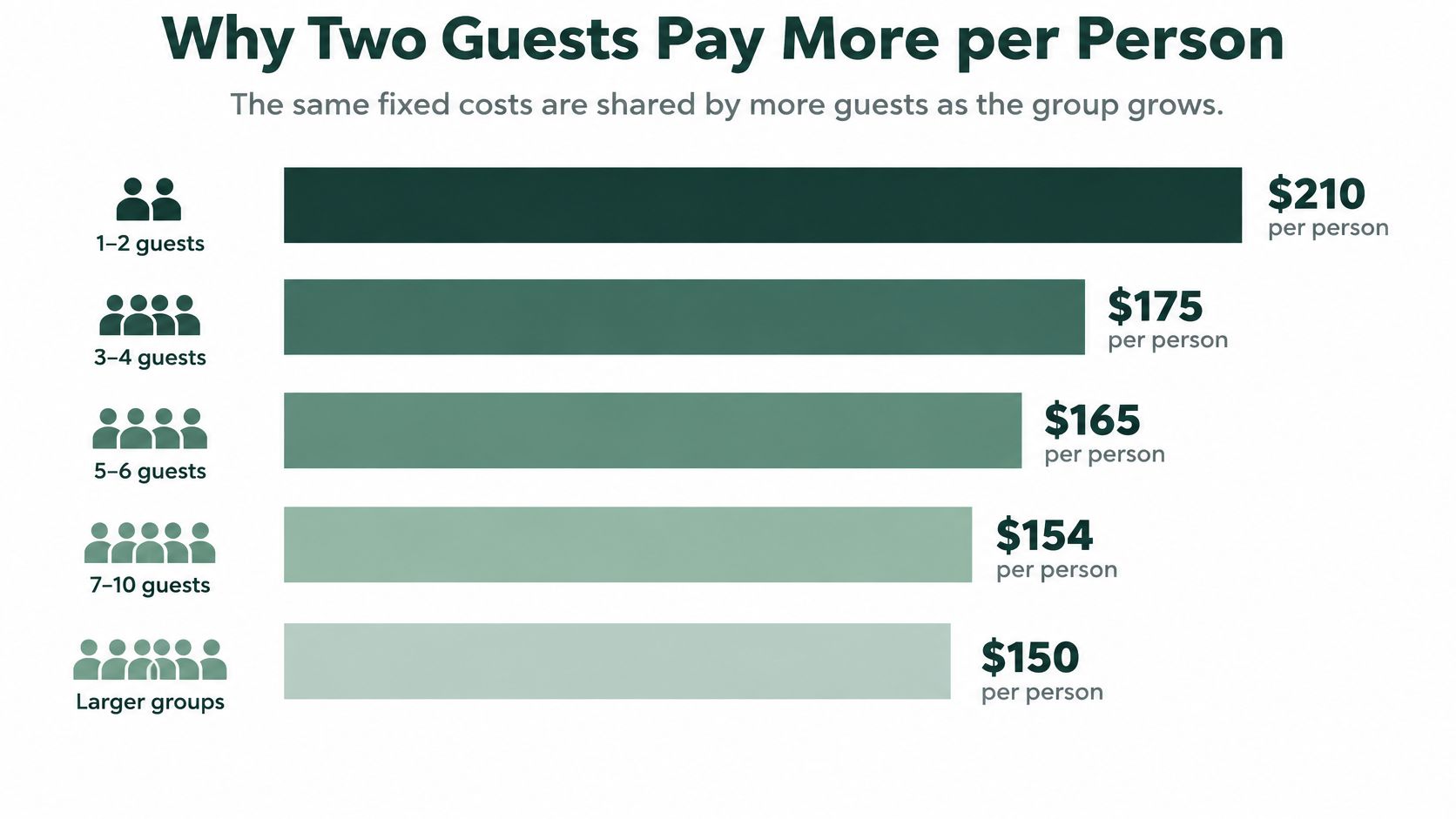
| Party size | Median per guest |
|---|---|
| One or two guests | About $210 |
| Three or four guests | About $175 |
| Five or six guests | About $165 |
| Seven to ten guests | About $154 |
| Eleven or more guests | About $150 |
The workload that doesn't shrink
A two-person booking still requires consultation, purchasing, mise en place, cooking, service and post-meal cleanup. Those tasks don't scale down proportionally with guest count. The chef drives to the market either way, breaks down the same case of fish either way, and washes the same pans either way.
Run it as a hypothetical. Say the fixed labor on a booking comes to $500. Two guests carry $250 each. Six guests carry about $83 each. Nothing about the food changed; only the number of people sharing the invoice did.
That's why the per-person figure is a poor proxy for quality. A couple paying $250 a head isn't buying better ingredients than a party of eight paying $150. They're buying a larger share of the same working day.
What the city averages tell you
City-level averages reported for Los Angeles, Miami, Chicago, New York and Houston range from $185 to $242 per person, per the same Take a Chef overview. That spread is narrower than most couples expect, which is useful: a quote far above the top of it should be explained by scope, credentials or sourcing, not by the city name alone.
When two quotes for the same menu differ by a wide margin, ask both chefs how many hours they've priced and what those hours include. The answer usually explains the gap faster than any discussion of ingredients.
For a luxury itinerary, this reframes the purchase. You're reserving a chef's full working block for a very small party, and the per-guest rate should be read with that in mind before you start comparing providers.
What the Price Covers in Labor, Ingredients and Overhead
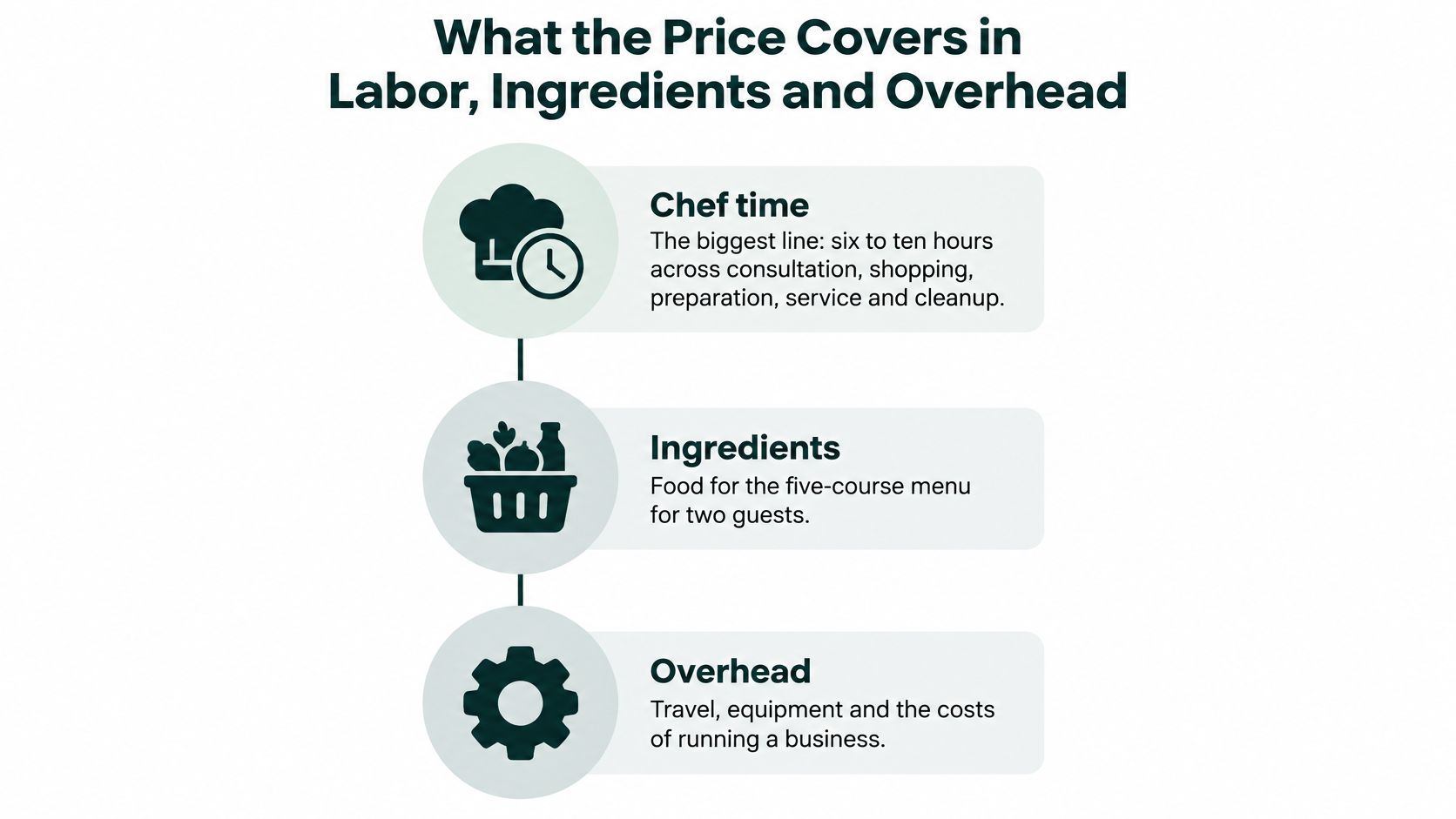
Chef time can outweigh the food itself: Haute Black's breakdown of private chef dinner costs for two describes six to ten hours of work, a representative $125 hourly rate, eight hours produces $1,000 in labor, and ingredients costing roughly $80–$250 for two.
That labor example excludes transportation, rentals and taxes. It also explains why a menu's ingredients are a poor guide to the payable total. Fine-dining proteins, specialty produce and premium seafood account for only part of the booking; consultation, purchasing, preparation, service and cleanup account for the chef's time.
| Component | How it is priced | What to compare for two |
|---|---|---|
| Chef time | Hours covering consultation, shopping, cooking, service and cleanup | Whether the fee covers the complete working block |
| Ingredients | Menu-dependent food allowance | Which proteins, produce and seafood are included |
| Travel and setup | Flat fee or mileage, plus kitchen setup | Whether distance and kitchen access add charges |
| Service staff and rentals | Additional servers, equipment and tableware | Whether staff and rental items sit outside the chef fee |
Restaurant pricing also has to cover food and labor before occupancy, equipment, administration and profit. Those 28–35% of revenue to food and 30–35% to labor benchmarks, with a combined prime-cost burden near 60–70%, illustrate the same underlying pressure: food purchases are only one part of operating a dinner service.
For a couple, the practical question is how much of that operating cost the quoted fee already absorbs. A small party has fewer guests sharing the chef's working block, so reducing ingredient spend may leave much of the bill unchanged.
Compare scope before comparing headline prices. Ask whether each quote includes the same labor, setup, staffing and equipment. An all-in fee and a base chef fee are not equivalent offers, even when their menus look similar.
Menu Choices That Move the Price Most
Two menus can carry the same per-person rate and still land at very different totals once you count what each asks the kitchen to do. Course count is the lever with the largest effect, because each additional course adds prep, plating and a service pass. A three-course menu and a five-course menu can use similar ingredients and still price differently, since the chef is billing hours, not plates. Decide the course count before you discuss proteins.
Restaurant menus run on the same arithmetic. For what a shared-plates format looks like on a card, see the lunch specials in Little Italy: a short list of dishes built to share rather than a fixed sequence of courses. A private-chef quote prices the same way, so every course you add is labor before it is food.
Wine is the next decision, and it's usually a separate line from the chef fee. A pairing across five courses means several bottles opened for two people, most of which won't be finished. A larger table stretches the same bottles further; a table of two absorbs the full cost of every cork. One good bottle, or a house wine the chef selects to match the menu, keeps the evening intact and the total lower.
| Menu choice | Effect on price | Lower-cost option |
|---|---|---|
| Number of courses | Each added course adds prep, plating and service time | Three courses instead of five |
| Wine pairing | Often billed separately from the chef fee | One bottle or house wine |
| Rare or out-of-season ingredients | Raises ingredient cost and sourcing time | Seasonal local produce |
| Dietary adaptation | Requires separate prep and planning | Shared base menu with adjusted components |
| Restaurant-style plating and staffing | Adds labor and extra service staff | Family-style service |
Sourcing and dietary requests
Rare products cost twice: once at the counter and again in the hours spent finding them. Ask the chef what's good at the market that week and build the menu around it. In Northern Spain that approach is the point rather than the compromise, and our explainer on farm-to-table dining in Northern Spain shows why seasonal local sourcing produces a better plate than an imported specification.
Dietary adaptation is where a small menu gets expensive, and where a couple can end up less efficient to serve than a bigger party. Two entirely separate menus mean two prep tracks running in parallel inside the same block of chef time. A shared base with adjusted components, one sauce held back, one portion finished differently, keeps the workload close to a single menu. A larger party eating one menu uses the kitchen once; a couple eating two menus uses it twice.
Service style is the last lever and the easiest to change. Individual plating with a second pair of hands in the room adds labor; the same food served family-style in wide bowls doesn't. If you want restaurant precision, price it deliberately and expect the quote to reflect the extra staffing. If you want a relaxed evening, family-style is often the better dinner anyway.
The Minimum Charge That Can Undo a Small Menu
A dinner for two isn't a discounted private event. It can be the least efficient booking a chef takes all week, and the minimum charge is where that becomes visible.
Published 2026 estimates place a romantic dinner for two at roughly $250–$350 per person because a minimum of about $500 may apply, while other references report booking minimums of approximately $400–$700 regardless of guest count, according to Plates Full's 2026 private chef cost guide. A separate example in the same guide lists a $1,000 chef-service minimum even for groups smaller than eight, with groceries and gratuity added separately.
Divide the minimum by the headcount
That last figure is the one to sit with. A $1,000 service minimum split across two diners is $500 per person before a single ingredient is bought. The same minimum split across seven diners costs each of them a fraction of that per head. The chef's workload barely moved. The invoice per head moved by a factor of three and a half.
This is why simplifying the menu sometimes changes nothing. If you're already at the floor, cutting a course reduces the chef's ingredient spend but not the amount you owe. You've paid for a block of time, and you may as well use it.
A minimum isn't a hidden fee when it's written down. It's a pricing structure, and it tells you the chef sells days rather than plates.
Travel works the same way. The Plates Full guide cites $100–$400 flat travel fees or $1–$3 per mile, which is a fixed cost attached to the booking, not to the guest count. Two people at a remote property absorb all of it.
Three checks before you accept a per-person quote
- Is it a floor or a rate? Ask whether the number is a labor minimum that applies regardless of headcount, or a genuine per-guest price that falls if you add diners. The two produce very different totals for a couple.
- What would four cost? Request the total for four guests on the identical menu. If it's close to the two-person total, you've found a minimum, and you'll know exactly how much of your bill is fixed.
- What sits outside it? Groceries, gratuity, wine, travel and rentals are commonly excluded from a service minimum. Get each one named, with a figure or a pricing rule attached.
The better question isn't what dinner for two costs. It's what the minimum includes, and what would change if the same chef served four.
Location, Travel and the Payable Total
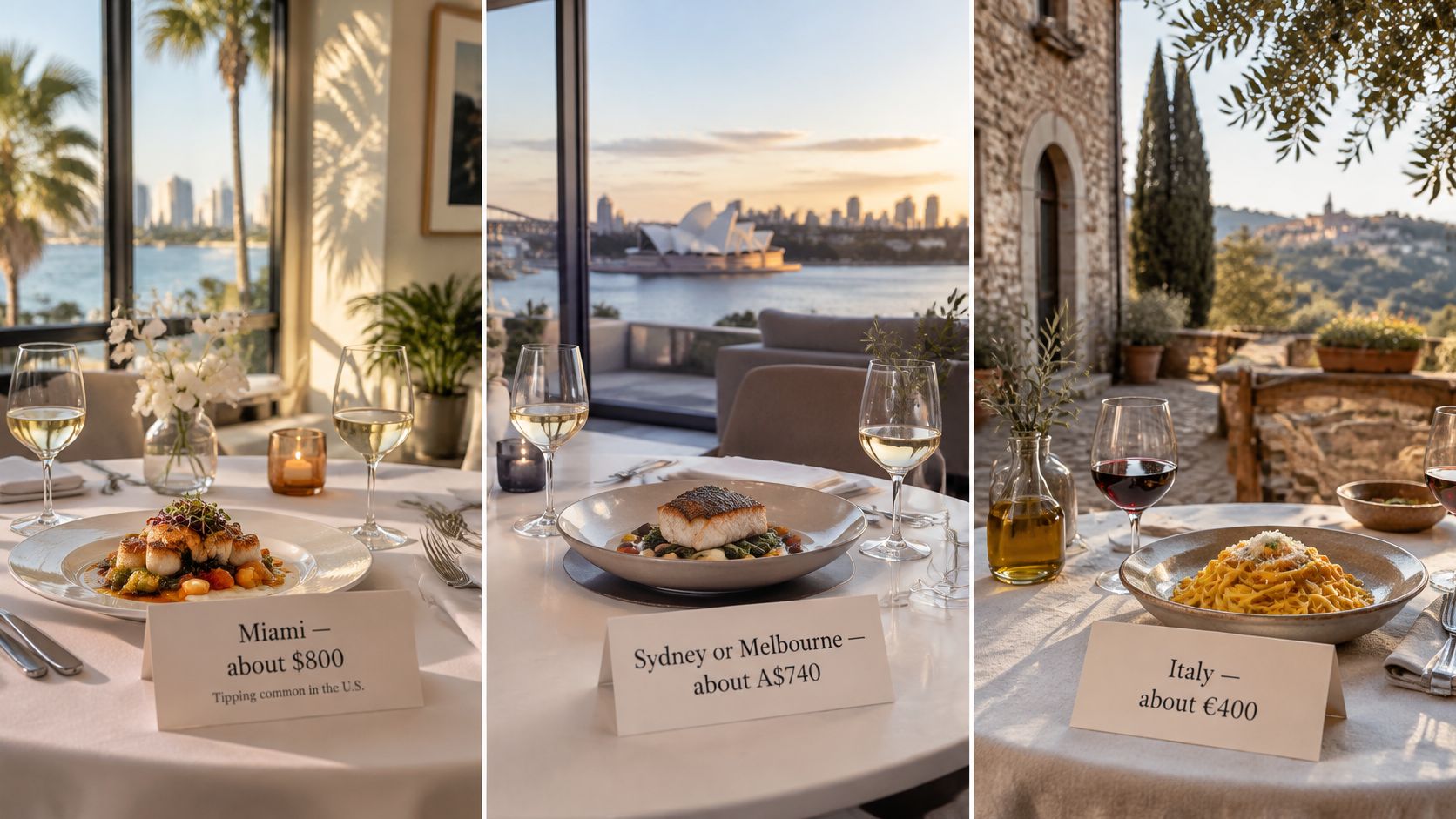
The same menu ends at very different bills in different markets, and the reason isn't only the price level. One 2026 comparison lists a five-course dinner for two at about $800 in Miami, A$740 in Sydney or Melbourne and €400 in Italy, noting that US diners commonly tip while tipping is less expected in Australia and Italy, in Chef on Demand's 2026 guide to hiring a private chef for a night.
Here's how those three markets sit side by side.
| Market | Five-course dinner for two | Tipping expectation |
|---|---|---|
| Miami, United States | About $800 | Tipping is common |
| Sydney or Melbourne, Australia | About A$740 | Tipping is less expected |
| Italy | About €400 | Tipping is less expected |
Price architecture matters more than the currency
Four questions decide whether a quote is all-in. Are groceries marked up or passed through at cost? Does the chef's fee include table service and cleanup, or only cooking? Is tax embedded in the figure or added at invoicing? And does a service charge already replace gratuity?
Couples arriving from the US often assume a percentage tip is expected in Northern Spain, or read a quoted chef fee as the complete experience price. Both assumptions distort the comparison before it starts.
Build the payable total line by line instead, and label each part:
- Chef minimum: fixed, and the largest single line on most two-person bookings.
- Ingredients: variable with the menu, passed at cost or marked up depending on the chef.
- Travel: fixed for the booking, either a flat fee or a mileage charge.
- VAT or local taxes: fixed as a rate, variable as an amount, and sometimes already inside the quote.
- Beverages, extra staffing and equipment: optional, and the lines most often missing from a headline price.
- Gratuity: discretionary in some markets, customary in others.
This short walkthrough shows what a chef-led evening looks like in practice, which helps when you're deciding how much service you want in the room.
One last asymmetry: personalization raises labor without raising headcount. Rare products, dietary adaptation, restaurant-quality plating, wine pairing or cooking in a hotel suite with limited equipment all add hours for the same two diners. That's the main driver behind a destination quote, and it's why a single global average tells you almost nothing about your evening.
Confirm the Quote Before You Book
The decision point is the payable total for two, not the headline per-person rate. Two diners are the least efficient group size for a private chef evening because fixed labor, travel and setup costs are spread across the smallest possible table. Ask direct questions before comparing offers.
- Chef hours and rate. Get the number of hours priced and the hourly figure, so you can see whether the labor line reflects a short evening or a full working day.
- Ingredient estimate. Ask for the food estimate attached to your actual menu, and whether it's billed at cost or as a flat allowance.
- Travel and kitchen setup. Confirm any flat fee or mileage charge for the property, and ask what the chef needs on site: burner count, oven, fridge space, work surface.
- Tax and service charge. Establish whether VAT or local tax is inside the quoted figure, and whether a service charge already covers gratuity.
- Wine, rentals and extra staff. Each should appear separately from the chef fee, with a price or a clear pricing rule.
- The total for two. This is the only figure that survives different minimum structures, so it belongs at the center of the comparison.
Set a ceiling before you contact chefs, not after. A ceiling forces useful trade-offs. The fifth course or the second server looks different when you can see what it does to the full two-person total.
There's also a format that can reduce the travel and kitchen-setup problem. One type of experience is sharing a meal with a chef in their own kitchen. That puts you at the chef's table and avoids cooking in an unfamiliar property. Northern Spain Travel also designs fully private journeys with no planning fees, including options with private drivers and local cultural storytellers.
If you're weighing a chef's evening against a restaurant booking on the same trip, our guide to securing fine dining reservations in Northern Spain explains how the two fit together on an itinerary.
Northern Spain Travel designs private, tailor-made journeys across the Basque Country, La Rioja, Navarra, Cantabria, Asturias and Galicia. Chef-led dinners can form part of those journeys, including chef-led dinners in boutique hotels and chefs' own kitchens. Share your dates and menu preferences, and start the conversation before you set your maximum total for the evening.