530,987 pilgrims received the Compostela in 2025, a 6% increase on the 499,239 who collected one in 2024, according to CaminoWays' summary of the Pilgrim Reception Office statistics. A number that size makes the Camino sound like a single procession heading west. It isn't. The routes differ so sharply in terrain that a plan built for one will fail on another.
The Camino del Norte punishes assumptions. It has no alpine pass and no altitude to acclimatise to, so walkers arrive expecting a coastal stroll and find a route that climbs and drops three or four times before lunch. Distance looks manageable on paper. The climbing is what empties the legs, and the gaps between villages decide whether a bad afternoon stays manageable.
This Camino del Norte guide is built the way a route planner builds one: fix the daily pace from the climbing load, lay the stages over it, then use private transfers only where the terrain or the timetable earns them.
Table of Contents
- Camino del Norte Stages at a Glance
- Why Climbing Sets Your Daily Pace
- Getting to Irún and Finishing in Santiago
- How to Plan Each Walking Day
- Where to Stay and How Far Ahead to Book
- Private Options for a More Comfortable Walk
- Plan Your Private Camino del Norte Journey
Camino del Norte Stages at a Glance
The route covers about 815–832 km from Irún to Santiago de Compostela, with roughly 14,400–14,700 m of cumulative ascent and a high point of 708 m above sea level, according to the Camino del Norte elevation profile. The stage data show three different planning pressures: heavy climbing at the start, long distances through Cantabria and Asturias, and a steep inland finish in Galicia.
| Stage | Distance | Ascent | Planning note |
|---|---|---|---|
| Irún to San Sebastián | 24.5–25 km | 596–789 m | Substantial first climbing day |
| San Sebastián to Zarautz | 22–22.3 km | 471–494 m | Moderate coastal day |
| Zarautz to Deba | 22 km | 636–669 m | Short distance, heavy ascent |
| Deba to Markina-Xemein | Under 30 km | About 700 m or more | Strong candidate for a private transfer |
| Markina-Xemein to Gernika | Under 30 km | About 700 m or more | Strong candidate for a private transfer |
| Gernika to Bilbao | 32 km | Rolling hills | Long day; consider splitting |
| Portugalete to Castro Urdiales | 32 km | Coastal ups and downs | Long coastal day |
| Santander to Santillana del Mar | 36 km | Mild road and field grades | Longest distance in this list |
| Llanes to Ribadesella | 30 km | Undulating coast | Long coastal day |
| Luarca to La Caridad | 30.5 km | Rolling, one steep pull | Long day with limited late-day transport |
| Ribadeo to Lourenzá | 27 km | 678 m | Coast gives way to inland Galicia |
| Lourenzá to Abadín | 26 km | 798 m | Steepest listed stage |
The opening stages make distance a poor guide to effort. Irún to San Sebastián is a hill day, despite being about 25 km, and Zarautz to Deba packs 636–669 m of ascent into 22 km. Walking both at full length can leave little capacity for the rest of the first week. Set a sustainable pace around climbing before choosing how many kilometres to cover.
Two transitions around Markina-Xemein each involve roughly 700 m or more of ascent, while Lourenzá to Abadín reaches 798 m over 26 km. That inland stage is the steepest in the table. These are the rows where shortening a day or arranging a private transfer may have more value than reducing distance on a relatively level stretch.
Long stages create a different constraint. The Santiago.es route overview lists Gernika to Bilbao at about 32 km, Santander to Santillana del Mar at about 36 km, and Ribadeo to Lourenzá at roughly 27 km with 678 m of ascent. The first two demand attention to distance and timing; Ribadeo to Lourenzá combines a shorter day with a significant climb. Plan each according to its actual load, rather than treating every long or steep stage as the same problem.
Use the table as a shortlist, not a fixed schedule. A long distance, heavy ascent or limited late-day transport can each justify splitting or shortening a stage. For a separate example of sequencing a variant route village by village, see the Camino del Baztan stage-by-stage breakdown.
Why Climbing Sets Your Daily Pace
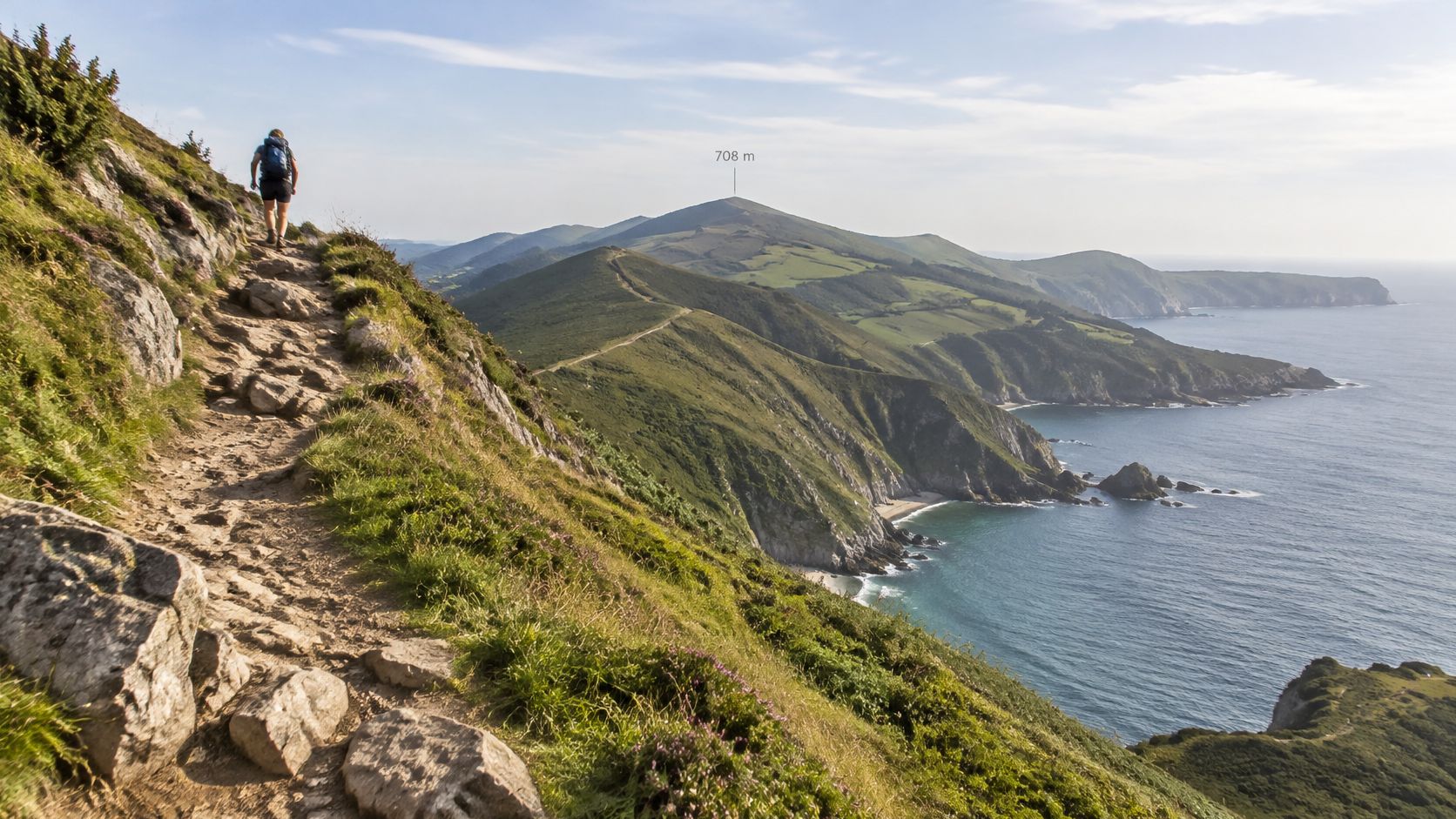
A high point of about 708 m sounds like a gentle route until you look at the total. Route measurements compiled in the Camino del Norte elevation profile put cumulative ascent at roughly 14,400–14,700 m across the 815–832 km between Irún and Santiago de Compostela.
That combination, low ceiling and enormous total, is what makes the Norte tiring. There's no single climb to train for and no altitude to acclimatise to. There are dozens of short, sharp efforts a day, linked by uneven coastal paths and descents that never let your legs settle into a rhythm.
The Basque opening proves the point. Irún to San Sebastián covers about 24.5–25 km with 596–789 m of ascent. San Sebastián to Zarautz is about 22–22.3 km with 471–494 m. Zarautz to Deba is about 22 km with 636–669 m. Three days, roughly 69 km, and somewhere between 1,700 and 1,950 m of climbing, none of it delivered as one memorable mountain.
Compare that with an alpine route where a single 1,200 m pass defines the day. You know when it's coming, you eat before it, and you recover after it. On the Norte the load arrives in fifteen-minute bursts, and every descent that follows lands on knees and quadriceps while your heart rate is still high.
Planning rule: if a day clears 700 m of ascent, decide how you'll cover it before you choose where you sleep. That decision is cheaper at a desk than in a village at seven in the evening.
A 20–25 km day with 500–700 m of ascent is a substantial walking day. Hold it as a working benchmark rather than a target to beat. The steepest Basque transitions, at roughly 700 m or more, are exactly where a private vehicle earns its keep and where a shortened walk protects the following week.
Matching a Pace Profile to the Group
Three profiles cover almost every group, and one of them has to be chosen before stage planning starts, because it changes trip length, luggage logistics and how many beds you reserve.
| Pace profile | Daily walking | Stage approach |
|---|---|---|
| Full walking | 20–25 km with 500–700 m ascent | Walk most stages and transfer only the hardest |
| Balanced | 15–20 km | Walk the coastal stages and add one cultural visit a day |
| Selective | 10–15 km | Pair short walks with chef-led meals, wineries and heritage sites |
Full walking demands recovery discipline: early starts, feet dry by mid-afternoon, and a rest day roughly every week. The selective profile runs the other way and makes daily luggage transfers a necessity, because much of the route is covered by vehicle and only the best sections are walked.
Watch three signals as the days accumulate. Sore knees on descents mean downhill load is outrunning recovery. Slow recovery after back-to-back climbing days means the pace profile is wrong, not that you need more willpower. Blisters on wet, uneven paths come from feet that never dry out, which is a sock and footwear decision rather than a fitness one.
Age, recent training, recovery needs and the spread of paces inside the group settle the argument. Groups that disagree still sleep in the same village, so profiles can only be mixed where the overnight stop is shared and the vehicle collects walkers at an agreed point.
The footage below shows what the coastal path looks like underfoot on a normal walking day.
Getting to Irún and Finishing in Santiago
Fix the trip length before booking a single bed, because it follows from the pace profile rather than from the holiday you have available. At 20–25 km a day, the route's 815–832 km works out at roughly 33–42 walking days. At 15–20 km a day it runs to about 41–55 days, and at 10–15 km a day it stretches to roughly 55–83 days.
Starting in Irún. Fly into San Sebastián or Biarritz and take the local train to Irún or Hendaye, then check the last connection times from your arrival city before you commit to a flight. A late arrival that misses the last train costs you the first stage, which is the worst one to lose because the Basque hills don't forgive a rushed start. Book the first night in Irún or San Sebastián and give yourself the evening to sort water, cash and a working map.
Finishing in Santiago de Compostela. Reserve the final night early in summer, when beds near the cathedral are the hardest in Spain to find at short notice, and collect the Compostela from the Pilgrim Reception Office once you arrive. Book onward travel for the day after you finish rather than the day itself, because the last stage habitually ends later than planned. If the final approach matters more than the distance, a route built around the last 100 km into Santiago shortens the walking without losing the arrival.
Three buffers make the difference between a plan and a hope:
- One spare night in the last third of the route, so a delayed stage or a missed booking doesn't break your flight home.
- One afternoon with nothing scheduled in Santiago, because arrival day is slower than the map suggests.
- One written record of the trip length on your planning sheet before any accommodation is booked.
How to Plan Each Walking Day
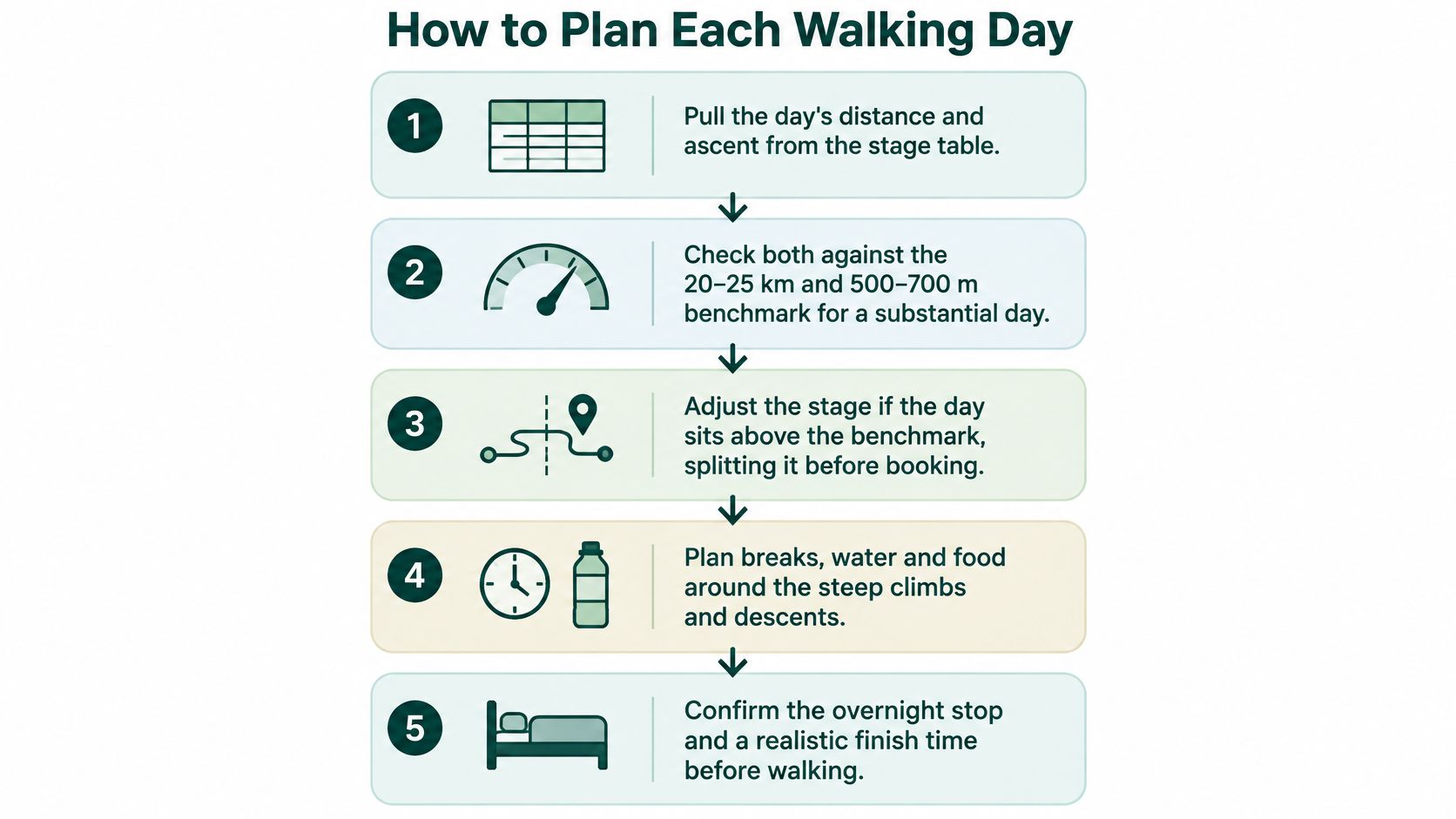
A single day takes about twenty minutes to plan once you have the numbers. Work through these steps in order, because each one narrows the next.
-
Pull both numbers, distance and ascent. Distance alone flatters the hard days, and a short stage with heavy climbing can cost more than a long one on rolling coast. Write both figures down before judging the day. Published village-to-village guides carry them, and the Camino Forum store's guide collection listed a Camino del Norte village-to-village guide from $15.00 in 2024.
-
Flag the day against the benchmark. Anything clearing about 700 m of ascent or 30 km gets marked as a split candidate. The flag isn't a verdict, it's a prompt to look harder at the afternoon.
-
Check the last third of the stage. Service intervals on the Norte are uneven, and the longest days are precisely where the last café sits far from the finish. Identify the final village with food, water or a bus stop, and note the time you expect to reach it.
-
Choose the fix. Shorten the walk, move the overnight to a different village, or put a private transfer over the least rewarding stretch. The third option is the one walkers forget, and it's usually the cheapest way to keep a good stage good.
-
Confirm the bed before you book the bag. Accommodation is the thing most likely to fail in high season, and a luggage transfer to a village with no room is a wasted booking. Lock the room, then tell the transfer company where the bag goes.
-
Write the end-of-day plan. Expected arrival time, a named backup stop if you're running late, and the host's phone number on your screen. Three lines save an hour of standing in a doorway at dusk.
What a Finished Day Plan Looks Like
A completed plan reads in one line: walk the first 18 km, stop at the village with the bus stop, transfer the exposed road section, arrive by 15:30, dinner booked at 20:00. Each element is checked against something real, and nothing depends on a shop being open when you arrive.
Practical rule: if the day plan has no named backup stop, it isn't finished.
Pack for the plan rather than for the route in general, and start with the Northern Spain packing guide for 2026 if wet coastal paths are new to you.
Where to Stay and How Far Ahead to Book
The Camino del Norte carries a small share of total Camino pilgrims, but demand concentrates in coastal resorts, where walkers and Spanish families seeking summer holidays compete for the same rooms. The pressure is local, not evenly spread along the route.
Many villages have fewer accommodation options than busier inland routes. You may find one albergue and a handful of guesthouses rather than a row of places to stay. That makes availability, especially on the coast, a more useful planning constraint than price alone.
| Option | Best for | Booking window | Trade-off |
|---|---|---|---|
| Albergue | Budget walkers with flexible plans | Often first-come outside peak weeks | Shared rooms and limited services |
| Guesthouse or pension | Mid-range walkers | Book ahead in summer | Facilities vary by village |
| Boutique hotel | Comfort-focused travelers | Book weeks ahead in peak season | Few rooms, sells out early |
| Coastal resort hotel | Beach-season trips | Book months ahead in summer | Pilgrim demand overlaps beach tourism |
| Rural casa | Quiet, scenic stops | Book early | Limited transport to and from the route |
Prioritize coastal and distinctive places to stay, which can fill before inland beds. Confirm that an albergue offers private rooms if you need one, since some have dormitories only. For a village off the main route, check late-day transport before booking. On longer stages, reserve the next night before setting out. If a village has just one hotel and no late bus, arriving without a booking can mean arranging an expensive transfer.
Four Questions to Ask a Host
Call the host rather than relying only on a booking form. A few practical answers can shape the day's timing and backup plan.
- Check-in hours: Can someone hand over a key after 18:00 if the stage runs long?
- Luggage handling: Does the property accept bag delivery, and who signs for it?
- Breakfast time: Is breakfast available early enough for a 7:00 start on a climbing day?
- Taxi arrangement: Which local firm does the host use, and what number should you call for a late pick-up?
Private Options for a More Comfortable Walk
Private support isn't one product. Four arrangements cover most requests, and they differ in what they take off your plate and what they cost you in flexibility.
| Option | What it covers | Best for | Trade-off |
|---|---|---|---|
| Self-guided with luggage transfer | Walk your own stages while bags move to each overnight stop | Independent walkers who want flexibility | You manage bookings and route changes |
| Private driver on hard transitions | A driver moves you past the steepest or least rewarding sections | Walkers who want full days on the coast | Less time on the trail |
| Private guide on walking days | Guided walks with local history and access to people and places | Travelers who want depth and context | Set schedule with less flexibility |
| Fully planned private journey | Accommodation, transport, guides and experiences arranged end to end | Travelers who want no logistics | Higher cost and more advance planning |
The decision rule is where most itineraries go wrong. Match the support to the stages, not to the trip. Put a driver on Deba to Markina-Xemein and Markina-Xemein to Gernika, and you keep your full walking days for the coast between Zarautz and Deba, where the scenery pays for the effort. Put a driver on the whole route and you've bought a car journey with occasional walks.
The same logic applies to the days that are long rather than steep. A transfer over an industrial approach or a featureless road section buys back an afternoon, and an afternoon in Bilbao, Santillana del Mar or Ribadesella is worth more than the kilometres it replaced. Guides work best on the days you walk, where a morning of local history turns a stretch of coast into something you remember.
The moment that separates providers is the one nobody plans for. A delayed transfer, a closed hotel or a stage abandoned at noon needs an answer within minutes, not an email the next morning. Northern Spain Travel provides 24/7 on-the-ground support during journeys, which is the part of the service that only matters when something goes wrong.
The right mix is usually a handful of planned transfers, one guided day, and a luggage service running in the background.
Plan Your Private Camino del Norte Journey
Start with three pieces of preparation, because they're what any planner needs before a route can be shaped.
-
List the experiences you won't give up. A cellar visit in Rioja, a Michelin-starred dinner in San Sebastián, the Guggenheim, a specific church or a coastal walk you've read about. These anchor the itinerary more than any stage table does.
-
Note your dates, your party and the pace mismatch. Two travelers at different speeds change the plan more than any other single factor, and it's better stated now than discovered on day four.
-
Choose a pace profile and mark the stages. Note what you walk, what you split and what you transfer. That list is the working document for everything that follows.
From there, the conversation runs in a fixed order. To book, the client shares must-have experiences, dream destinations, preferred travel dates and the style of journey they imagine, and Northern Spain Travel then designs a personalized draft itinerary from that checklist. The team manages every detail from first contact until the client returns home, including accommodation, transport, logistics, luggage, guides and experiences.
Reach the planners by phone at +34 747 473 529 or through the Enquire Now and Request a Private Consultation buttons. Send the completed checklist before you reserve a single bed, and the stages follow from the trip you want rather than the other way around.
A Camino del Norte journey works best when the walking, the beds and the transfers are designed together, and that's what Northern Spain Travel builds for travelers who want the coast, the climbs and the tables along the way without carrying the logistics themselves. Every itinerary is private and thoughtfully planned, from selected walking stages and luggage transfers to guided days with the history and the people behind each village. Share your dates, your must-have experiences and your pace, and the team will draft the route around them.