Napa Valley drew approximately 3.7 million visitors and about $2.5 billion in visitor spending in 2023, and Spain's organized Wine Routes logged 3,076,334 winery and museum visits in 2019, according to compiled wine tourism statistics. Almost every one of those visits runs on the same activity, a hosted tasting.
A private wine tasting event narrows that activity down to one party. Your group, your host, your pace, your theme. The wine doesn't change much, but the design decisions multiply: which format, which room, what temperature, how much goes into each glass, and what the guest who isn't drinking gets to hold.
Most planning advice treats serving temperature, guest moderation and sustainability as finishing touches. In a properly built tasting they're structural. They get decided at the same moment as the guest list and the venue, and they're painful to retrofit later.
Table of Contents
- Private Tasting Formats Compared
- Settings That Shape the Experience
- Serving Temperatures for Each Wine Style
- How a Private Tasting Unfolds, Step by Step
- Matching the Tasting to Each Guest
- Planning Logistics and Sustainable Choices
- Confirm Your Format Before You Book
Private Tasting Formats Compared
A private tasting is a session reserved for one party, with the host, the pours and the pacing set for that group alone. It isn't a public tasting with fewer chairs.
Tasting sits at the centre of the whole sector. In a 2025 international study covering 1,310 wineries in 47 countries, wine tastings were the most popular activity, selected by 56% of respondents across both European and overseas markets, as recorded in the Global Wine Tourism Report findings. The same research found that 52.9% of overseas wineries reported offering private events, a statistically significant difference from European respondents at p < 0.01.
That gap tells you something useful. Outside Europe, the exclusive format has already become a standard product line rather than a special favour. Treat it as a commercial service when you plan: you set the terms, and the format is the first term to fix, because pour size, serving temperature and even how many glasses end up in the recycling all follow from it.
Six formats and who each one suits
| Format | Typical group size | What it includes | Best for |
|---|---|---|---|
| Seated flight in a tasting room | 2-12 guests | 4-6 wines in 40-50 ml pours, with water and bread | Couples and small celebrations |
| Cellar tasting with a winemaker | 2-8 guests | Barrel or cellar visit, library wines, winemaker commentary | Serious wine lovers |
| Vineyard walk with tasting | 2-10 guests | Guided walk among the vines, tasting at the row ends, light lunch | Active travelers and daytime events |
| Food-paired tasting | 4-14 guests | Wines matched to each course, with the host or chef explaining pairings | Milestone dinners and gastronomy groups |
| Hands-on cooking session with wine | 4-12 guests | Cooking in a private kitchen, shared meal, wines served alongside | Multigenerational groups and families |
| Home-hosted tasting | 4-20 guests | Host-led flight in a private house, catered or home-cooked food | Private reunions and corporate hospitality |
The study also tracked culinary pairings, wellness programs and cultural events as growing complementary formats. That explains why food-led options now appear on nearly every private list, and why a plain seated flight can feel under-designed next to them.
Each format also carries hidden design choices. A seated flight keeps pours small and easy to moderate, because a spittoon and a water jug sit naturally on the table. A vineyard walk does the opposite: glasses travel, spitting feels awkward, and sun exposure warms the wine in the glass within minutes, so whites and lighter reds cope better there than heavily structured bottles. A home-hosted tasting gives you full control over the fridge and the glassware, but no cellar door team behind you, which means chilling bottles, timing the pours and clearing empty glasses all become your logistics.
Read the table in one direction only. Choose the format first, then the venue that can deliver it. Format sets group size, pace, how much food arrives, and how much walking or cooking the group does. Groups that pick a venue first usually end up with a room that's too large or a flight paced too fast. If you're comparing single-estate options, exclusive winery gatherings in Carneros shows how one property splits seated flights, villa space and larger group formats into distinct products.
Settings That Shape the Experience
Where a tasting happens changes what guests remember, and it also changes what the host can physically control: room temperature, noise, daylight, and the distance to the nearest kitchen.
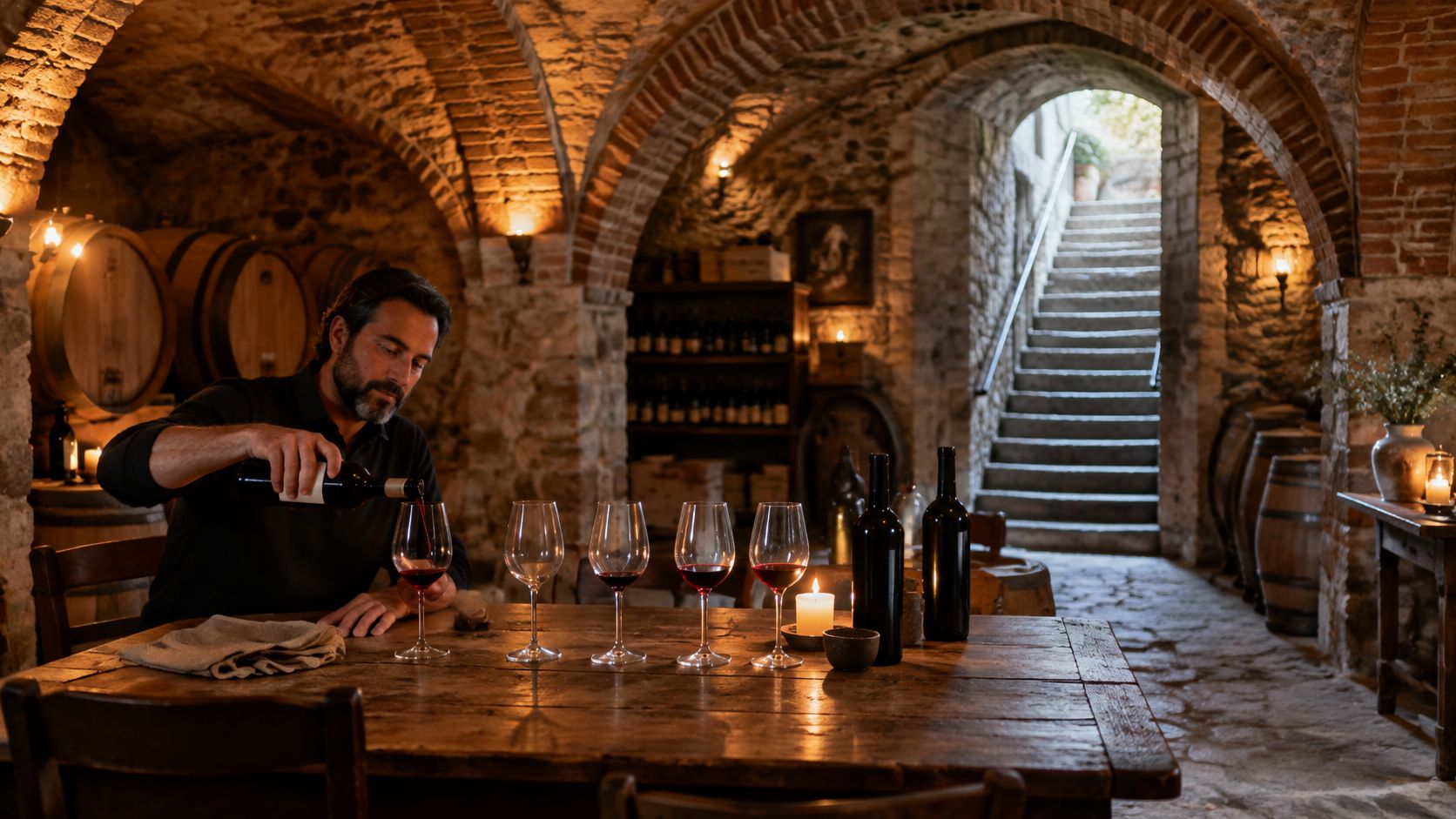
A cellar cut into the earth
There's a reason wineries dig their tasting rooms into hillsides. Stone and earth hold a steady temperature, the light is soft, and the room does half the storytelling for you. On the first day of our Wine & Waves journey, guests walk into cellars carved beneath the earth, then a wine museum, then sit down with a local artist, which stacks three kinds of context into one afternoon.
The trade-off is physical. Cellars mean stairs, damp air, low ceilings, and sometimes a walk through cold air between buildings. Anyone with mobility limits, a dislike of enclosed spaces or a thin jacket needs to hear that before the day.
Old barrels and a final bottle
A historic cellar gives you a different scene: the last bottle opened among old barrels, echoing stone, a host who has told the story a thousand times and still enjoys telling it. Sound bounces badly in these rooms, so keep the group small enough to hear without raised voices and place the speaker against something soft rather than a barrel head.
Vineyard, estate and hill town
A private estate with vineyard rows, a cellar tour and lunch served outdoors does one thing better than any indoor format, which is place. It also depends entirely on weather. A medieval hill town or a historic wine street adds atmosphere and a walk between stops, and takes away your control of noise, crowds and shade.
Practical rule: ask two questions before confirming any setting. What is the room or cellar temperature, and what is the indoor alternative if the weather turns.
A home, a villa, a hired sommelier
The format growing fastest among private groups is the villa tasting, with a sommelier or chef coming to the house. No driving after the last pour, total control over food, and a room guests already feel comfortable in. What you lose is production. No barrel room, no vineyard view, no winemaker drifting in mid-flight unless you pay for the visit. Our insider's guide to private winery tours in Spain explains how those settings differ between regions.
The setting should serve the wines, not compete with them. A room so dramatic that nobody looks at the glass has stopped being a tasting.
Serving Temperatures for Each Wine Style
Serving temperature is the cheapest and most controllable thing that changes what a wine tastes like. A controlled study of temperature and wine perception compared white wines served at 4°C, 10°C and 18°C and red wines at 14°C, 18°C and 23°C, and found that sensory attributes shifted with the thermometer rather than staying fixed.
The direction of the shift is consistent. Cooler samples were perceived as more sour, bitter, astringent, smooth and thin, while warmer samples expressed more aroma. Volatility, viscosity, acidity and tannin perception all move together as the glass warms.
The rule that replaces one fridge temperature
Don't pull every bottle from the same refrigerator and pour. Build a progression instead, colder at the start of the flight and warmer as the wines gain weight.
| Wine style | Serving temperature | Why it matters |
|---|---|---|
| Sparkling and light whites | 6-8°C | Lower temperature keeps acidity bright and aroma restrained |
| Fuller whites | 10-12°C | Slightly warmer serving opens aroma while keeping structure |
| Rosé | 8-10°C | Balances fruit with freshness |
| Light reds | 12-14°C | Keeps fruit lively and alcohol less prominent |
| Structured reds | 16-18°C | Warmer serving shows aroma; cooler serving reads more tannic and astringent |
| Full-bodied reds | Up to 18°C | Kept slightly below room temperature to avoid heavy, alcohol-forward notes |
Treat the ranges as a starting point, not a specification. An older white that has spent years in bottle often shows better a degree or two warmer than a young wine of the same grape, because the aromatics have developed and need the encouragement.
Tools that hold a temperature
Backup bottles belong in a wine refrigerator, not on the table. For service, an ice-water bath chills faster and more evenly than ice sitting directly on the glass, and it doesn't leave a puddle on the label. When the pacing slows, wrap the bottle in an insulated sleeve or move the wine into an insulated decanter so it doesn't climb four degrees during a long conversation.
Taste-check every bottle immediately before it's poured. Cellar temperature, transit time, glass volume and room conditions can move a wine several degrees, and you're the only person who can catch it. A short explanation of why the sparkling is colder than the Rioja also turns a control measure into something guests enjoy arguing about.
How a Private Tasting Unfolds, Step by Step
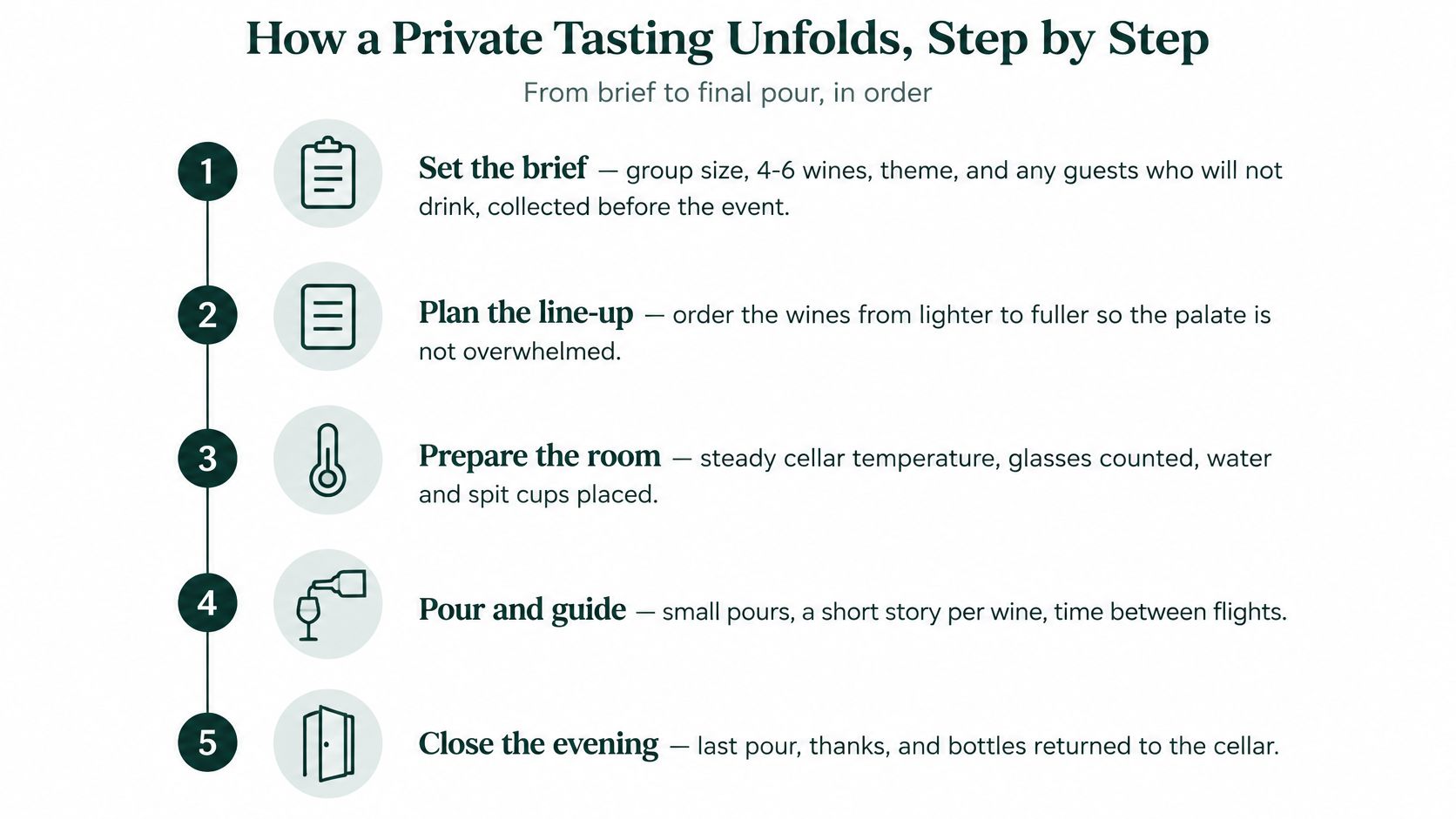
Order and volume are design decisions, not details. Guidelines for hosting safe and successful wine events put a standard tasting pour in an ISO tasting glass at approximately 40 to 50 ml, and recommend marked glassware or another visible measure so the number stays honest.
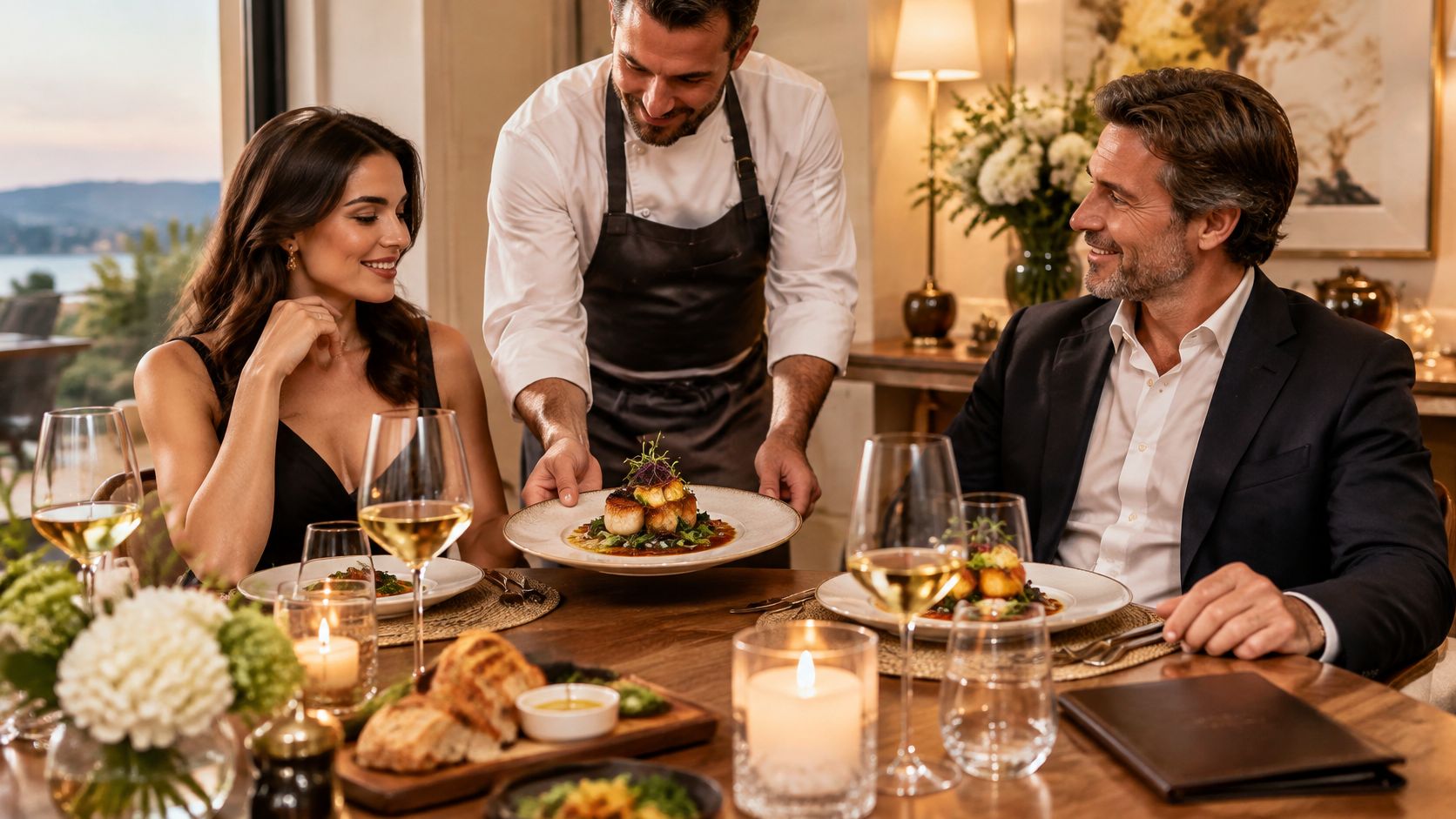
Treat the sequence like a well-set table. Each choice guides attention: what appears first, how much arrives in the glass, when the room pauses, and when the story ends.
The seven steps in order
- Set the brief before you buy anything. Group size, four to six wines, a theme, and the names of anyone who won't be drinking. Collect it a week out, not on the morning of the event. Moderation belongs in the plan at this stage, beside glassware and food, because it changes the flight you design.
- Order the flight from light to powerful. Sparkling and light whites first, then fuller whites, rosé, light reds, structured reds, and age-worthy or sweet wines last. Open the trophy bottle first and everything after it tastes thin. The sequence works like a dimmer switch, raising intensity slowly rather than flooding the room at the start.
- Set temperatures and taste-check each bottle. Work from the serving ranges for each style, then verify with your own palate, because the room will have moved things since delivery. Serving temperature is part of the design here, not a final adjustment made when a guest complains.
- Pour 40 to 50 ml into identical glasses within a flight. Mark the level discreetly so refills don't creep upward as the evening loosens. Keep the measure steady, and guests can compare wines rather than portions.
- Pause between flights. Water, neutral food such as bread, plain crackers and unsalted nuts, and ten quiet minutes. Palates reset better with a pause than with a bigger pour. The pause also gives guests room to speak without the host filling every silence.
- Use coded or unlabelled samples for comparison exercises. Standardized temperature and volume, with a randomized or balanced order, reduce order effects and expectation bias. Reveal the labels at the end. That reveal turns a simple comparison into a conversation about what people tasted.
- Close with something written. A short tasting note each guest fills in, plus any bottles they're taking home. It gives the evening a shape and gives the non-drinker something to contribute. Sustainability fits here too: reusable notes, shared bottles and a clear plan for leftovers make restraint feel intentional.
The arithmetic of a flight is worth doing before you buy. At 40 ml, six wines come to about 240 ml; at 50 ml, the same flight reaches 300 ml before any welcome drink or informal top-up.
| Wines in flight | Total at 40 ml | Total at 50 ml |
|---|---|---|
| 4 wines | 160 ml | 200 ml |
| 5 wines | 200 ml | 250 ml |
| 6 wines | 240 ml | 300 ml |
That difference matters for multigenerational groups, older guests, and any tasting followed by driving or a long dinner. Keep spit cups available without making them conspicuous, and place them where guests can reach them without announcing anything.
A well-paced flight has a rhythm you can feel. Nobody is rushed toward the next glass, guests start comparing notes with each other rather than with the host, and the room gets louder in a good way.
Matching the Tasting to Each Guest
Wine volumes are falling across the world's ten largest wine markets, with active moderation and fewer drinking occasions among the drivers, according to an analysis of global wine market trends. Some guests are drinking less while still paying close attention to quality. That changes the job of a private tasting. Moderation becomes a design choice, like serving temperature or sustainability, rather than a late adjustment.
The design question is practical. The guest who is not drinking should receive the same care, the same sequence and the same level of attention. Equal treatment here does not mean identical liquid in every glass. It means everyone can follow the same story and take part in the same comparisons.
The preference card that prevents most problems
Send a short preference card with the invitation. Ask what each guest drinks and avoids, any allergies, who is driving, whether anyone is pregnant or taking medication, and what the celebration is. Five fields take about two minutes to fill in. They prevent the awkward conversation at the table, when the host has already started pouring and the group has to stop to discuss who can drink what.
The card also helps the host plan moderation. If several guests are driving, the flight can be shorter or built with more pauses. If one guest avoids alcohol, a parallel pour can be ready before anyone sits down. The guest should not have to ask for a different path through the tasting.
Build a parallel flight, not a substitute
Alternate alcoholic and non-alcoholic pours through the same sequence, in the same glassware, with the same explanation for each. A serious non-alcoholic pairing, a good vermouth, a dry cider, or a well-made de-alcoholised sparkling can hold its place beside wine when the host presents it with the same conviction. Seat the group together, never at a separate end of the table. Let the non-drinker choose whether to spit, just as every other guest can.
A tasting that sells expertise, access, food, place and personal attention holds its price even when the alcohol comes down. Exclusivity was never about volume.
Multigenerational groups benefit most from this approach. Teenagers and grandparents can share one narrative with different pour sizes, and a family celebration stops feeling like two events happening in the same room. Adding a private tasting with a named winemaker, or building in a slower afternoon, is a scheduling decision. Northern Spain Travel can adjust journeys to deepen winery access, add private tastings with renowned winemakers, expand culinary experiences, or add time for rest and reflection.
A Northern Spain host has strong material to work with: a Rioja cellar, a txakoli producer working with a light, high-acid style, and a cider house where the non-alcoholic pour belongs to the house tradition. The aim is to make each choice feel intentional, so moderation, serving temperature and sustainable choices shape the tasting before the first glass is poured. Our expert wine tasting tips for Northern Spain cover how to read those different rooms.
Planning Logistics and Sustainable Choices
Most of what goes wrong in a private tasting goes wrong in the week before it. Confirm the headcount, then confirm it again 72 hours out, because seats, glasses and food are all priced per person. Book transfers before you book the second winery. Set a start time that leaves room for a slow middle, decide the pour count, check the cellar temperature, and put one spare bottle per flight in the fridge in case of a corked wine.
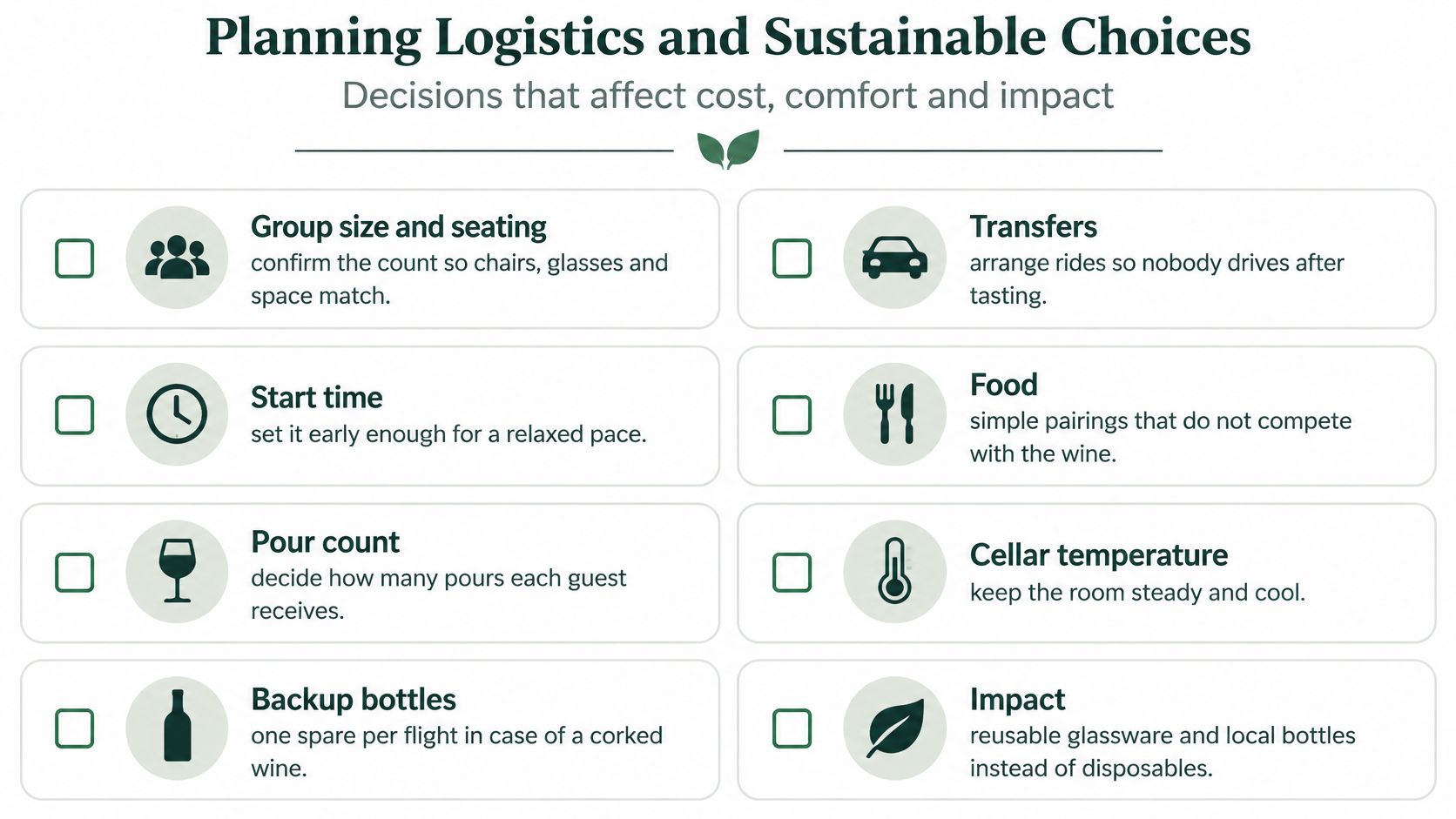
Why transfers change the plan
On a single-estate visit, transport is optional. On a multi-stop day it isn't, because one driver removes both the drink-driving risk and several car movements between properties. If you're building that kind of day, planning a wine tour right covers the sequencing and vehicle side in detail. Our own private event planning guide for Northern Spain sets out how we sequence cellar visits, meals and drives across a region where the distances look short on a map and aren't.
What sustainability means beyond the certificate
Choosing an organic or biodynamic winery answers one question and leaves six open. Recent wine-industry reporting identifies sustainability and climate adaptation as central themes for 2025, while noting a tension that promotional pages rarely mention: consumers increasingly value sustainable production, but most don't want to pay more for it, as this review of global wine industry trends sets out.
A smaller, higher-priced tasting is only greener if it reduces unnecessary driving, avoids disposable serviceware, limits over-pouring and food waste, and uses local seasonal pairings. Exclusivity on its own proves nothing. The questions that survive scrutiny are transport emissions, bottle and packaging weight, water use in the tasting room, where the food came from, how many guests the room is being heated for, and whether a claim has been independently verified.
Testing a claim in one question
Ask any host whether the sourcing and waste practices can be explained in writing. A provider who can name the farm, the waste route and the certification body will answer in a paragraph. Vague words such as natural or eco-friendly usually mean nobody has checked.
Climate matters to your booking too, since changing conditions affect vineyard management and can shift harvest timing and which wines are available. Flexible dates and a backup wine list protect the plan. On cost, format and group size set the base price per guest, with transfers, food, cellar access and seasonal bottles adding to it. Ask for a per-person price that states whether pours, food, transfers and gratuity are included, then compare quotes on the same format and headcount.
Confirm Your Format Before You Book
Five decisions settle most of the risk. Name the goal in one sentence, whether that's a milestone dinner, a wine-focused escape or a family reunion. Pick the format from the comparison table rather than from a photograph. Confirm the setting, the temperature control and the pour volume in writing. Collect guest preferences, including the non-drinkers and whoever is driving. Ask about transfers and sustainability practice before you pay a deposit.
Then put one question to every provider you're considering: can you send the format, inclusions, pour count, timings and cancellation terms in one written summary? Anyone who can't answer that in a single document will be improvising on the day. Estates that publish their group formats in that much detail, such as the options to host a private winery event at B.R. Cohn Winery, give you a concrete benchmark to hold your own quotes against.
Our own version of this is the Wine & Waves journey, a 6-night package from €7,200 per person excluding flights, based on two people sharing, which pairs a Rioja wine journey with Basque coastal exploration and runs in April, May, August and September. Behind-the-Scenes Access adds private winery visits, artist workshops and secret cultural gems, Michelin-Star Workshops add private cooking classes with chefs, and groups moving across the region have 24/7 on-the-ground support.
If you're planning private wine tasting events around a cellar table, a vineyard lunch or a bottle opened among old barrels, Northern Spain Travel builds the whole day around your group, with private winery visits, winemaker meetings and cooking sessions with chefs across Rioja, the Basque Country and Navarra. Every itinerary is fully private and paced to the people in it, never shared with strangers. Visit Northern Spain Travel to start shaping the format, the setting and the flight.