You've come home from Europe with beautiful photographs and a nagging sense that the trip was harder than it needed to be. Too many hotel changes, too many early departures, a celebrated restaurant that felt rushed, and a supposedly hidden village filled with visitors because everyone else had read the same guide.
That's the point at which tailor made tours in Europe start to make sense. The value isn't a private car, a better hotel, or a longer list of exclusive experiences. It's the judgment to decide where to slow down, what to remove, when to move, and how to connect coast, wine, cities, and mountains without exhausting the people traveling.
For travelers who have already seen Madrid, Barcelona, or Rome, Northern Spain offers an ideal case study. The region rewards careful sequencing, local access, and a pace that leaves room for an unplanned lunch, a coastal viewpoint, or a conversation with a winemaker.
Table of Contents
- When a Standard European Trip Stops Feeling Like Enough
- What Tailor Made Tours in Europe Actually Mean
- How a Boutique Planner Designs a Private Trip
- Why Timing and Pace Matter More Than the Itinerary
- Matching the Itinerary to the Traveller
- A Northern Spain Case Study in Bespoke Design
- Budgets, Timelines and What You Pay For
- A Short Checklist for Choosing a Boutique Agency
When a Standard European Trip Stops Feeling Like Enough
The standard European itinerary usually begins with good intentions. You want culture, food, scenery, and variety, so the route expands until it includes every place that seems too important to miss. By the end, the journey may contain several cities, multiple flights or long transfers, and a calendar so full that every delay feels like a crisis.
A private tailor-made journey solves a different problem. It doesn't ask, “How many destinations can we include?” It asks, “What should this trip feel like each day?”
Start with the rhythm, not the map
A strong designer begins by identifying your natural travel rhythm. Do you enjoy a slow breakfast and a late dinner, or do you prefer an early start and a full day outdoors? Will one traveler happily walk through a steep old town while another needs a nearby vehicle and a quiet afternoon? Are you looking for privacy, conversation, discovery, celebration, or relief from decision-making?
Those answers shape the route. A couple who wants long lunches, private tastings, and boutique hotels may need fewer bases than an active traveler who enjoys changing scenery. A multigenerational family may need two-night stays, flexible activity tracks, and accommodation that makes rest effortless.
Practical rule: If the route looks impressive on paper but leaves no space for weather, fatigue, or spontaneous pleasure, it isn't finished.
What the private format should fix
A well-designed journey gives you control over pace, privacy, and access. You're not adapting to a group's departure time, a standardized restaurant booking, or a guide who has to satisfy twenty different interests. You can spend longer in a market, shorten a visit when the energy drops, or replace a strenuous walk with a scenic drive without dismantling the entire trip.
That flexibility matters most in mature destinations. Europe is the world's largest international tourism market, with approximately 747 million international tourist arrivals in 2024, around 5% more than in 2023 and about 1% above its 2019 level, according to Eurostat's tourism statistics. The opportunity for a private journey isn't to cover more ground. It's to find depth within a large, busy market.
Northern Spain is particularly suited to that approach. The Basque Country, La Rioja, Asturias, Galicia, Cantabria, Navarra, and the Pyrenees offer distinct experiences without demanding a conventional checklist. The luxury is choosing the right order and allowing each place enough time to become more than a stopover.
What Tailor Made Tours in Europe Actually Mean
A tailor-made tour is a private journey designed around your priorities rather than a pre-existing route. Think of it as a bespoke suit, not an off-the-rack jacket with minor alterations. The destination may be familiar, but the combination of hotels, guides, transport, dining, activities, and timing is built for the people traveling.
That distinction matters because many travel products appear customized while changing very little. An online package may let you select a hotel category. A luxury hotel may offer a list of standard excursions. A small-group tour may promise an intimate atmosphere but still operate on fixed dates and a fixed schedule. A traditional agent may book your requested components without taking responsibility for how they work together.
What genuinely changes
A genuine tailor-made proposal should adapt several connected decisions:
- Routing: The sequence of regions should reduce unnecessary backtracking and match your arrival and departure points.
- Pacing: Nights are allocated according to energy, interest, and transfer friction, not because a destination is popular.
- Accommodation: Hotels are chosen for location, atmosphere, room configuration, service, and how easily they support the day.
- Human support: Private guides, drivers, chefs, artisans, and local specialists are selected for relevance to your interests.
- Access: Experiences may include private tastings, behind-the-scenes visits, or timing that avoids the busiest periods.
- Contingency: Rain, fatigue, closures, and delays have credible alternatives.
A useful overview of when to hire a Europe travel agent can help clarify when professional planning adds value, especially when a journey involves several regions or travelers with different needs. The key question isn't whether someone can make bookings. It's whether they can take responsibility for the joins between those bookings.
For a deeper explanation of the components involved, this complete guide to tailor-made vacations offers useful context on bespoke planning and private travel design.
What large operators can't easily do
Large operators work efficiently because they standardize. That's useful when you want predictable departures, established routes, and simple purchasing. It becomes a limitation when a family needs separate activity levels, a couple wants a quiet winery rather than a famous one, or a traveler needs a vehicle to stop close to an old-town entrance.
Boutique agencies operate with fewer layers between the traveler and the local network. They can reject a beautiful hotel that creates logistical problems, shift a visit from a weekend to a weekday, or tell you that an ambitious route will feel tiring. That candid judgment is often more valuable than another list of options.
When reviewing a proposal, ask whether the agency can explain why each stop is there, what it costs in time and energy, and what happens if the preferred plan becomes unavailable. If the answer is vague, the itinerary may be assembled rather than designed.
How a Boutique Planner Designs a Private Trip
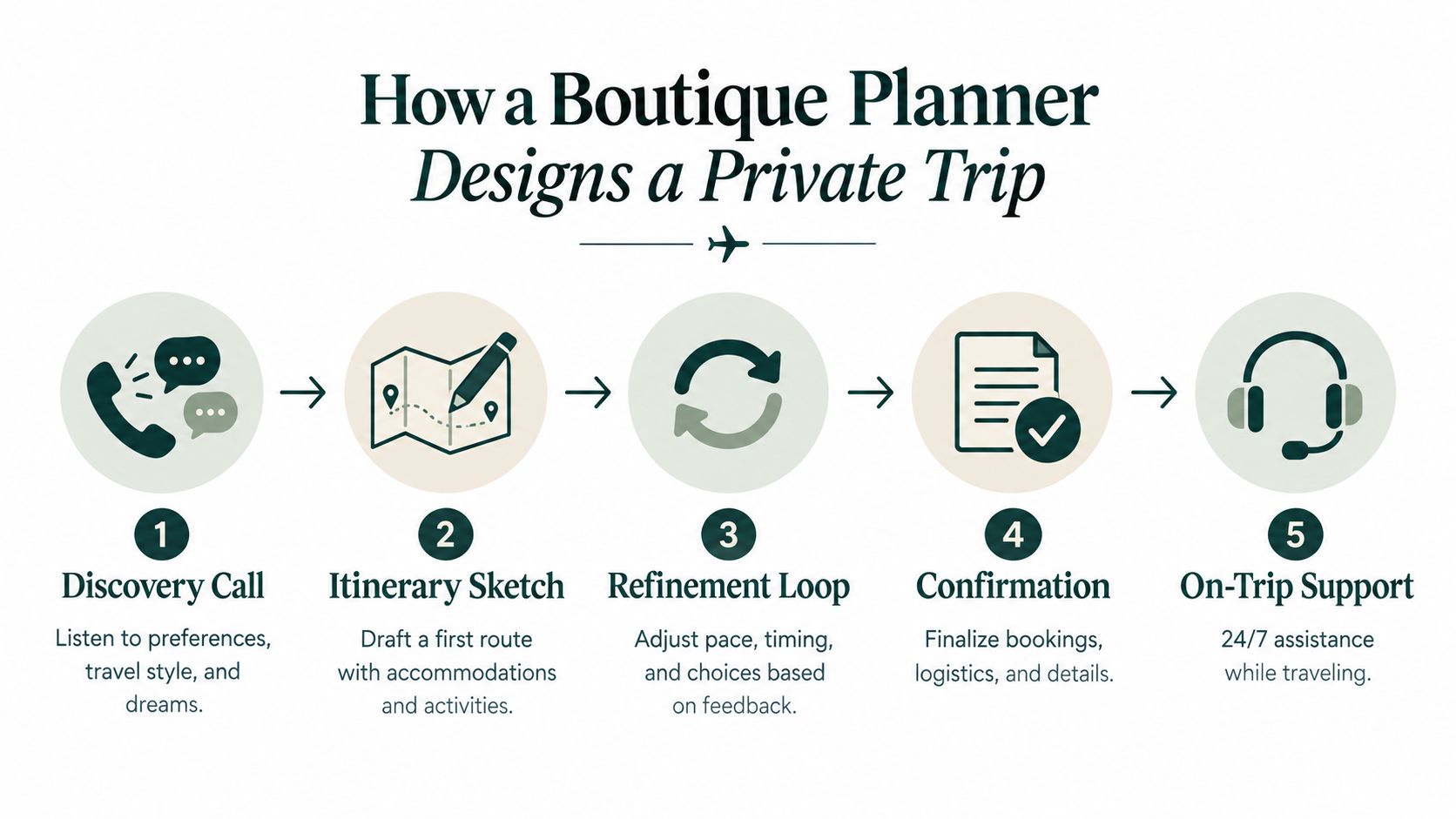
The planning relationship should feel like a thoughtful conversation, not a sales form. A capable designer is listening for the preferences you state directly and the patterns you reveal indirectly. “We love food” might mean long lunches, market visits, serious wine, cooking with a family, or avoiding tourist restaurants altogether.
Discovery and the first sketch
The discovery conversation should cover travel history, physical comfort, preferred hotel atmosphere, dining habits, sleep patterns, important dates, and the moments you want to remember. A good planner also asks what you disliked on previous journeys. That answer often reveals more than a wish list.
The first itinerary sketch isn't a final product. It's a test of logic. It should show the broad route, proposed bases, likely transfers, and the experiences that give each place a reason to exist. You should be able to see where the trip breathes and where it might feel demanding.
At this stage, don't focus only on hotel names. Ask:
- Why this base: What does its location make easier?
- Why this sequence: What does the order prevent or improve?
- Why this activity: Does it reflect our interests, or is it only popular?
- Why this duration: Would another night create a calmer experience?
The best designers welcome those questions because the first draft should invite refinement.
Refinement is where expertise appears
The second phase is a loop, not a handover. You might remove a destination, replace a long drive with a rail journey, add a rest afternoon, or change a guided visit to a self-directed exploration. A designer should explain the trade-off each time. Adding Galicia may deepen the coastal and culinary story, but it can also create a longer transfer. Staying in one rural base may feel peaceful, but it could require more driving for day trips.
The private travel designer guide for Northern Spain describes the kind of specialist input travelers should expect when local knowledge is central to the journey.
Confirmation and support
Once the structure works, the agency confirms accommodation, guides, drivers, dining, access requirements, and payment terms. The final documents should be practical rather than decorative. They should show meeting points, realistic transfer expectations, contact details, and clear instructions for days when travelers have choices.
On-trip support is part of the design. A restaurant may alter its service, a mountain route may become unsafe, or a driver may need to adjust the meeting point. A boutique agency should offer a responsive local contact who can solve the problem without forcing you to rebuild the day yourself.
Why Timing and Pace Matter More Than the Itinerary
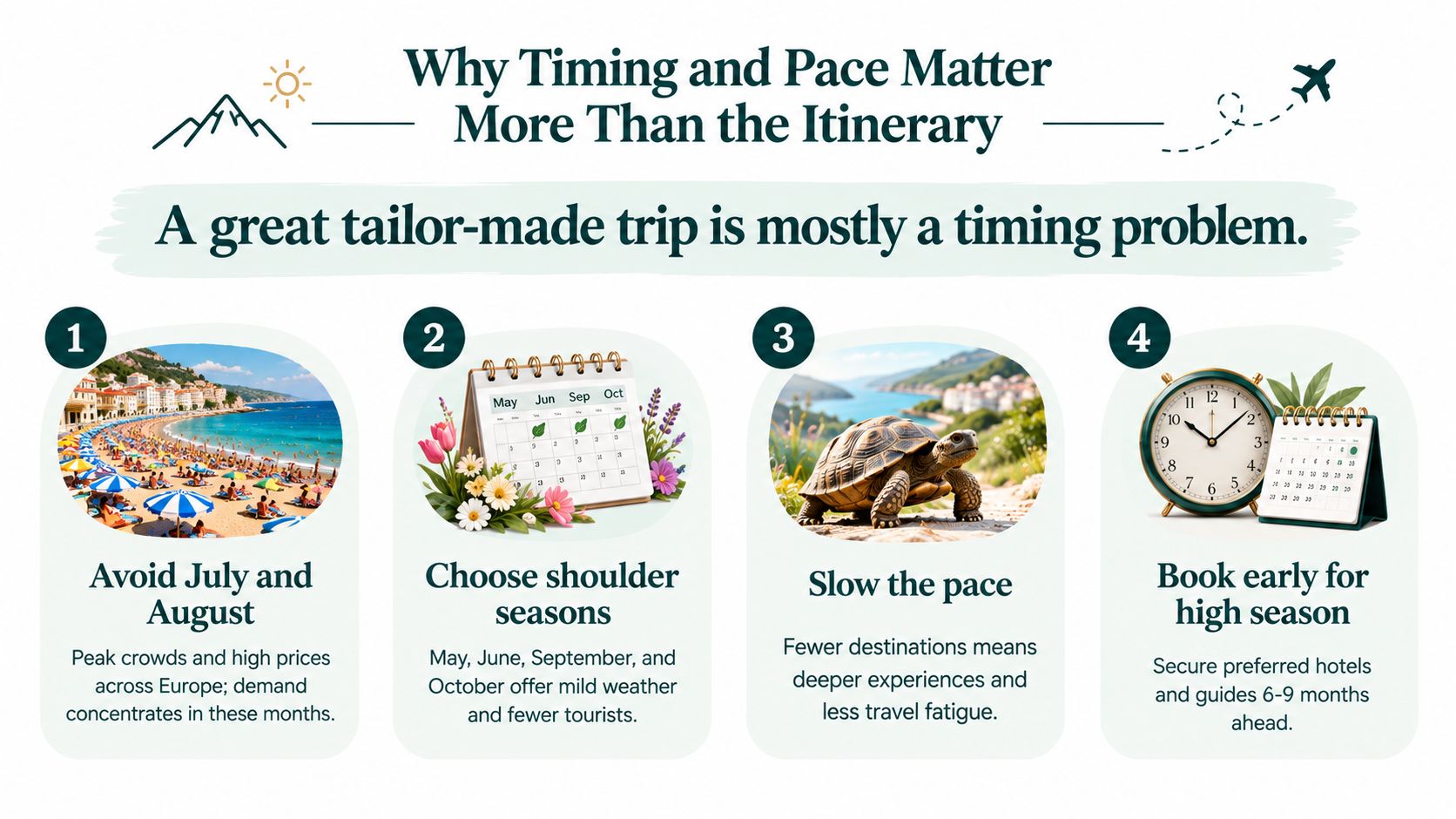
A great tailor-made trip is mostly a timing problem. The same hotel, restaurant, or setting can feel serene at one hour and congested at another. The best destination choice can still produce a poor journey if the route ignores local peaks, transfer fatigue, opening schedules, and the difference between a weekday morning and a summer weekend.
The pressure is visible in current European travel patterns. July and August represented 31% of all EU accommodation nights in 2025, while Spain received a record 96.8 million international tourists in 2025, according to Spain's official tourism statistics. Those figures don't mean summer travel is impossible. They mean timing becomes a design decision rather than an afterthought.
Four rules that consistently improve a trip
Choose the month before choosing the route. May, June, September, and October can offer a more comfortable balance of weather, access, and demand than the height of summer, but each has its own trade-offs. Coastal conditions, mountain weather, harvest schedules, festivals, and restaurant closures all need checking.
Put famous experiences at the right time. A celebrated market, viewpoint, or historic quarter may be worth visiting, but it rarely needs to occupy the busiest part of the day. Early starts, weekday appointments, private entrances where available, and a well-chosen lunch location can change the mood completely.
Sequence geography in one direction. A route that moves naturally between regions is more luxurious than one that repeatedly crosses the same ground. Private transport gives flexibility, but it doesn't eliminate fatigue. A scenic drive can still be tiring if it follows a demanding walk or a late dinner.
Build recovery into the plan. A free afternoon isn't wasted capacity. It protects the experiences that matter most. If rain cancels a hike or a family member needs rest, the itinerary should have an appealing alternative rather than a hole.
The designer's test: You should remember the meals, conversations, and landscapes. You shouldn't remember changing hotels every night.
Slow travel is not a synonym for inactivity. It means making fewer movements earn their place. This guide to slow travel and immersive journeys provides useful language for thinking about depth, but the practical test is simple. If removing one destination improves the remaining days, remove it.
Matching the Itinerary to the Traveller
The right design depends on who needs what from the journey. Couples often want emotional depth and privacy. Families need flexibility and physical clarity. Active-luxury travelers want genuine natural surroundings without turning every day into an endurance test.
Use the matrix below as a first filter when comparing proposals.
Choosing the Right Tailor Made Approach by Traveller Type
| Traveller Type | Ideal Pace | Core Priorities | Common Pitfalls |
|---|---|---|---|
| Couples seeking depth | Two or more nights in meaningful bases, with unstructured time | Boutique hotels, private dining, wine, cultural access, scenic drives, and room for spontaneity | Adding destinations to make the itinerary look more impressive |
| Multigenerational families | Stable bases, short transfers, and optional activity tracks | Connecting rooms or suites, private drivers, easy access, flexible meals, and weather-proof alternatives | Treating every traveler as equally mobile or interested |
| Active-luxury travelers | A substantial experience followed by recovery time | Gentle hiking, coastal exploration, cycling, private guides, excellent food, and comfortable lodging | Confusing more activity with better design |
Couples need atmosphere, not constant novelty
For a couple, the best itinerary often has a clear emotional arc. A lively city can lead into wine country, then a quieter coast or mountain setting. Private access matters, but not every moment needs to be exclusive. A small local restaurant with the right table can feel more personal than a formal dining room chosen only for prestige.
Families need optionality built in
Multigenerational travel works when the itinerary anticipates divergence. One group may visit a museum while another takes a gentle walk. Teenagers may want an active morning and grandparents may prefer a garden, market, or long lunch. The driver, guide, and accommodation plan should make those choices simple rather than improvised.
Ask for mobility grades, door-to-door timing, luggage handling, and vehicle access. Steep old towns, cobbled villages, irregular rail connections, and weather exposure can turn a beautiful plan into a frustrating one if nobody explains the practical details.
Active luxury needs restraint
Soft adventure is strongest when comfort supports the setting instead of competing with it. A coastal village, a scenic drive, or a light hike through the Picos de Europa can be enough when the day also includes an excellent meal and a restful hotel. The goal is not to collect activities. It's to make the physical experience feel rewarding and optional.
A Northern Spain Case Study in Bespoke Design
Northern Spain shows why sequencing matters. San Sebastián, Rioja, Navarra, Cantabria, Asturias, Galicia, and the Pyrenees don't form a single compact resort area. They're a collection of distinct regions and cultures, connected by roads, regional transport, and carefully chosen bases.
Consider a 10-night private journey for a couple arriving with a serious interest in food, wine, and Atlantic scenery. I'd avoid treating every region as a separate box to tick. The structure might begin in San Sebastián, where a private food-focused introduction establishes the culinary character of the Basque Country. The journey could then move inland to Rioja for cellar visits and slower countryside days, before continuing west toward a coastal or mountain base.
The number of stops matters less than the handoffs. A private driver can turn a transfer into a scenic day with a village, producer, or viewpoint, but only if the schedule allows the travelers to enjoy those places rather than rush through them. If the route eventually reaches Asturias or Galicia, a car rental in Santiago de Compostela may be relevant for travelers who prefer independent driving at the end of a professionally guided journey, although the right choice depends on road confidence, parking, and the desired level of support.
For a multigenerational family, I'd simplify the geography. San Sebastián and Rioja could provide the opening contrast between city, cuisine, and countryside, followed by a stable base in Asturias or Cantabria. A private vehicle would handle luggage and reduce connection friction. One day might combine a short coastal visit with a relaxed lunch, while another offers a gentle cultural activity for grandparents and a more energetic option for younger travelers.
Soft adventure can replace an overfilled activity stack. The Picos de Europa might provide a scenic drive and an accessible walk rather than an ambitious hike. A fishing village could become the setting for a local meal. Galicia might be included for its food, architecture, and Atlantic atmosphere, not because the itinerary needs another destination name.
The texture comes from the details: pintxos in the Basque Country, Rioja producers, cider traditions in Asturias, seafood in Galicia, village markets, private guides, and conversations with people who know the region. Those experiences work best when the schedule gives them room.
A short visual pause can help you understand the atmosphere this style of travel aims to create.
Luxury here isn't a sequence of expensive inclusions. It's a route that remains comfortable when the weather changes, a driver who knows where the vehicle can stop, and a planner who recognizes when the better choice is to stay another night.
Budgets, Timelines and What You Pay For
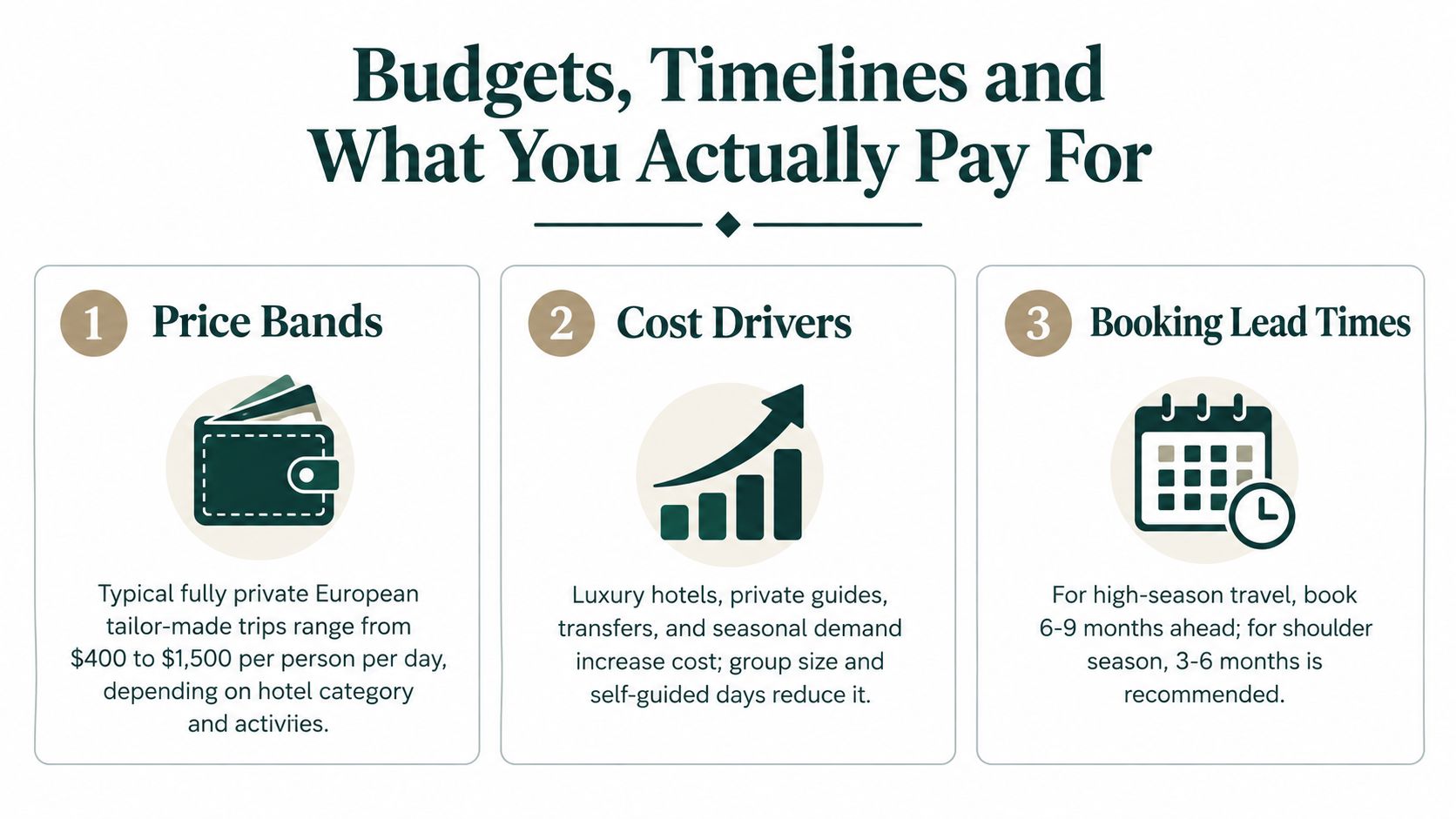
A private European journey costs more because it replaces standardized capacity with reserved attention. You are paying for the design work, the local relationships, the private transport, the quality of the stays, and the ability to change course without losing the whole day.
At Northern Spain Travel, fully private journeys typically run from $400 to $1,500 per person per day, depending on hotel category and activities. Use that as a planning range, not a promise. The final quote shifts with room type, group size, transfers, guides, dining, season, and how many private services are included.
Spend where friction is highest
Put the budget into the parts of the trip that change comfort or access.
- Private drivers: They matter most in regions with dispersed villages, difficult parking, or roads that make self-driving tiring.
- Specialist guides: A strong guide changes what you notice and how easily you enter a place.
- Well-located hotels: Good location cuts daily transfers and makes free time more useful.
- Hard-to-secure dining and access: Pay for these when they fit your interests, not just because they sound prestigious.
- On-trip support: A responsive local contact protects the itinerary when conditions change.
You do not need every day to be fully guided. A balanced plan can combine private touring with independent mornings, self-guided walks, or a free afternoon. That keeps the journey personal while the structure stays coherent.
Sustainability should appear in the route
Sustainability matters when it changes the route. A representative analysis of more than 25,000 citizens across the 27 EU member states found that 82% were willing to change at least one travel habit to become more sustainable, with local consumption among the most broadly supported actions. The findings are discussed in this study of sustainable travel behavior in Europe.
In practice, that can mean regional dining, locally owned accommodation, fewer unnecessary transfers, and conservation-linked experiences. The route should use rail, walking, cycling, or electric mobility when those choices improve the trip. The European Travel Commission reported that travelers using predominantly human-powered or electric mobility rose from 13% to 18% year on year in its 2025 long-haul monitoring, as reported in its responsible travel analysis.
For high-season travel, start planning early enough to protect the hotels, guides, and restaurants you want. Shoulder-season trips usually give you more flexibility, but local festivals, seasonal closures, and weather-sensitive activities still need checking before the route is fixed.
A Short Checklist for Choosing a Boutique Agency
Before accepting a proposal, ask these questions:
- How will you control pace? Look for realistic transfer times, rest periods, and a reason for every hotel change.
- What happens if weather or fatigue changes the day? Expect specific alternatives, not a vague promise of flexibility.
- Who provides local support? Confirm whether a real person is available during the journey and what assistance includes.
- What is included in the quote? Ask about drivers, guides, meals, entrance fees, taxes, gratuities, and cancellation terms.
- Why were these experiences chosen? The answer should connect to your interests rather than a standard package.
- Can you explain the transport trade-offs? If you're considering premium arrival options, an Approved Jets charter guide can help you understand the wider planning considerations, but the ground itinerary still determines how calm the journey feels.
A strong agency doesn't add luxury components. It edits the journey until the timing, movement, and experience fit the travelers.
Northern Spain Travel designs fully private journeys across the Basque Country, Rioja, Navarra, Cantabria, Asturias, Galicia, and the Pyrenees, with private guides, drivers, handpicked stays, food and wine access, and on-trip support shaped around your pace. Visit Northern Spain Travel to begin a discovery conversation and turn your preferred rhythm into a carefully sequenced European journey.