Most advice about Europe in April is lazy. It tells you to head south, expect sunshine, and treat the month like an early version of summer. That's not smart travel planning. It's weather wish-casting.
April is one of Europe's most changeable months, and the travelers who enjoy it most are the ones who stop chasing a fantasy of guaranteed warmth. If you want a better trip, especially if you're booking boutique hotels, private guides, winery visits, coastal drives, or outdoor days that can't readily be “redone later,” you need to think in terms of volatility, regional contrast, and microclimates.
That matters across the continent. It matters even more in places like Northern Spain, where the reward is extraordinary if you plan properly and frustrating if you don't.
Table of Contents
- The April Weather Myth Why Your European Trip Needs a New Plan
- The Big Picture A Continent in Transition
- A Tale of Three Climates Regional Weather Patterns in April
- Navigating April Showers and Sun Packing for Volatility
- Spotlight on Northern Spain The Best of Aprils Complexity
- Beyond the Weather April Events and Strategic Timing
- The Smart Travelers Approach to April in Europe
The April Weather Myth Why Your European Trip Needs a New Plan
The biggest myth about Europe weather in April is simple: go south and you'll get warm, dry, easy conditions. That advice is outdated.
Recent reporting highlighted a serious content gap in generic April travel advice. The usual “sun-seeker” pitch ignores volatile spring patterns, cold snaps, and reports of a “season's worth in days” of rainfall in Spain and Italy, with the warning that “April showers may become April downpours” due to erratic jet streams, as noted by Travel Center's April Europe weather discussion. If you're planning walking tours, coastal stays, vineyard lunches, or mountain days, that's not a minor detail. It's the difference between a smooth itinerary and a badly timed one.

Warm doesn't mean stable
Southern Europe can absolutely be pleasant in April. It can also swing sharply. A bright terrace lunch can turn into a wet afternoon. A coastal road trip can start in shirtsleeves and end with cold wind and heavy rain.
That's why blanket advice fails. It treats latitude as destiny. In April, it isn't.
Practical rule: Stop asking “Where is hot in April?” Ask “Where can I handle a weather swing without losing the trip I want?”
Good April planning is about options
The smartest April itineraries don't depend on perfect weather every day. They mix outdoor time with things that still feel luxurious if the sky turns. Think market visits, cellar tastings, private museum access, long lunches, scenic drives, and towns that are enjoyable both under sun and under cloud.
That approach is better than gambling on a single weather narrative.
If you travel in April expecting certainty, Europe will punish that assumption. If you travel expecting movement, variation, and local nuance, April becomes one of the continent's most rewarding months.
The Big Picture A Continent in Transition
April feels unstable in Europe because it is unstable. This month sits between seasons, and the atmosphere behaves like a negotiation that hasn't been settled yet.
One reliable way to understand Europe weather in April is to think of the continent as a broad meeting ground between retreating Arctic air and advancing subtropical warmth. That clash creates the classic spring mix of mild afternoons, chilly mornings, passing rain, and sudden shifts that can catch underprepared travelers off guard.
Why one continent feels like several seasons at once
The temperature spread across Europe in April is wide enough to make generic advice useless. According to April city temperature averages across Europe, Barcelona averages 18°C (64°F) for a high and 9°C (47°F) for a low, while Copenhagen averages 10°C (50°F) high and 2°C (36°F) low, and Helsinki averages 9°C (48°F) high and 0°C (32°F) low. The same source notes that southern Europe commonly sits in the 15°C to 20°C range by day, central Europe often lands in the 10°C to 15°C band, and northern countries can remain in the 5°C to 10°C range. It also notes that the Mediterranean can see up to 9 hours of daily sun, while showers remain common across the continent.
That's not a minor difference in comfort. It changes what kind of trip works.
What this means on the ground
If you're choosing between cities, coastlines, and countryside routes, April rewards matching your destination to your travel style.
- If you want café terraces and coastal walks, southern cities and Mediterranean edges usually give you the best shot at mild weather.
- If you care more about museums, architecture, and food than lounging outdoors, central Europe can be excellent because cooler temperatures suit urban days.
- If you're heading north for design, scenery, or culture, pack for brisk conditions and treat any sunny interval as a bonus.
April doesn't fail travelers. Generic expectations fail travelers.
The right mindset for this month
Don't treat April as a lesser version of June. Treat it as spring with range.
That mindset changes everything. You stop planning around a fantasy of uninterrupted sunshine and start building an itinerary that works in changing conditions. That's how seasoned travelers handle Europe in April. They respect the transition instead of fighting it.
A Tale of Three Climates Regional Weather Patterns in April
Europe in April makes more sense when you divide it into practical travel zones rather than countries. For most travelers, three climate groupings matter most: the Mediterranean south, Western and Central Europe, and the north.
The point isn't to crown one region as “best.” The point is to be honest about trade-offs.
Mediterranean Europe
Generic advice often points to Southern Europe first, and not without reason. Southern Europe usually gives you the warmest daytime conditions of the month. In broad terms, Spain, Italy, Greece, and other Mediterranean areas often deliver comfortable days for walking, long lunches, and coastal stays.
But pleasant temperatures don't equal guaranteed beach weather. April remains transitional, and the weather can shift quickly. In practical terms, this region is best for travelers who want mild spring light, not travelers who need summer certainty.
Western and Central Europe
France, Germany, Belgium, the Netherlands, and nearby areas often offer a balanced version of April. You won't get the warmest temperatures, but you can get very enjoyable city weather for museums, gardens, architecture, and food-focused travel.
This zone suits travelers who don't need heat to enjoy a trip. It also works well for people who prefer active sightseeing over resort-style downtime. The drawback is inconsistency. A crisp, beautiful morning can slide into drizzle by afternoon.
Northern Europe and Scandinavia
This is the coolest end of the spectrum in April, but writing it off would be a mistake. Northern cities can feel fresh, elegant, and uncrowded at this time of year. If your priorities are design, gastronomy, museums, waterfront walking, or a calmer shoulder-season atmosphere, this region can be very appealing.
What you give up is softness. Even sunny days can feel brisk, and evenings often demand proper outerwear.
April in Europe A Regional Climate Snapshot
| Region | Average High Temp (°C/°F) | Average Sunshine Hours/Day | Typical Conditions |
|---|---|---|---|
| Mediterranean Europe | 15°C to 20°C / 59°F to 68°F | Up to 9 hours in some Mediterranean areas | Mild to warm by spring standards, brighter overall, but still prone to showers and sudden swings |
| Western and Central Europe | 10°C to 15°C / 50°F to 59°F | Variable | Mixed spring weather, comfortable for cities, some warmth, some chill, regular rain risk |
| Northern Europe and Scandinavia | 5°C to 10°C / 41°F to 50°F | Variable | Brisk, cool, often crisp, best for travelers comfortable with layers and cooler evenings |
How to choose the right region
Pick your April destination by tolerance, not fantasy.
- Choose the Mediterranean if you want the best odds of outdoor meals, sea views, and a generally softer spring feel.
- Choose Western or Central Europe if you want cultural density and don't mind carrying a jacket every day.
- Choose the north if you enjoy cool-weather travel and care more about atmosphere than warmth.
The mistake is expecting one answer for the whole continent. April doesn't work that way.
Navigating April Showers and Sun Packing for Volatility
Packing for Europe in April shouldn't look like packing for summer with an emergency umbrella thrown in at the last minute. That's amateur logic.
A better approach starts with one fact: reporting on spring conditions showed that April was predominantly wetter than average across the entire European continent, challenging the idea that only the UK or the Netherlands deserve rain planning, as discussed in Expat Explore's guide to Europe in April. If you're heading to Northern Spain, that matters even more because blocking patterns can produce long dry spells followed by sharp, intense rain.

Build a wardrobe not a suitcase
April rewards modular packing. Every piece should work with at least two others, and nothing should exist for one narrow scenario.
Use this framework:
- Start with adaptable base layers. Light knitwear, long-sleeve shirts, and good-quality T-shirts let you adjust through the day without overpacking.
- Add one serious outer layer. A lightweight waterproof jacket matters more than a bulky coat in most April itineraries.
- Treat shoes as strategy. Closed-toe walking shoes that can handle wet streets are more useful than elegant but fragile footwear.
- Carry compact rain protection. A small umbrella or packable poncho belongs in your day bag, not back at the hotel.
- Use accessories to fine-tune comfort. A scarf and sunglasses solve more problems than most travelers expect.
If you want to save space without creating chaos, a practical resource is this guide to compression packing cubes, which explains how to organize layers for changing conditions rather than stuffing everything into one case.
For Spain specifically, this more detailed Northern Spain packing guide for 2026 is worth reading before you finalize your suitcase.
A quick visual helps most travelers get this right:
Plan days with weather pivots
Packing solves only half the problem. Your day plans also need flexibility.
Bring the best jacket you own for light rain, not the heaviest coat you own for winter.
A strong April day has a pivot built in. Start outdoors when conditions are best, then move into tastings, museums, or a long lunch if rain arrives. If the skies clear, go back outside. This isn't overplanning. It's how you protect the quality of the trip.
Travelers who insist on fixed outdoor windows often spend April annoyed. Travelers who build elegant alternatives into the day usually love it.
Spotlight on Northern Spain The Best of Aprils Complexity
If you want one region that proves why April deserves nuance, it's Northern Spain. This is not a place for simplistic weather assumptions. It's a place for travelers who appreciate texture.
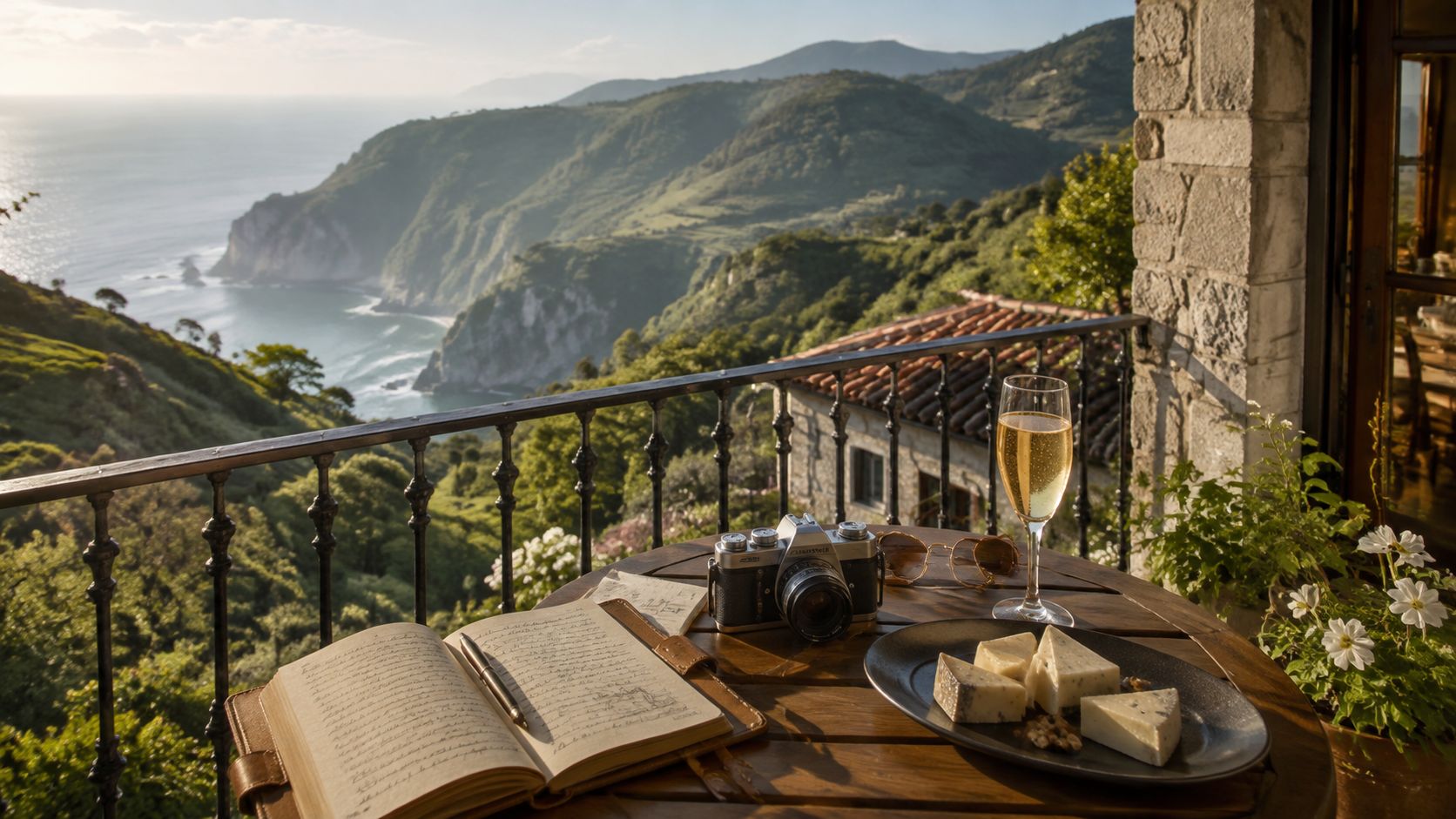
Northern Spain in April can give you green hills, Atlantic light, excellent food, cool mornings, soft afternoons, sea air, vineyard days, and mountain drama in the same trip. It can also force you to think carefully about pacing, clothing, and route design. That's exactly why it works so well for discerning travelers.

Why Northern Spain shines in April
April in this part of Spain feels alive. The rain-fed countryside is intensely green, villages feel authentic rather than overwhelmed, and the whole region sits in that attractive spring window where a fire in the evening and a terrace at lunch can both make sense.
Weather references for Iberia show the pattern clearly. In Barcelona, average April temperatures range from 9°C to 18°C, while Bilbao and San Sebastián typically run slightly cooler, with lows near 7°C to 8°C and highs around 15°C to 17°C. The same weather summary notes around 7 to 9 rainy days across Northwestern Spain in April, with 20 to 38 mm of monthly precipitation, and an Atlantic sea temperature of around 18°C (64°F) that makes coastal activity more comfortable with protective gear than with summer expectations, according to this April weather overview for hot places in Europe.
That range is exactly the point. Northern Spain isn't difficult in April. It's layered.
Where the complexity matters most
The coast, inland cities, wine country, and mountains all behave differently enough that a one-size plan falls apart.
Consider the contrast from the wider European picture in April 2026. Copernicus reported that the European-average surface air temperature reached 8.88°C, which was 0.50°C above the 1991 to 2020 baseline for April, making it the 10th warmest April in the ERA5 dataset, with all nine warmer Aprils occurring between 1999 and 2025. It also described sharp regional contrast, with southwestern Europe much warmer than average and eastern Europe colder than average, driven by a persistent high-pressure system over western Europe and low pressure over the east. Late in the month, a deep low-pressure system over the eastern North Atlantic pushed hot air from North Africa toward southwestern Europe, and parts of northern Spain and southern France saw their warmest April since at least 1979. Spain recorded its warmest April since 1962, and France its third-warmest since 1900, according to Copernicus' April 2026 surface air temperature report.
For travelers, that means two things.
First, broad national labels won't help you enough. “Spain in April” is too blunt. Coastal San Sebastián, inland Rioja, and the Picos de Europa are not interchangeable.
Second, April rewards route design. You want plans that account for local shifts.
- On the coast, humid air and passing showers can make towns feel atmospheric rather than inconvenient, especially if your day includes food markets, pintxos bars, galleries, and scenic drives.
- Inland, places like Rioja often feel ideal for cellar visits and long lunches because cooler spring temperatures suit wine travel beautifully.
- In the mountains, conditions can turn quickly, so outdoor plans need proper gear and backup judgment.
Northern Spain in April is for travelers who like places with personality, not weather on autopilot.
If you're trying to understand those sub-regional differences in more detail, this overview of weather in Northern Spain is a useful starting point.
The payoff is huge. April gives Northern Spain freshness without summer pressure. You get dramatic scenery, serious gastronomy, and a more intimate rhythm. You just need to plan it like an adult, not like a brochure writer.
Beyond the Weather April Events and Strategic Timing
Weather matters, but it isn't the only reason to travel in April. This month often works because of the combination of atmosphere, timing, and access.
For many experienced travelers, April is more attractive than peak summer because Europe still feels lived-in. Hotels, restaurants, and cultural sites haven't yet taken on that fully compressed high-season rhythm. You can often move through places with more ease, and the trip feels less performative.
What April does better than summer
April is strong for travelers who value texture over bragging rights.
You can build days around spring markets, religious celebrations, flower seasons, reopening terraces, and long cultural lunches without stepping into the heaviest crowd patterns of the year. In Spain, Semana Santa can shape logistics and availability. In the Netherlands, King's Day changes the mood of entire cities. Across Europe, local calendars often matter as much as the forecast.
That's why shoulder season planning should never be reduced to “fewer crowds.” It's about choosing whether you want a destination at full summer volume or at a more civilized tempo.
When timing matters more than temperature
The best April itineraries are date-sensitive. A city can feel elegant one week and logistically awkward the next if a major holiday or festival collides with your plans.
A smart approach is to decide what kind of trip you want first:
- Cultural immersion: build around seasonal events and accept some weather unpredictability.
- Food and wine focus: prioritize regions where cool spring weather improves the rhythm of the day.
- Scenic touring: keep route flexibility so you can respond to local conditions.
- Family travel: avoid locking every activity outdoors.
If you're comparing destinations for spring travel, this curated list of the best places to travel in April for 2026 is a helpful planning reference.
Good April travel isn't about finding perfect weather. It's about finding the right intersection of climate, culture, and calendar.
The Smart Travelers Approach to April in Europe
The smartest way to handle Europe weather in April is to stop demanding certainty from a month that doesn't offer it.
April is a transition month. That's why it can be so rewarding. You get spring color, lighter crowds, fresh seasonal energy, and a wider range of experiences than summer often allows. But you only enjoy those advantages if you plan for movement, not stability.
The wrong approach is simple. Pick a destination based on a generic promise of warmth, pack too lightly for rain, and build a rigid outdoor itinerary.
The better approach is just as simple. Choose a region based on how you like to travel. Pack for range. Build elegant indoor alternatives. Respect microclimates, especially in places like Northern Spain, where a small shift in location can change the feel of the day completely.
That's what seasoned travelers do. They don't chase a fantasy version of April. They use good judgment and get a better trip because of it.
If Northern Spain is on your shortlist, Northern Spain Travel designs private tailor-made journeys that account for exactly this kind of spring complexity, from coastal stays and wine country to mountain routes, food experiences, and effective wet-weather backup plans.