You've saved a seaside hotel, bookmarked restaurants in San Sebastián and found a winery you'd love to visit. Then the practical questions start. Who'll drive after the tasting, how much walking will your parents manage, and will a private visit still feel special if the surrounding town is packed?
A bespoke travel agency helps turn those separate wishes into a workable journey. Its real value isn't obtaining exclusive access. It's deciding what to include, what to leave out and how to balance your privacy, energy and effect on the places you visit.
Table of Contents
- Bespoke Agency Versus Standard Tour Operator
- How the Planning Process Unfolds Step by Step
- Questions to Ask Before You Hire an Agency
- Tailored Experiences Across Northern Spain
- Planning Family, Group and Milestone Trips
- Keeping Exclusive Trips Low-Impact
- Confirm the Agency Fits Before You Book
Bespoke Agency Versus Standard Tour Operator
| Factor | Bespoke Travel Agency | Standard Tour Operator |
|---|---|---|
| Itinerary | Designed from scratch around one client's preferences | Pre-set packages and fixed routes |
| Group size | Private, usually only your own party | Shared with other travelers |
| Pace | Set by the client and adjusted day by day | Set by the operator's schedule |
| Accommodation | Boutique or private stays chosen for each client | Chosen from a standard hotel list |
| Guides and drivers | Private guides and drivers matched to the trip | Often a shared coach and group guide |
| Mid-trip changes | Rebalanced by a local planner | Handled through the operator's standard process |
| Fee structure | Separate planning charges, bundled pricing or supplier remuneration; request written terms | Usually built into a package price |
The core distinction is straightforward: a standard tour operator sells a product that already exists; a bespoke agency designs a journey that takes shape around you. These are useful model comparisons, not rigid industry boundaries. Some operators also offer private departures, so a private vehicle alone doesn't prove that a trip is bespoke.
Think of a tailor. You're measured first, and the garment is cut to fit, rather than selected from a rack and altered slightly. In travel, those measurements include your rhythm, tastes, curiosity, comfort requirements and appetite for company.
On a fixed departure, you leave when the group leaves. With a private driver, you might linger in a village, provided the planner can adjust whatever follows. That qualification matters: flexibility doesn't make a restaurant reservation or a winemaker's working day disappear.
What the agency actually coordinates
The agency's core job is orchestration. Someone must connect hotels, transport, guides, restaurants, activities and private access so that each partner understands the same plan. A wonderful cellar visit isn't much use if it clashes with check-in, requires an uncomfortable transfer or leaves no time for lunch.
Local destination management companies work at this operational level, connecting destination knowledge with delivery. The useful question isn't how many experiences an agency can list, but how carefully it can combine them.
For affluent travelers, the benefits can include privacy, deeper interpretation, comfortable pacing and access that's difficult to arrange independently. If you've already explored Madrid, Barcelona and Andalusia on group tours, you may now want an unhurried conversation with a producer rather than another checklist of sights.
That appetite has a commercial signal. In a 2024 survey of 400 affluent U.S. adults, 66% said they would spend more on personalized, bespoke trips matched to their interests and preferences, according to Kensington Tours and Opinium Research, reported by TravelAge West. At a broader market level, DataIntelo attributed 38.4% of the global luxury travel service market in 2025 to customized travel, equivalent to approximately $591.4 billion in revenue.
What you're paying for
Each Northern Spain Travel journey is designed for each guest. We shape it around their rhythm, tastes and curiosity, with an emphasis on stories remembered through the people met along the way.
Across the industry, bespoke pricing can reflect private services, scarce access and the work involved in coordinating them. Fees differ, and the most expensive option isn't automatically the best fit.
Before comparing totals: Request a written breakdown of inclusions, exclusions, service charges and cancellation terms. Compare the work and services behind the price, not just the final figure.
How the Planning Process Unfolds Step by Step
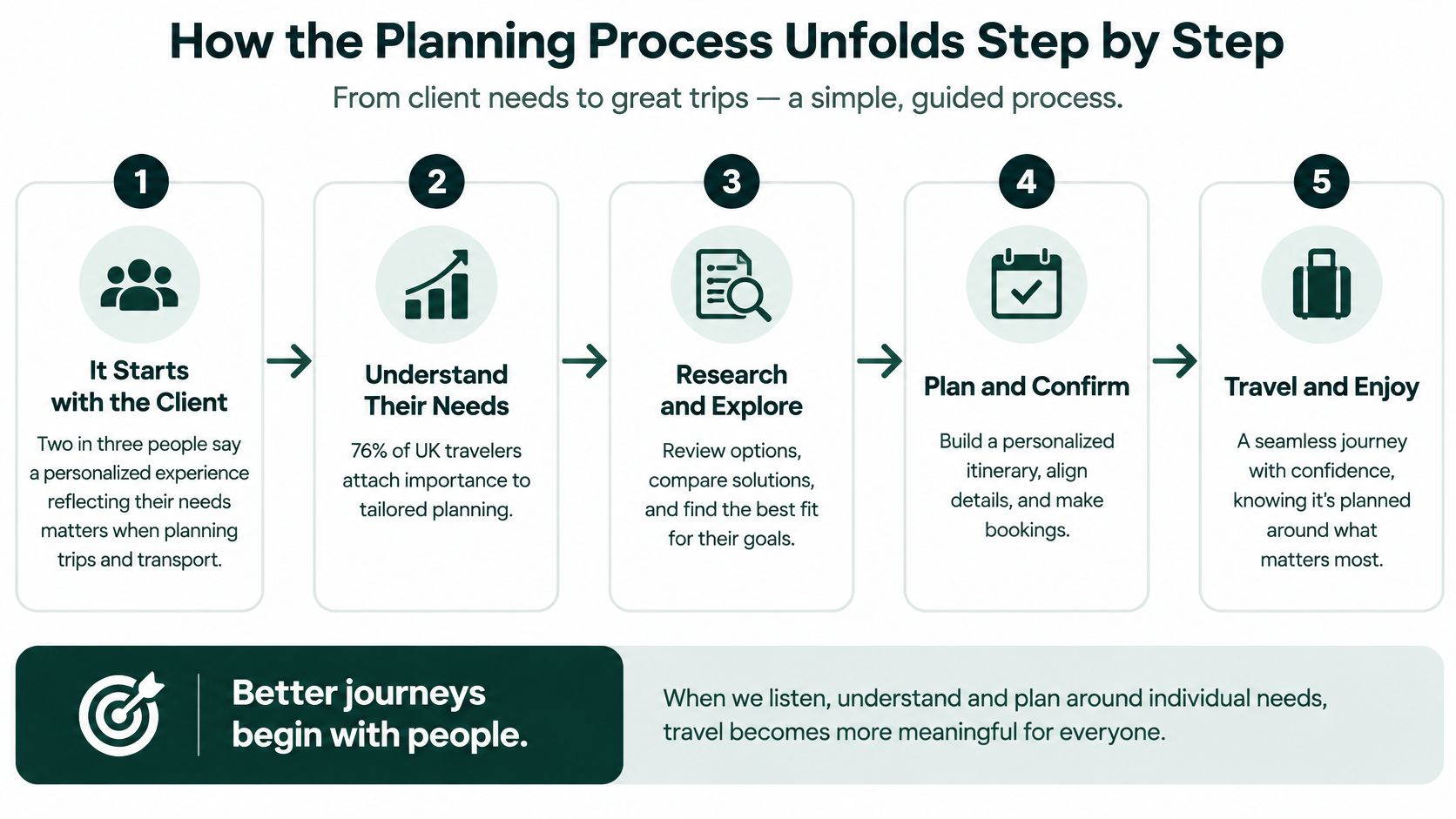
A couple sends an agency three lines: a harvest lunch in Rioja, a quiet base by the sea, no more than two hotel changes. Weeks later they hold a plan in which every transfer, table and guide carries a name and a time. The work between those two moments is the planning process, and knowing its shape helps you judge any agency's craft.
The appetite behind that work is broad. According to EY's Future Travel Behaviors Observatory, two out of three people consider a personalized experience reflecting their needs important when planning trips and selecting transportation, while 76% of UK travelers attach importance to personalization, compared with 60% in Germany.
The steps below show how preferences become bookings.
From wishes to a workable draft
-
Describe experiences, not just destinations. Share your must-have experiences, dream destinations, preferred travel dates and the style of journey you imagine. Saying you want to understand Rioja through conversations with producers gives a planner more direction than naming Rioja alone. Include what you don't enjoy, such as early starts or formal meals every evening, and name the interest that anchors the trip. If golf is that anchor, working through a guide to planning your first golf trip shows how tee times, transfers and rest days set the schedule before hotels enter the discussion.
-
Let specialists turn the checklist into a route. Our local specialists design a personalized draft itinerary from your answers. Read it for coherence rather than attractions: geography, availability and your preferred pace decide what belongs together. A beautiful detour that costs you a rest day is a trade, not a gift.
-
Review the ordinary details. Check accommodation level, privacy, walking demands, dietary requirements and mobility limits. Read the draft as though you're living each day: when will you eat, rest, change clothes and have time without a guide? A plan that looks elegant on paper can feel relentless by four in the afternoon.
From draft to confirmed arrangements
-
Refine the choices. Every adjustment trades one pressure against another: privacy against access, a slower pace against wider coverage, a quiet village against a famous city at its busiest hour. Replacing a distant attraction with an afternoon near your hotel can be a design improvement, not a compromise in quality. Say which pressure matters most to you, and the planner will know where the plan can bend.
-
Confirm the services and their conditions before paying. Establish which hotels, drivers, restaurants and guides are booked, which requests remain pending and what critical requirements each partner has received. Obtain the written fee breakdown and the rules for changes and cancellations.
-
Travel with a defined support arrangement. Know who will coordinate changes and how to reach that person. On a fully guided tour a host makes sure every detail is taken care of from start to finish. On other formats, agree at the draft stage who answers when plans shift.
A finished plan should include a day-by-day schedule, realistic transfer allowances, confirmed dining reservations where applicable and named contacts for the relevant services. It should also distinguish confirmed bookings from preferences. A requested terrace table and a secured reservation are not the same promise.
Questions to Ask Before You Hire an Agency
Treat an agency interview like choosing an architect: attractive examples matter, but you also need to understand who'll do the work and how decisions will be documented. Copy these questions into an email and judge the precision of the replies.
Use this checklist to organize the conversation.
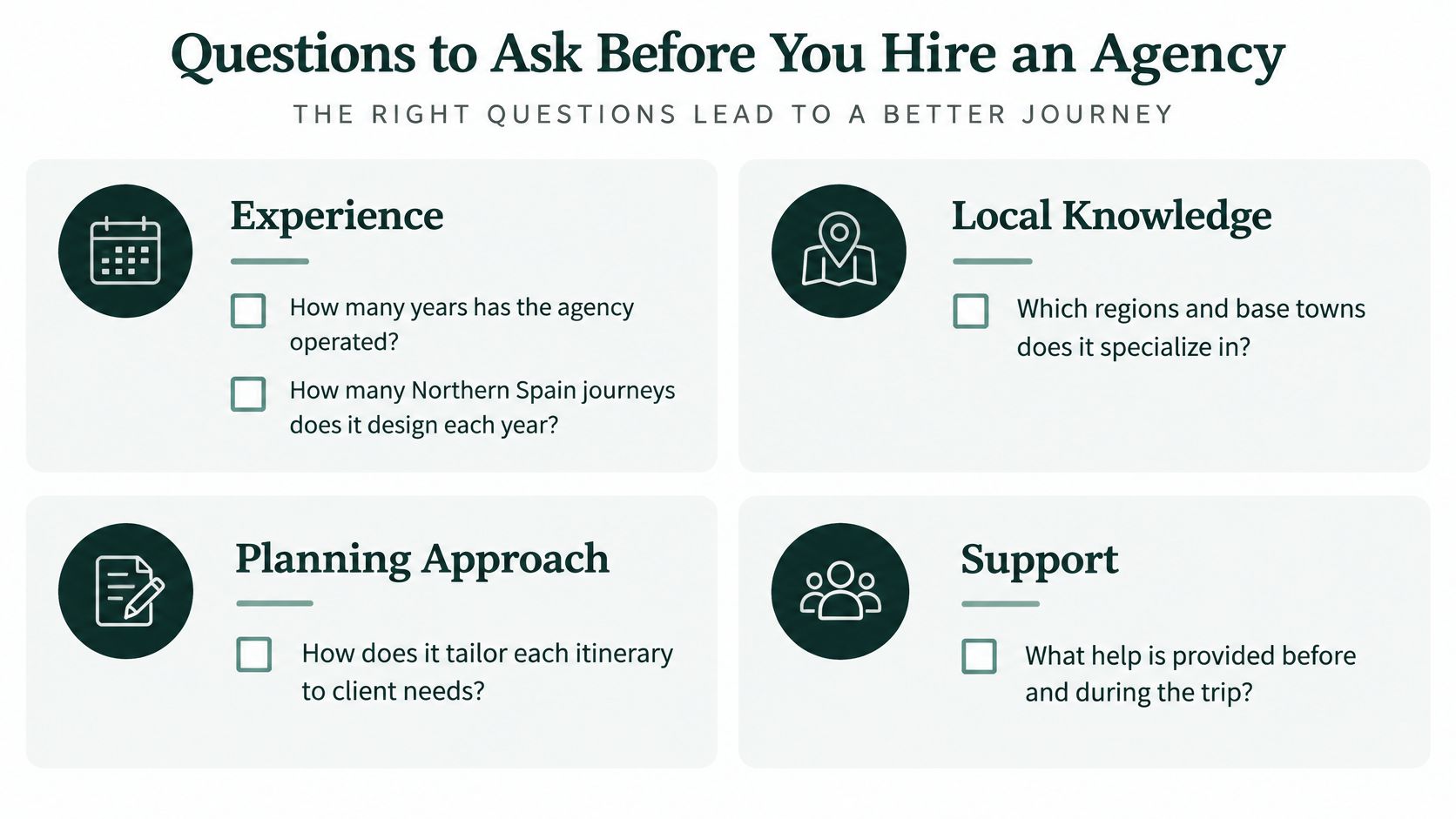
Experience and the people delivering the trip
-
What experience does your team bring, and how much work do you handle in Northern Spain? Ask separately about years in travel, years operating the agency and journeys designed locally. We bring 17+ years of travel experience. A good answer distinguishes those measures; a warning sign is presenting general travel experience as proof of detailed knowledge of every region.
-
Which regions and base towns do you know best? Look for an explanation of why a particular base suits your interests and mobility. A list of famous destinations without any route reasoning tells you little.
-
Who will guide and drive us? We provide expert private guides and local tour guides. Clarify the role required for each visit, who coordinates drivers and whether subcontracted services have an accountable contact. Subcontracting isn't itself a problem; an unclear chain of responsibility is.
Changes, privacy and financial terms
-
What happens after a weather disruption, closed restaurant or missed connection? A useful answer explains who responds, how replacements are approved and whether extra charges may apply. Our around-the-clock local support provides a contact during the trip. Be cautious if an agency promises that nothing will go wrong rather than explaining its response.
-
Will we share any part of the itinerary with other clients? Our itineraries are fully private, never shared with strangers. Elsewhere, clarify whether “private” describes the vehicle, guide, venue or entire experience, because those are different arrangements.
-
How do fees, changes and cancellations work? Request written terms identifying the contracting party, payment recipient, booking holder and applicable supplier conditions. A verbal assurance that everything is flexible isn't an adequate answer.
-
Can I review a personalized draft before committing? We create a draft from your initial checklist. Establish what you can review before payment and which commitments, if any, the agency requires to proceed. A generic sample can demonstrate presentation, but it can't demonstrate that someone has understood you.
The more specifically an agency explains who does what, the easier it is to judge whether its design process is real.
Tailored Experiences Across Northern Spain
| Region | Signature Experience | Best Season | Base Town |
|---|---|---|---|
| Basque Country | Pintxos crawls and culinary access in San Sebastián | May to October | San Sebastián |
| La Rioja | Private cellar tastings and winery visits | Late September to November | Haro |
| Navarra | Access to San Fermín in Pamplona | Early to mid July | Pamplona |
| Asturias | Cider houses and Picos de Europa hikes | May to September | Oviedo |
| Galicia | Camino de Santiago and Rías Baixas albariño | April to October | Santiago de Compostela |
| Cantabria | Altamira and coastal fishing villages | May to September | Santillana del Mar |
Use these seasonal starting points to discuss your priorities, rather than assuming every experience is available throughout each window. Venue access, weather and event schedules need checking against your actual dates.
This regional overview can help you identify the strongest starting point.
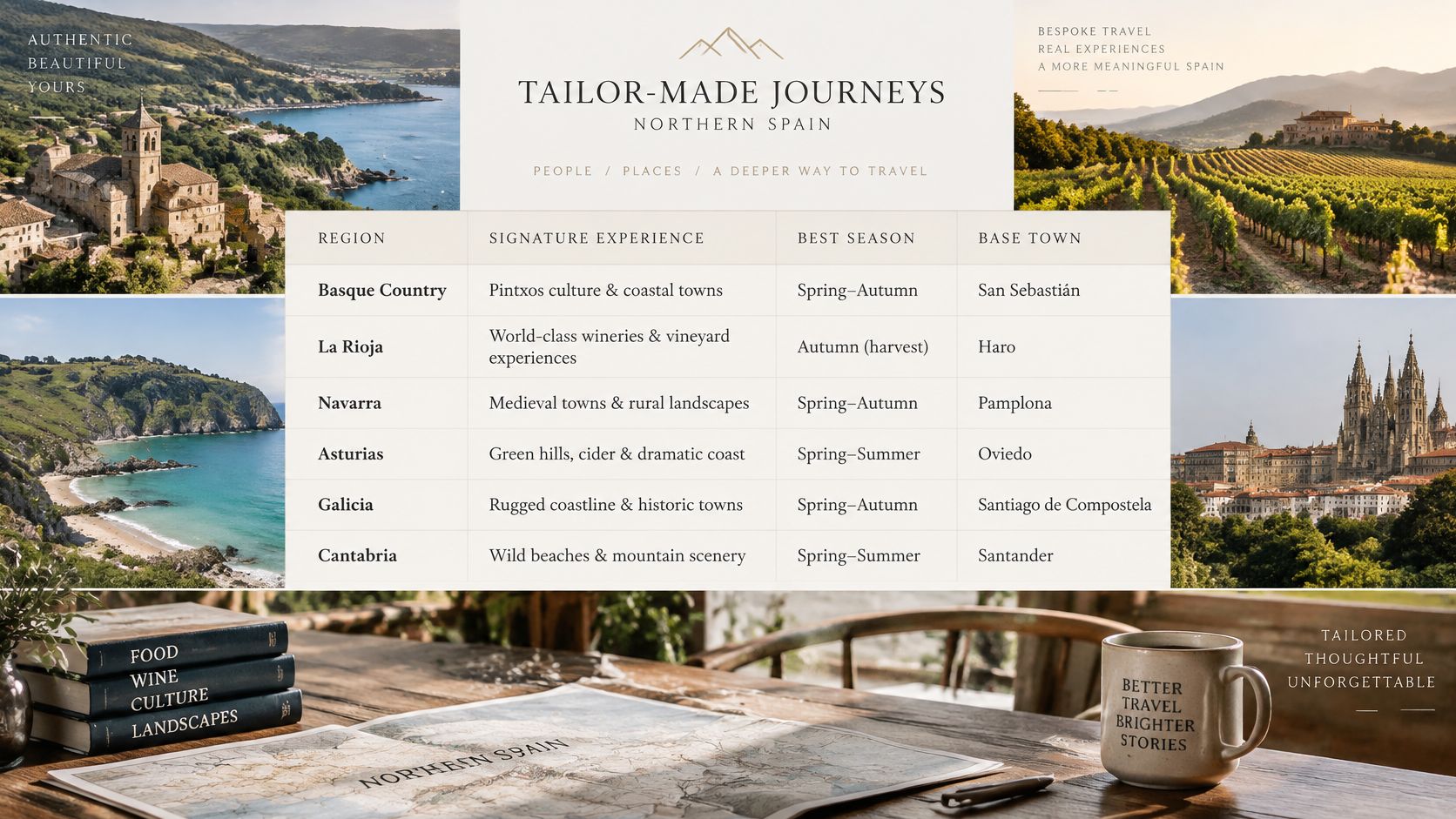
A food, wine and festival route
Say your main interests are cooking, wine and local celebrations. You could begin in San Sebastián with a guided pintxos outing and private culinary access, continue to Haro for a private cellar tasting, then finish in Pamplona with arrangements around San Fermín.
The difficult decision is the calendar. A festival-led journey fixes your travel window, while a wine-led journey might prioritize the producer's availability instead. Don't assume that a harvest-focused visit and a summer festival belong in the same itinerary.
Ask the planner to calculate each transfer using your actual hotel, winery and event entrance, including stops and arrival arrangements. City-to-city map estimates don't account for luggage, parking or restricted access during celebrations. Check event dates and operating arrangements for the year you'll travel before committing.
For a broader visual introduction to the destination, watch the video below.
Our Blended Journeys combine private driver tours, fully guided insider experiences and exclusive events in a single trip. That format doesn't require visiting every region. Pick the region that best matches your main interest, then choose the season and base town around it, adding neighboring areas only when they improve the journey.
Planning Family, Group and Milestone Trips
A journey for several generations or a private group isn't just a larger version of a couple's holiday. You're coordinating different abilities, meal preferences and sleep schedules, often alongside the expectations attached to a special celebration.
| Traveler Group | Main Planning Priority | Typical Setup |
|---|---|---|
| Couples seeking depth | Boutique hotels, fine dining and private wine access | Private driver, flexible daily pacing |
| Multigenerational families | Mixed-age activities, rest time and easy access | Adjoining rooms, short private visits, accessible viewpoints |
| Milestone groups | Privacy, balanced pacing and special dinners | Private transfers, one shared base, personal touches |
| Active-luxury travelers | Gentle hikes, coast and scenic drives | Comfortable stays with guided sections and rest days |
Design around the least flexible requirements
Start with needs that can't be negotiated: step-free access, essential dietary restrictions, suitable beds and a child's rest routine. Then separate these from preferences such as who wants another tasting or a longer walk.
We offer bespoke wine, food, culture and event-led journeys for couples, families and private groups. For luxury group travel, the practical work includes deciding when everyone should stay together and when separate activities would make the day more enjoyable.
Request adjoining rooms explicitly, rather than assuming rooms on the same floor will suffice. Discuss luggage handling and the walk between vehicle drop-off and reception. An accessible hotel doesn't automatically make the surrounding streets comfortable for someone with limited mobility.
Leave room for different energy levels
Genuine downtime means nothing is reserved and nobody has to catch up later. A short private visit followed by an open afternoon may serve children and older travelers better than a full day of exclusive appointments.
Keep alternatives that address the same interest. If rain makes a guided hike unsuitable, a private museum visit might provide a satisfying cultural afternoon, subject to availability and agreed costs. The planner should explain what can be substituted, not promise unrestricted last-minute access.
Group planning rule: Write down shared constraints separately from individual preferences. Protect the requirements everyone relies on, then offer choices around them.
For milestone trips, apply that distinction to the celebration itself. A shared dinner can be the emotional center without requiring every guest to follow an identical schedule all day.
Keeping Exclusive Trips Low-Impact
The tension is clear: 83% of global travelers consider sustainable travel vital, while 49% believe suitable options are insufficient, according to the 2025 Tourism Trends report. A bespoke agency should make the choices visible, not rely on a general promise of responsible luxury.
Calling somewhere less-traveled doesn't solve crowding if planners concentrate visitors in a newly promoted village. Privacy for a visitor also doesn't necessarily mean a lighter burden for residents.
Test the itinerary with practical questions
-
Choose quieter periods. Ask when your preferred experiences can operate outside their busiest window. Check that the proposed timing suits residents and producers, rather than arriving before a village is ready to receive visitors.
-
Distribute visits thoughtfully. Ask how the route avoids concentrating every outing in the same popular town. Spreading visits across neighboring regions can help, but not if it requires constant long-distance transfers.
-
Identify local partners. Ask who leads visits, supplies meals and hosts tastings. A locally based guide or producer gives you a clearer picture of who benefits from the booking.
-
Follow the spending. Request an explanation of which services support local businesses and what the agency's coordination covers. Transparency is more useful than an unexplained sustainability label.
Private drivers, boutique stays and exclusive access can support a more considerate itinerary, but they aren't automatic environmental advantages. Limit unnecessary driving, cluster nearby visits and book smaller venues at suitable off-peak times. Avoid access arrangements that displace residents or add pressure to already constrained events.
An early village visit instead of joining the midday visitor peak may be a sensible swap, provided opening hours and local routines allow it. Our guide to eco-friendly travel provides further context for these decisions.
Apply a final test: would this itinerary still work if half as many people visited the same place? If the answer relies on quieter encounters, viable local hosts and fewer unnecessary movements, you're evaluating something more meaningful than an exclusivity label.
Confirm the Agency Fits Before You Book
A bespoke travel agency suits travelers who want a designed journey, private access and professional coordination, and are willing to pay for the services involved. A standard tour operator is a better fit when you prefer an established route and package price with fewer decisions.
Make the decision concrete
Answer these questions:
- Direction: Can you describe your must-have experiences, preferred dates and journey style, even if you haven't chosen every destination?
- Independence: Do you want a private, adjustable pace rather than a shared departure?
- Reassurance: Would you value a local contact who coordinates solutions while you travel?
If those answers are yes, take these steps this week:
- Write a short travel brief. Include your priorities, destinations under consideration, dates, budget expectations and essential needs.
- Request a private consultation or a customized version of a journey. We offer both starting points, and our Personalized Itineraries let guests adapt experiences to their preferences.
- Evaluate the draft against the questions above. Look for thoughtful choices and clear omissions, not just an impressive list of reservations.
- Confirm who holds each booking, how changes are priced and how support will work during your trip.
The right plan isn't perfect because nothing changes. It's well designed because the people responsible can respond without leaving you to coordinate every consequence.
Northern Spain Travel designs private, custom journeys around food, wine, culture, nature and events, with local specialists and on-the-ground support. Visit Northern Spain Travel to request a private consultation or a custom journey, and bring your preferred dates, must-have experiences and the pace you'd like to keep.