
You've already explored Madrid, Barcelona and Andalusia. For your next trip, you want a quieter side of Spain, with coastal villages, thoughtful hotels and meals worth traveling for. You can book flights and rooms yourself, but you don't want to spend another holiday chasing restaurant confirmations or sorting out a missing transfer.
That's where a luxury travel agency should earn its place. The useful question isn't how many extras it includes. It's whether someone can turn your preferences into a well-judged journey and take responsibility when the details become complicated.
Table of Contents
- What a Luxury Travel Agency Does Differently
- The Services a Luxury Travel Agency Covers
- Local Access, Certainty and Its Limits
- A Luxury Itinerary for Four Traveler Types
- How Planning Works, From Brief to Booking
What a Luxury Travel Agency Does Differently
A luxury travel agency designs a private, tailor-made trip around your group's pace, interests and standards, then manages the arrangements from first contact until you return home. For the kind of journey described here, three markers matter: fully private itineraries, local specialists and around-the-clock support on the ground.
Those markers describe a service, not a hotel category. A beautiful suite won't help if your driver has the wrong collection time or your guide hasn't been told that someone struggles with stairs.
Booking inventory versus designing a journey
A booking website sells available inventory: rooms, seats, cars and activities. An agency can sell those same components without doing much more. The distinction appears when a travel designer decides which components belong together, which should be left out and who will handle a disruption.
Say you want a winery visit followed by a special dinner. Selling inventory means confirming both reservations. Designing the experience means considering the journey between them, whether you'll want another substantial meal after the tasting and whether the hotel location makes the evening comfortable.
For a complementary explanation of concierge-style assistance, the Approved Lux Personal Assistant travel guide is a useful resource when thinking about the help you want beyond reservations.
What you're actually buying
Safety belongs in that assessment. In Virtuoso's 2025 Global Luxury Traveler Report, 75% of Virtuoso clients identified safety and security as leading planning considerations, while 65% said added protection was a top benefit of using a travel advisor.
This is a substantial international business: Research and Markets estimated the global luxury travel market at approximately US$1.2 trillion in 2024, with a projected value of US$1.8 trillion by 2030.
Scale, however, doesn't prove an individual agency's quality. Use a practical test when comparing proposals:
- Judgment: Can the designer explain why a particular route suits your group?
- Coordination: Will someone reconcile conflicting arrangements across different suppliers?
- Accountability: Is there a named service responsible for resolving problems locally?
A standard booking website doesn't provide those functions across a whole private journey. An agency should be able to explain exactly how it does.
The Services a Luxury Travel Agency Covers
Service layers a luxury travel agency handles
| Service layer | What the agency handles | What the traveler gets |
|---|---|---|
| Discovery | Preferences, dates, must-have experiences | A brief the whole trip is built from |
| Itinerary design | Pacing, route, a small number of daily anchor experiences | A personalized draft to review and adjust |
| Accommodation and transport | Boutique hotel choice, private drivers, transfers | Door-to-door movement without shared vehicles |
| Guides and experts | Private guides, chefs, winemakers, local insiders | Specialist encounters beyond a standard public visit |
| Events and restaurants | Premium lounges, private boxes, scarce table bookings | Confirmed seats and tables before travel |
| On-trip support | Escalation line, reroutes, replacements | Help resolving problems while away |
A full-service arrangement connects these layers rather than leaving you to coordinate them. At Northern Spain Travel, we manage every detail from first contact until you return home, including accommodation, transport, logistics, luggage, guides and experiences.
What each layer looks like in practice
Discovery might establish that your group enjoys wine but doesn't want technical tastings every day. That distinction should change the itinerary, not just appear in a welcome email.
During design, the planner could place a coastal afternoon after an intensive cultural visit. Accommodation and transport then make that choice workable: a hotel in the right location and a private driver collecting the group at the airport remove unnecessary connections.
Guides add interpretation. A food specialist can explain what to order and how a local dining tradition works, rather than merely escorting you between stops. Restaurant and event coordination means pursuing the right reservation early and distinguishing a request from a confirmed booking.
On-trip support connects the moving parts when circumstances change. For a comparison with the flight-specific side of concierge service, Approved Jets explains what 24/7 aviation concierge covers. Treat aviation assistance and destination management as scopes to coordinate, not interchangeable promises.
Our luxury travel concierge resources provide further context for private destination arrangements.
Questions that reveal gaps
Before accepting any proposal, make the division of responsibility explicit:
- Reservation ownership: Who holds each booking, and whose name appears on the confirmation?
- Transfer failure: Who is your first call if the vehicle doesn't arrive?
- Guide selection: Is the guide a subject specialist, and are they independent or part of a supplier's standard tour?
- Support coverage: During which hours is the line staffed, and who handles urgent local decisions?
- Excluded arrangements: Which flights, meals, luggage movements or activities remain your responsibility?
Practical rule: A service is only coordinated when the next person knows what the previous person has agreed.
A gap in any layer tends to become visible during the trip, when you're least interested in becoming its project manager.
Local Access, Certainty and Its Limits
In McKinsey's survey of more than 5,000 luxury travelers, defined as travelers spending at least US$500 per night on lodging, respondents emphasized attentive service, recognition, advance knowledge of preferences and exclusive privileges. Those priorities point toward service execution and distinctive access, not more elaborate surroundings.
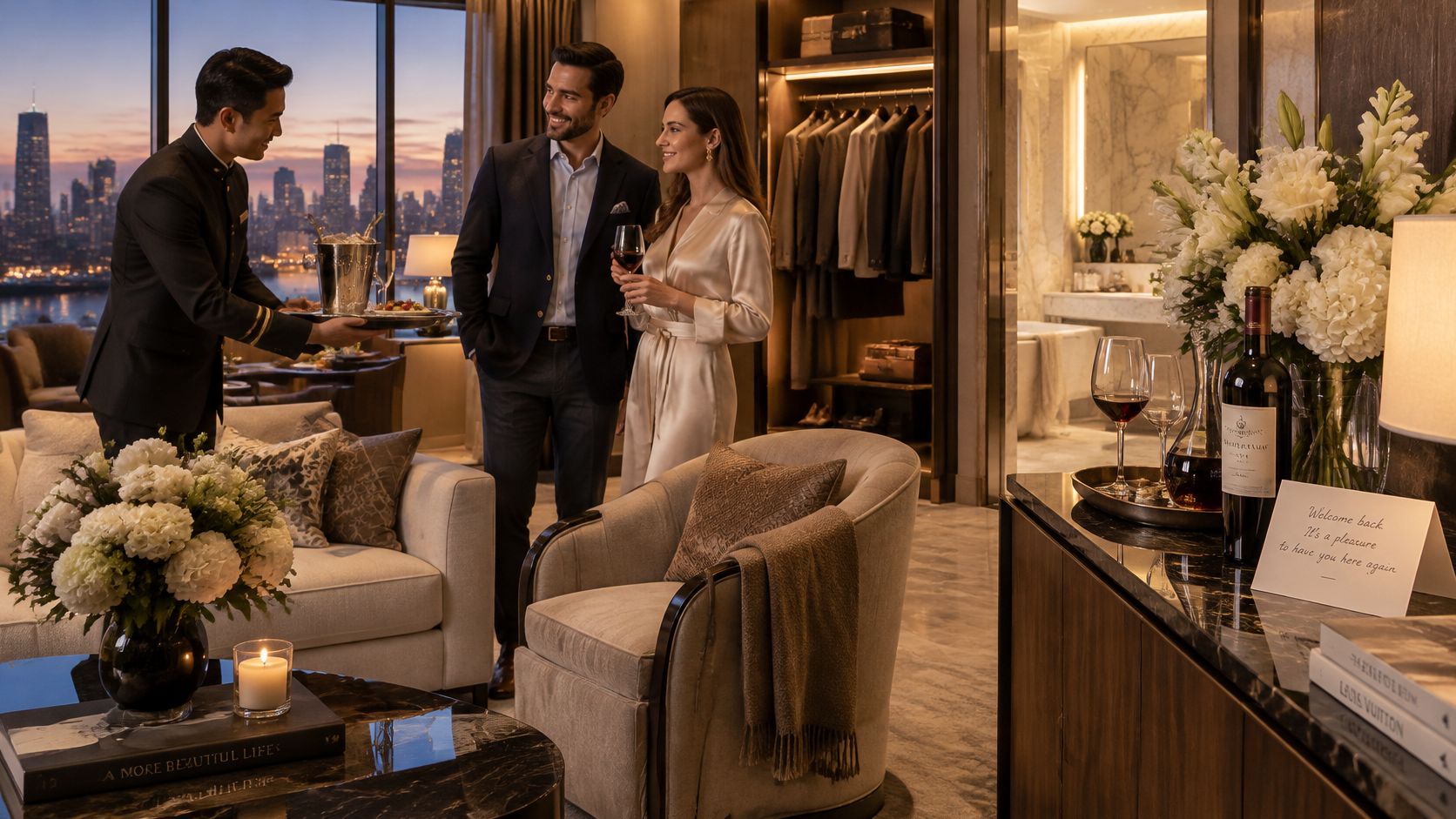
Personal attention is the useful detail behind the familiar luxury-suite image.
Local judgment makes access worthwhile
Consider a hypothetical Northern Spain journey. A private cellar tasting in La Rioja gives the group time for questions. A chef-led meal in San Sebastián can focus on the cooking that interests them. A cider house visit introduces a different setting, while a driver familiar with the Pyrenees helps make a mountain day practical.
These aren't valuable merely because they're private. Their value comes from the match between the traveler, the host and the circumstances. An excellent tasting is still the wrong choice for someone who wanted an informal lunch and an afternoon outdoors.
Our journeys are designed by local Spanish travel designers as private, tailor-made journeys, with expert private guides and local tour guides. For advisor partners, our destination management resources for Spain address the local coordination behind that approach.
Turn reassurance into operational controls
A credible service model needs more than a promise to take care of everything. It needs clear controls:
- Response-time standards: Separate urgent disruption from routine requests, identify who receives each message and establish how an unresolved issue escalates.
- Supplier-quality checks: Assess whether drivers, guides and hosts communicate reliably and recover well when something goes wrong, not just whether their presentation looks impressive.
- Contingency capacity: Identify usable alternatives for outdoor excursions, event arrangements and restaurant bookings before they become necessary.
For a festival-centered visit such as San Fermín, local planning should address the approach to the venue, viewing arrangements, crowd exposure, collection point and a comfortable exit. Premium access without an achievable pickup plan leaves an important part of the experience unfinished.
Our Exclusive Hospitality offering includes premium lounges, private boxes and luxury seating at iconic sporting and cultural events. The specific event, category and availability still need confirmation.
The following video provides an additional visual interlude on travel and hospitality.
Certainty isn't a guarantee that nothing changes
A luxury agency can't create a table at a fully booked restaurant, guarantee admission to a sold-out event or remove weather and road closures. It can explain what is confirmed, identify decision deadlines and prepare a substitute that respects the reason you booked the experience.
That distinction matters when comparing a carefully edited itinerary with a crowded package. Capital One Travel's Luxury Trendcast reports that 79% of premium travelers value curated recommendations from professional sources and 72% plan trips around dining experiences, concerts, sporting events or cultural moments; it also cites Deloitte's finding that negative financial sentiment among US travelers earning at least US$200,000 rose from 9% in 2024 to 15% in 2025.
The practical response is to make value legible. Identify the experience that matters most, explain what protects it and remove inclusions that make it harder to enjoy.
Certainty means knowing who will act, what alternatives are acceptable and which decisions still belong to you.
A usable itinerary should document realistic driving times, restaurant substitutes, walking requirements, child or elder arrangements and the escalation procedure. Privacy also needs practical decisions, such as discreet collection points and avoiding unnecessary time in crowded arrival areas.
The design principle is a small number of high-value anchor experiences, protected by travel buffers and around-the-clock escalation support. A longer list isn't a better promise.
A Luxury Itinerary for Four Traveler Types
Say your group lands at Bilbao Airport and meets a private driver for a direct transfer to the hotel. There is no shared shuttle and no extra pickup circuit, although airport formalities still take their normal course. On Northern Spain Travel's Fire & Mist journey, that drive runs straight to Pamplona and ends at Hotel La Perla in the old town, chosen because a useful location beats an impressive photograph.
From that same starting point, one planning method can produce very different holidays. A couple may want an unhurried evening nearby. A family may need dinner promptly and room to settle in. Neither arrival should be treated as unused space to fill.
What a luxury agency arranges for four traveler types
| Traveler type | Core priority | What the agency arranges |
|---|---|---|
| Couples who have seen the main cities | Depth, boutique hotels, slow pacing | Coastal villages, private wine tastings, fine dining reservations |
| Multigenerational families | Logistics and mixed-age activities | Private drivers, age-appropriate options, flexible days |
| Food and wine lovers | Authentic yet refined tables | Pintxos crawls, cider houses, reserved fine dining, private winery visits |
| Soft adventure travelers | Nature with comfort | Guided walks, scenic drives, rest stops between activities |
One region, different versions of the day
A well-designed itinerary works like a well-cut suit: same cloth, different measurements. For the couple, a village visit could leave room for browsing and a long lunch. For the family, the designer might plan a shorter guided outing for grandparents while teenagers take a more active option, then bring everyone back together over dinner. Nobody has to enjoy the same afternoon for the day to work.
Food-focused travelers need contrast as much as access. A pintxos outing, a cider house meal and a formal dinner should feel like three different experiences, not interchangeable eating appointments. An active group needs the same kind of judgment: the right walk for its ability, a suitable place to stop and comfortable arrangements afterward.
Our Blended Journeys combine private driver tours, fully guided insider experiences and exclusive events in one trip. In a journey like this, that could mean an independent-feeling scenic day with a driver, a specialist-led culinary day and a cultural event arranged around the group's interests.
Recovery belongs in the design
Later starts, fewer hotel changes, quiet rural stays and flexible dining can restore more than another spa appointment squeezed into a crowded day. Couples may want shared downtime. Teenagers may prefer an optional activity. Older travelers may appreciate a shorter outing without feeling they have held anyone back.
Design principle: Leave enough freedom for travelers to enjoy the place they came to see.
Gastronomy, wine and cultural depth do not have to disappear from a restorative trip. They need a rhythm that lets you appreciate them. What separates these four versions is judgment, not the length of the inclusion list: the traveler's brief, not a template, determines the design.
How Planning Works, From Brief to Booking
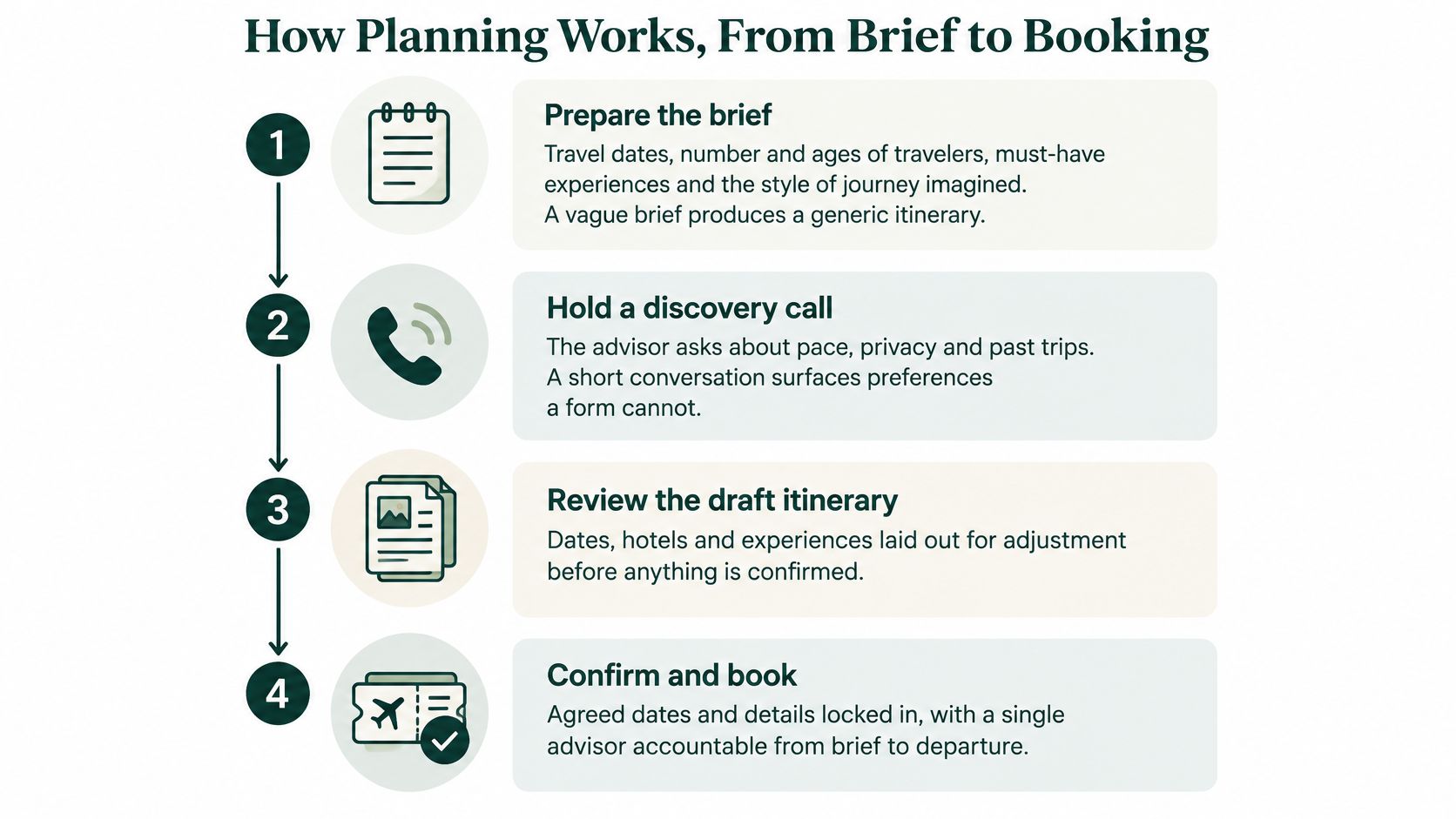
Good planning turns preferences into decisions that a hotel, driver, guide and restaurant can act on. The traveler shouldn't have to repeat the same requirements to every person involved.
The overview below shows the main stages before confirmation, followed by the checks that make them useful.
Prepare and refine the brief
-
Write down what matters before the consultation. Include preferred travel dates, the number and ages of travelers, dream destinations, must-have experiences and the style of journey you imagine. Distinguish essential requests from possibilities: a particular event may determine the route, while a general interest in wine leaves more flexibility. We use this checklist to design a personalized draft itinerary.
-
Use the discovery call to describe how you travel. Discuss pace, privacy, dietary requirements, room configuration, mobility, tolerance for driving and previous trips. Explain whether teenagers or grandparents would appreciate separate options. Specific descriptions help: “comfortable walking on level ground, but not repeated staircases” is more actionable than “moderately active.”
The reason for recording these details is practical, not decorative. In Deloitte's survey of 6,600 hotel guests across 25 brands, 75% of respondents returned to hotels delivering a strong guest experience, while luxury guests valued the ability to customize experiences 33% more than guests at other hotel tiers.
A preference record should inform supplier selection and the instructions each supplier receives. It should also distinguish information needed to deliver the trip from personal information that doesn't need wider circulation.
Review the actual day, not just the highlights
-
Read the draft as if you were traveling it. Look at departure times, meals, driving, walking and the time you'll reach your hotel. Check whether an appealing excursion still feels appealing after the previous evening's plans. Our luxury vacation planning resources offer further context for shaping a private journey.
-
Revise before you approve. Replace a hotel if its location doesn't suit you, swap a formal dinner for something relaxed or leave an afternoon free. You can request an adjusted version of a journey rather than accepting its original outline. A common mistake is approving attractive descriptions without checking how the day will feel between them.
Before approval: Explain what you'd remove as clearly as what you'd add.
Confirm responsibility and travel prepared
-
Separate proposed arrangements from confirmed bookings. Review the final accommodation, transfers, experiences and alternatives. Agree who owns each handoff, including arrival collection, hotel changes and any independently booked elements. Keep the final itinerary and relevant confirmations accessible while traveling.
-
Resolve scarce-access questions before committing. Establish the reservation deadline for the restaurant or event that matters most, what remains subject to availability and what happens if it changes on the day. Review cancellation and amendment terms for the actual arrangements rather than assuming every component follows the same rules.
-
Use local support, then give specific feedback. During travel, report a difficulty while someone can still help. Afterward, record what you enjoyed in practice: perhaps the informal meal mattered more than the formal tasting, or a longer countryside stay would have suited you better. Those details make a future journey more precise.
There are no planning fees, so the price is the trip itself. That doesn't mean the travel services are free or that every later change is without cost.
Request a private consultation with your initial checklist ready, and confirm the scope, fee terms and booking conditions in writing before paying a deposit.
Northern Spain Travel designs private, tailor-made journeys with local Spanish travel designers, specialist guides and on-the-ground support. Visit Northern Spain Travel to request a private consultation, sharing your preferred dates, who's traveling and the experiences you most want to protect.