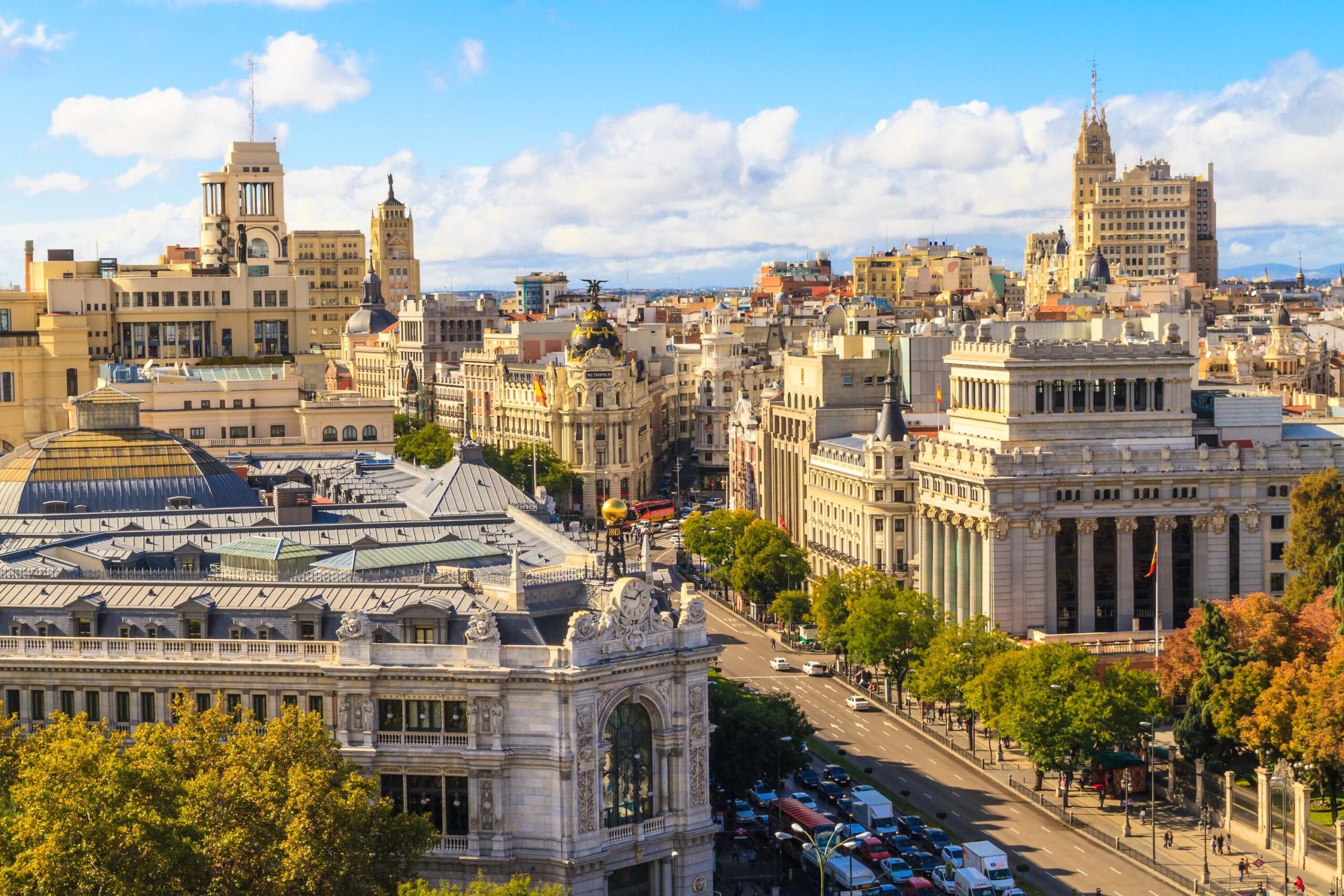
Galicia doesn't need beach weather to justify a journey. Santiago de Compostela's pilgrimage routes earned World Heritage recognition in 1993, with the Northern Routes added in 2015, giving the region an international cultural foundation quite independent of summer, as recorded by UNESCO's World Heritage listings for Spain. My recommendation is to stop treating Galicia as an appendix to a Spanish holiday. Build the trip around its distinct personalities, then give each enough time to feel different.
Table of Contents
- What Makes Galicia Different from the Rest of Spain
- Understanding Galicia's Geography and Climate
- Santiago de Compostela and the Pilgrimage Routes
- Choosing the Right Galician Coast for Your Trip
- Seafood, Wine and the Galician Table
- Two Sample Itineraries Built Around Private Logistics
- Traveling Galicia in Shoulder and Low Season
- Logistics, Accessibility and Booking Smarter
What Makes Galicia Different from the Rest of Spain
The mistake is arriving in Santiago, visiting the cathedral, eating seafood and deciding you've seen Galicia. That's a city break, not a regional journey. For travelers who already know Madrid, Barcelona and Andalusia, I'd design something more revealing: urban culture, an estuary-focused food stay, an exposed Atlantic coast and, with enough time, an inland retreat.
Luxury here should mean depth rather than accumulation. A market visit becomes worthwhile when you understand what the cook is buying. A coastal afternoon improves when you can abandon the schedule for a long lunch. A historic hotel earns its place when you have time to enjoy it rather than merely leave your luggage there.
Choose the experience before the hotel
These are the travel profiles I'd use to shape the brief:
- Urban culture in Santiago. Prioritize architecture, an informed private guide and time to experience the city outside its principal sightseeing hours.
- Coastal seafood in Rías Baixas. Put meals, wine appointments and waterside downtime ahead of a relentless sequence of villages.
- Atlantic drama on Costa da Morte. Choose this for scenery and atmosphere, not a guaranteed sunlounger holiday.
- Thermal inland escapes. Give Ourense and the surrounding countryside their own chapter rather than squeezing them between coastal stops.
Couples don't necessarily need all of them. A food-led anniversary might concentrate on Santiago and Rías Baixas, while an active family could replace some dining time with coastal walking.
Design principle: A complete journey isn't one that includes everything. It's one in which nothing feels like a compromise.
Any useful Galicia Spain travel guide should help you subtract. My strongest recommendation is to choose a dominant interest, add a contrasting setting and leave room for an unscheduled afternoon. That's more satisfying than collecting hotel keys across the region.
Understanding Galicia's Geography and Climate
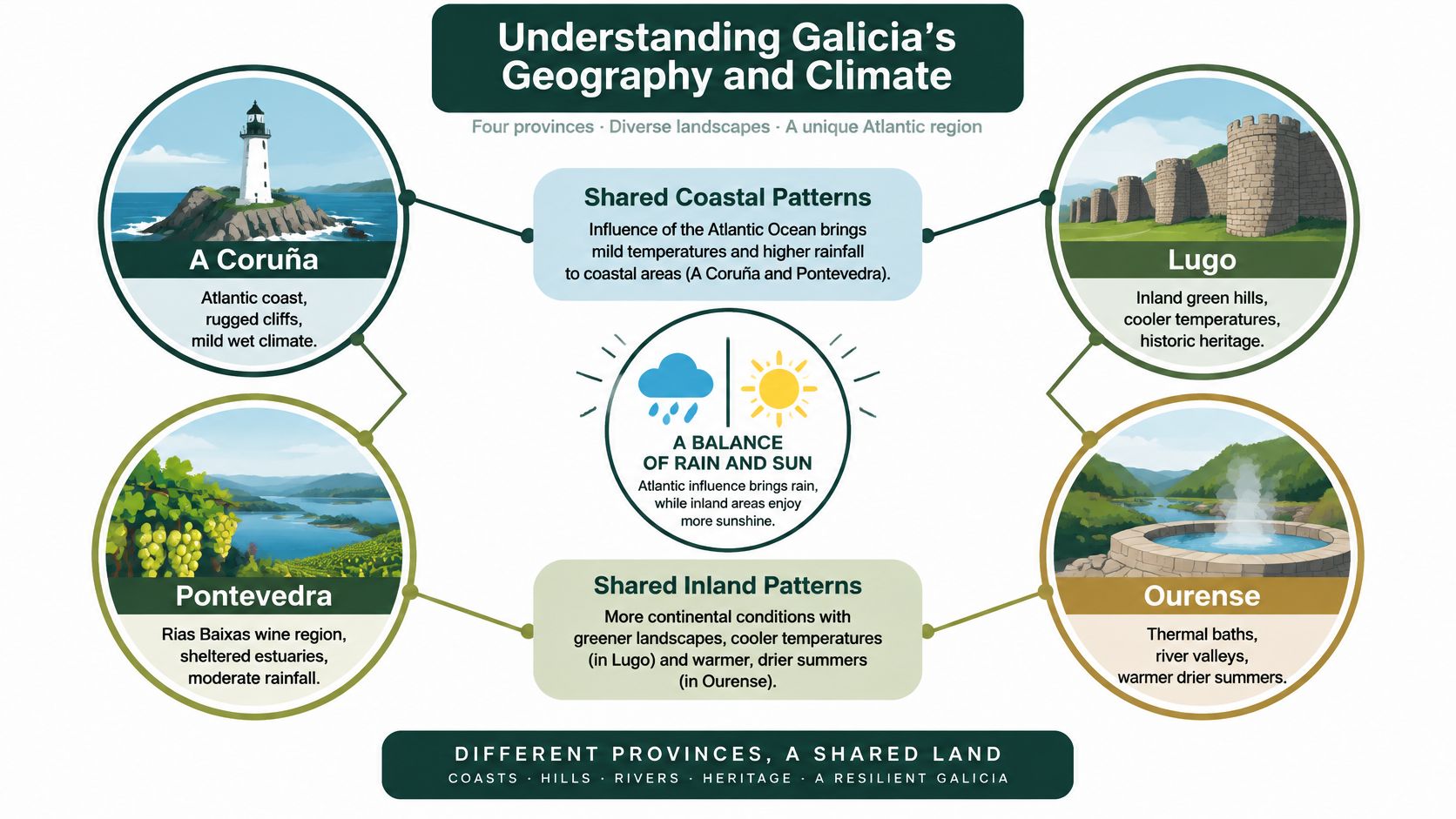
A couple I routed through Galicia last spring wanted Santiago's museums, Rías Baixas oysters and the Finisterre lighthouse inside four nights. The geography vetoed it. Galicia covers approximately 29,576.74 square kilometers across A Coruña, Lugo, Ourense and Pontevedra, and the population data confirms what the map suggests: A Coruña and Pontevedra together accounted for approximately 76.8% of the registered population in 2025, according to Spain's National Statistics Institute population figures. Roads, restaurants and services concentrate along that western Atlantic corridor, while inland Lugo and Ourense run on longer transfers and thinner infrastructure. A single base fails.
Use the map below as a routing framework. Each zone earns its days differently.
| Zone | Character | What it means for the route |
|---|---|---|
| Santiago and the western corridor | The population center, with the cathedral city and the region's best-connected services | Anchor arrival days and culture days here |
| Rías Baixas | Southern estuaries, shellfish and albariño wine country | One waterfront base beats three coastal hotels; let lunches and boat time set the schedule |
| Costa da Morte | Exposed cliffs facing the open Atlantic | Book it for drama in any month, and pick a base comfortable enough for weather days |
| Inland Ourense and Lugo | Thermal springs, river valleys and the trip's longest drives | Pair the transfer with an overnight stay; an afternoon detour wastes the distance |
Let the forecast reorder your days
Atlantic fronts arrive fast, and Galicia's rainy reputation is earned in any month. Build each coastal day around one fixed commitment, a long lunch reservation or a private boat, and hold the exposed elements, cliff walks, headland drives, as movable slots. When swell cancels the boat, swap it with an indoor day rather than losing it altogether.
The drive inland is the longest single transfer most itineraries contain. Treat it as a travel day with a worthwhile stop and a proper meal, and choose hotels you'd happily occupy through a wet afternoon. A property that charms only in sunshine is the wrong property for Galicia.
One question settles most routing debates: which bookings still work when it rains? If the honest answer is none, the itinerary isn't finished.
Santiago de Compostela and the Pilgrimage Routes
Santiago is the one Galician stop where I insist on a private guide, and the one where a mediocre guide does real damage. A generic cathedral tour reduces the city to a photo stop. A good one reads the building as the endpoint of a continent-wide network and sends you back into the streets with somewhere to go.
Scale is the part most visitors underestimate. UNESCO describes the Northern Routes as an almost 1,500-kilometer network whose documentation records 166 towns and villages and more than 1,800 historic buildings across the broader route, while Santiago's Old Town has held World Heritage status since 1985, as detailed in UNESCO's pilgrimage-route documentation. You will not "do" the Camino from a Santiago base. You can, however, walk one honest piece of it.
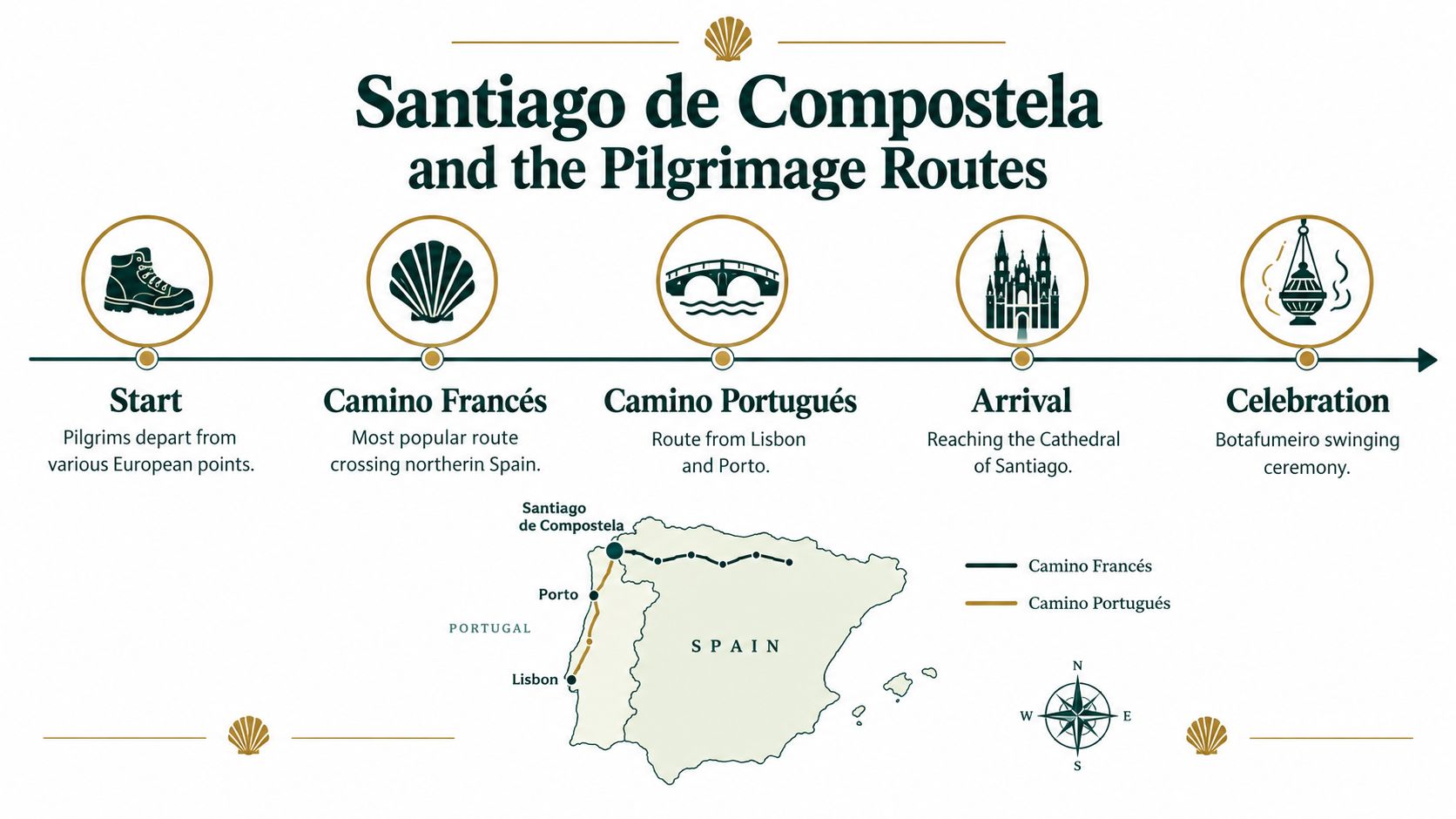
That piece is where I push back on clients. The instinct is mileage; the better brief is meaning. I route a guided half-day on a selected stage, luggage moved separately, a driver waiting at an agreed meeting point, the distance calibrated to the least enthusiastic walker in the party. Reaching the cathedral under your own steam while still fresh enough to enjoy it beats any heroic finish.
Travelers who want the walking to become the trip itself should look at a privately designed journey along the final Camino stages. That is a multi-day commitment, a different product from adding a supported walk to a wider Galicia itinerary.
Three briefs cover almost every party I send here:
- Architecture first. A guide who connects the Romanesque bones to the Gothic and Baroque layers, two focused hours, finished before lunch.
- Devotional or reflective. Quiet time protected inside the program, commentary rationed, no forced group ritual.
- Mixed-interest family. Guided city time for everyone, optional walking for those who want it, reunion over lunch.
For the overnight, Parador de Santiago de Compostela belongs on the shortlist, on the condition that the specific room category fits your party; a famous address does not guarantee a workable layout.
Whatever you book, request private guiding by name and get any restricted visit, performance or special ceremony confirmed in writing with its conditions. Verbal promises of "special access" are how disappointing mornings get made.
Choosing the Right Galician Coast for Your Trip
Choose your coastal center of gravity before booking accommodation. Rías Baixas and Costa da Morte serve different travel priorities, while A Mariña Lucense makes more sense for some routes than others. Trying to treat them as interchangeable beach destinations produces a disjointed holiday.
The seasonal preferences below are planning recommendations, not guarantees of weather or operating schedules.
Comparing Galician Coastlines for a Luxury Itinerary
| Coastline | Defining Character | Signature Experience | Best Season |
|---|---|---|---|
| Rías Baixas | Estuary-focused food and wine travel | A seafood lunch paired with a separately booked cellar visit | My preference is late spring or early autumn for a dining-led trip |
| Costa da Morte | Exposed Atlantic scenery and contemplative touring | A flexible coastal drive with a lighthouse-focused stop | Choose dates for walking opportunities, with weather alternatives |
| A Mariña Lucense | A quieter northern-coast chapter | An unhurried stay built around selected coastal outings | Favor the warmer travel period if beach time is essential |
Rías Baixas for food-led stays
For couples whose ideal afternoon involves lunch, wine and nowhere urgent to be, Rías Baixas would be my first choice. I'd use Cambados, O Grove and Pontevedra as candidates when testing the route, rather than promise to include all of them.
Choose your base after the principal restaurant and winery appointments are established. For accommodation, shortlist Parador de Cambados and Quinta de San Amaro, then compare room categories, dining arrangements and the journeys required by your actual program.
Costa da Morte for landscape
I'd send travelers focused on scenery toward Muxía and Fisterra, with O Semáforo de Fisterra considered for a lighthouse-focused stay. Confirm the precise room, access arrangements and meal provision before building the evening around the property.
Don't fill this chapter with consecutive viewpoints. A substantial walk, a leisurely meal and time to watch the coast can deliver more than a procession of brief stops.
Choose Costa da Morte because you want to spend time with the Atlantic, not because you need another destination between hotels.
For A Mariña Lucense, I'd consider Ribadeo as a routing candidate when the journey continues along northern Spain. I wouldn't add it automatically to a Santiago and southern-coast trip.
Use this guide to choosing Galicia's beaches to distinguish a scenic outing from a beach day. They require different expectations, clothing and backup plans.
Seafood, Wine and the Galician Table
Galicia cooks better than most of Spain and rewards restraint over ambition. The travelers who eat badly here are usually the ones who booked every lunch and dinner as an event. Leave gaps in the food program. A market walk before noon, a plate of whatever came in that morning, one serious tasting menu across the whole trip: that rhythm beats a week of reservations.
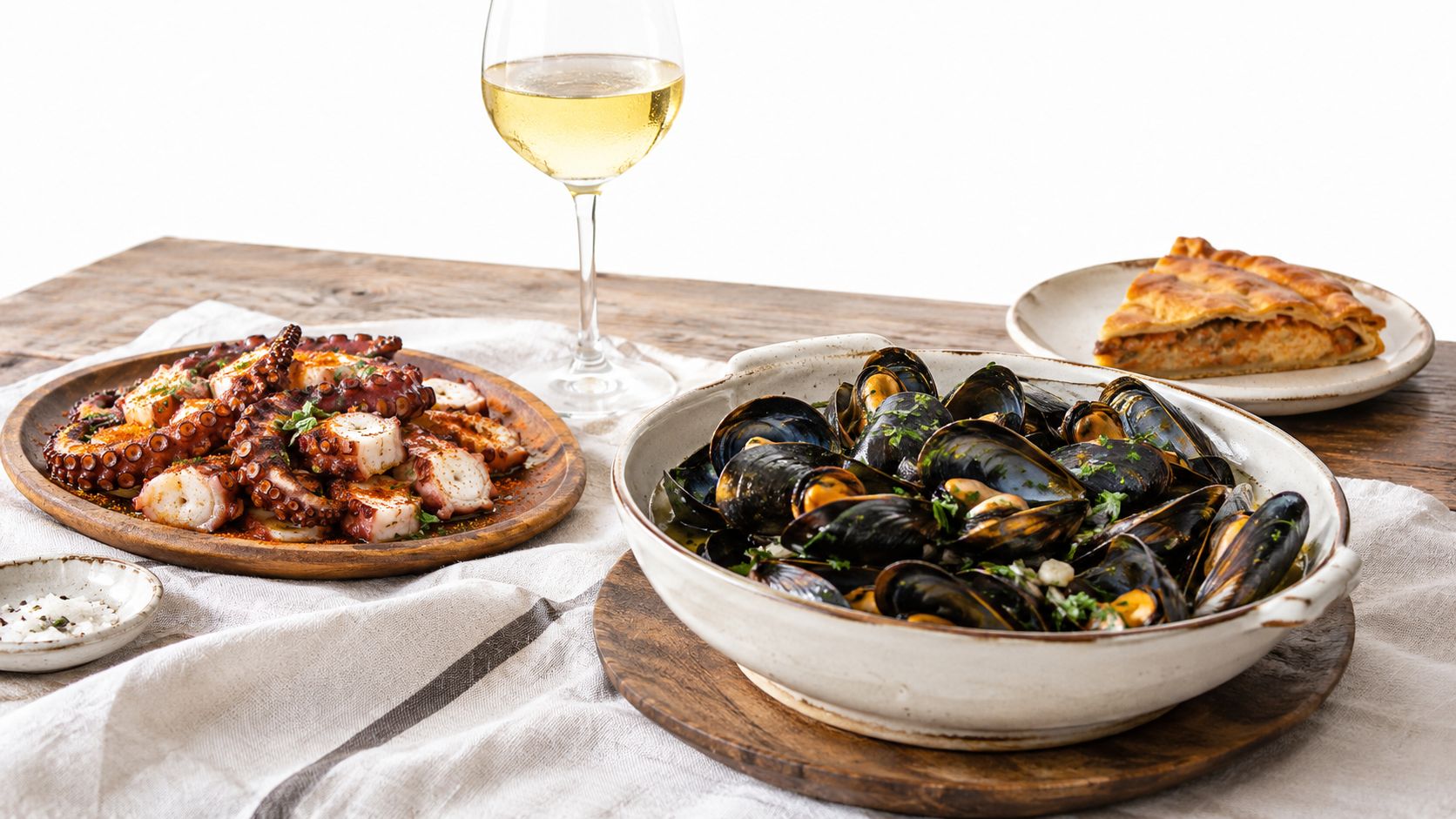
Three meals carry the program. First, a marisquería lunch on the coast, where you order from the counter and the day's catch rather than a checklist. Second, an octopus-focused meal, pulpo á feira done properly in a Santiago tavern or an inland market town. Third, a single extended tasting menu for travelers who enjoy long evenings. Put Culler de Pau and Casa Solla on the research shortlist for that slot, and verify current menus, opening dates and dietary flexibility before fixing either into the itinerary.
Never arrive with a rigid shellfish list. Percebes, scallops and specific fish move with weather and season, so ask the restaurant what's available, where it came from and how it will be prepared. If something specific matters to you, confirm it with the kitchen close to the meal rather than trusting a generic seasonal calendar.
Couples should protect one unhurried lunch and keep that evening free. Families do better requesting straightforward alternatives and realistic meal lengths at the booking stage. Wine-focused travelers should treat the cellar appointment as the day's main event, never squeezed between two substantial meals.
Watch this short introduction before telling me your own food preferences.
On wine, compare regions rather than repeat tastings. An albariño-focused cellar visit belongs to the coastal chapter; an inland program among terraced slopes suits the thermal-escape leg of the trip. The Ribeira Sacra wine and cuisine guide helps decide whether food and wine justify extending the route inland.
One practical note on packing. Galician restaurants rarely enforce dress codes, though long evenings reward comfortable clothes. Travelers combining Galicia with a Californian coastal stay can check California Cowboy's Big Sur restaurant dress code advice as a separate packing reference for that leg. Ask each booked Galician restaurant directly about its own expectations.
Two Sample Itineraries Built Around Private Logistics
These are proposed routes, not accounts of completed client trips. Hotel names are shortlist suggestions, and the final sequence should follow confirmed accommodation, restaurant availability and the party's preferred pace.
A seven-day flagship journey
| Day | Proposed program | Dining and accommodation approach |
|---|---|---|
| Arrival | Transfer to Santiago, settle in and take a brief orientation walk if energy allows | Keep dinner simple; consider Parador de Santiago de Compostela |
| Santiago | Private architectural guiding with protected independent time afterward | Reserve the more ambitious dinner for this evening |
| Camino | A selected supported walk, followed by an easy return | Have lunch after walking, not against a rigid deadline |
| Rías Baixas | Relocate south, using Pontevedra or Cambados as the principal stop | Compare Parador de Cambados with Quinta de San Amaro |
| Food and wine | A booked cellar visit and seafood lunch, leaving the later afternoon free | Avoid adding another tasting menu |
| Costa da Morte | Transfer toward Muxía or Fisterra, with weather-dependent coastal stops | Consider O Semáforo de Fisterra after checking practical suitability |
| Departure | Return toward the confirmed departure point | Add touring only if the flight timing genuinely permits it |
The route works best when the coastal chapters remain selective. I'd rather remove a village than shorten lunch or arrive at the final hotel too late to enjoy the setting.
A ten-day journey with inland Galicia
Keep the opening Santiago, walking and Rías Baixas program, then use the extended route to introduce a different rhythm rather than more coastal stops.
- Day six. Transfer inland toward Ourense. Make this a settling-in day, with thermal time only where access and suitability have been confirmed.
- Day seven. Leave room for an unhurried Ourense program and a relaxed lunch. Don't combine a substantial city visit with a tightly timed spa booking.
- Day eight. Continue toward Ribeira Sacra for a reserved wine experience. Consider Parador de Santo Estevo as an accommodation candidate.
- Day nine. Request a geographically coherent Romanesque program in Lugo province, adapted to opening arrangements and walking preferences.
- Day ten. Depart through the gateway that best fits the final base, without adding a cross-region sightseeing loop.
Before confirming either route, address vehicle comfort as carefully as hotel comfort. The Seat Belt Extenders seat advice can prompt useful questions about posture and seating, but request a properly fitted vehicle and discuss any restraint requirements with the transport provider. Don't assume an aftermarket accessory is appropriate for a particular passenger or vehicle.
My routing test: If a transfer requires skipping the experience you most wanted, change the route rather than asking the driver to rescue the schedule.
Traveling Galicia in Shoulder and Low Season
Summer isn't the only defensible choice. Official tourism figures reported summer accounting for just 29% of annual visitors and 35% of overnight stays in 2024; January, May and December 2025 each grew by more than 4% year over year, while June grew 6.7%, according to the tourism interview published by IFEMA. Those figures support considering other dates, but they don't establish that every coastal hotel, kitchen or excursion operates throughout the year.
A walking-led holiday needs a different contingency plan from an urban cultural break.
Match the month to the purpose
| Month | How I'd frame the journey | What to confirm |
|---|---|---|
| January | Santiago culture and an indoor-comfort emphasis | Hotel dining and holiday-period closures |
| February | A driver-led cultural and thermal proposal | Spa operation and flexible outdoor plans |
| March | Architecture with optional countryside outings | Walking conditions and site access |
| April | A mixed cultural and coastal program | Booking pressure around holiday dates |
| May | A candidate for combining the principal travel profiles | Restaurant and winery appointments |
| June | A strong month to investigate for an outdoor-led route | Accommodation and activity availability |
| July | A candidate when beach time matters most | Reservations before building the daily program |
| August | A family-holiday option requiring early organization | Preferred room configurations |
| September | My shortlist for food and wine interests | Winery access around producers' working schedules |
| October | An inland-led proposal with selective coastal time | Outdoor alternatives and kitchen schedules |
| November | A city-based stay with optional coastal excursions | Every destination restaurant and overnight stop |
| December | Culture, dining and a deliberately comfortable hotel | Holiday menus, closures and transfer arrangements |
Book what actually operates
For November, I'd first investigate Santiago, A Coruña, Vigo or Ourense as bases, then test coastal outings against confirmed dining options. I wouldn't promise a particular small town's open kitchen without checking the travel dates.
Likewise, don't book around an assumed shellfish peak or harvest encounter. Ask suppliers what's possible on your dates.
The off-season trade-off is straightforward: consider privacy and atmosphere, but verify availability. If swimming or a particular boat excursion is essential, choose dates around that requirement rather than expecting a winter cultural itinerary to reproduce a summer holiday.
Logistics, Accessibility and Booking Smarter
Choose the gateway after sketching the route, not before. Ask your planner to compare Santiago, A Coruña and Vigo against the actual international itinerary, including Madrid or Lisbon where relevant. Confirm operating schedules and connection conditions before assuming a convenient flight exists.
A private transfer should begin with the confirmed arrival details and end at the correct hotel entrance. Ask who monitors delays, how you contact the driver and what happens if the arrival changes.
Specify access rather than requesting comfort
“Suitable for older travelers” isn't a useful booking instruction. Describe walking tolerance, stair difficulties, transfer needs and whether anyone requires a step-free route from vehicle to bedroom.
For travelers researching powered equipment, DME Superstore's guide to find airline-friendly mobility scooters can help prepare questions. The airline must still confirm acceptance of the specific device and battery, and the ground team must confirm vehicle storage and handling.
- Rooms. Request the exact category, bathroom configuration and access route, not merely an accessible-room label.
- Vehicles. Specify luggage, mobility equipment, child restraints and passenger seating requirements.
- Walks. Ask about surfaces, gradients, resting places and a realistic alternative for anyone opting out.
- Families. Confirm connecting-room arrangements and whether separate activities can run without leaving someone waiting.
Put the support arrangements in writing
A private driver isn't automatically a guide, and a guide isn't automatically available throughout the evening. Establish who handles restaurant changes, weather substitutions, missed connections and urgent assistance.
Compare a specialist destination-management company with a self-booked journey on those practical responsibilities, not just on the hotel list. Ask who can change the plan while you're traveling, what support is included and which experiences remain subject to third-party confirmation.
Before requesting a quotation, answer the most important question: What do you want to have time for? Name your priorities, your tolerance for hotel changes and the things you'd happily omit. A strong designer should turn those answers into a selective route, not send back an encyclopedic itinerary.
Northern Spain Travel designs private, tailor-made Galicia journeys with boutique accommodation, guides, drivers and food and wine experiences shaped around your pace. Visit Northern Spain Travel with your preferred dates, travel party and priorities to discuss a route combining Santiago, your chosen coast and an inland escape where it fits.