You've found the leather piece you wanted, reserved a sculptural ceramic from a workshop in the north, and spotted the perfect final purchase online. The problem begins when you ask whether everything can be delivered to your hotel, carried onto the aircraft, returned from abroad, or included in a tax-free claim.
Luxury shopping in Spain now rewards preparation. The most satisfying journey combines a private appointment in a Madrid or Barcelona flagship, a carefully chosen artisan visit in Northern Spain, and online ordering for pieces that are safer or simpler to send home. You're not merely browsing shops. You're coordinating access, timing, documentation, delivery, and after-sales support across borders.
Table of Contents
- The Evolution of Luxury Shopping at Spain
- Where to Shop – Luxury Flagships and Artisan Markets
- Understanding the Spain VAT Refund Procedure
- Timing Your Trip – Best Periods for Shopping
- Logistics – Packing, Shipping, and Cross-Border Solutions
- Building Your Personalized Shopping Itinerary
The Evolution of Luxury Shopping at Spain
A discerning traveler arriving in Northern Spain rarely wants a generic retail itinerary. She may begin in Bilbao looking for a beautifully cut leather bag, continue to San Sebastián for local design and culinary specialties, and reserve an afternoon in a discreet workshop where the maker explains the origin of the material. Later, from her hotel, she may order a larger piece online and have it delivered directly to her home rather than allow it to occupy valuable luggage space.
That combination is the defining change in shopping in Spain. The country offers the scale of a major European consumer market, but its appeal lies in the contrast between polished urban retail and regional craftsmanship. Spain's retail market reached about USD 316.61 billion in 2024 and is projected to reach nearly USD 477.75 billion by 2034, with a 4.2% CAGR projected from 2025 to 2034, according to Spain retail market projections. Those figures describe a substantial market, but they don't explain the experience a luxury traveler wants.
Why physical retail still matters
Online commerce has become firmly established. E-commerce penetration reached 68% in 2022, with about 30 million users in 2021 and projected growth toward about 40 million users by 2025. Yet the same market research places Spanish e-commerce revenue at about USD 72 billion in 2022, equivalent to 5.7% of GDP. These figures support online research and ordering, but they don't make the boutique visit obsolete.
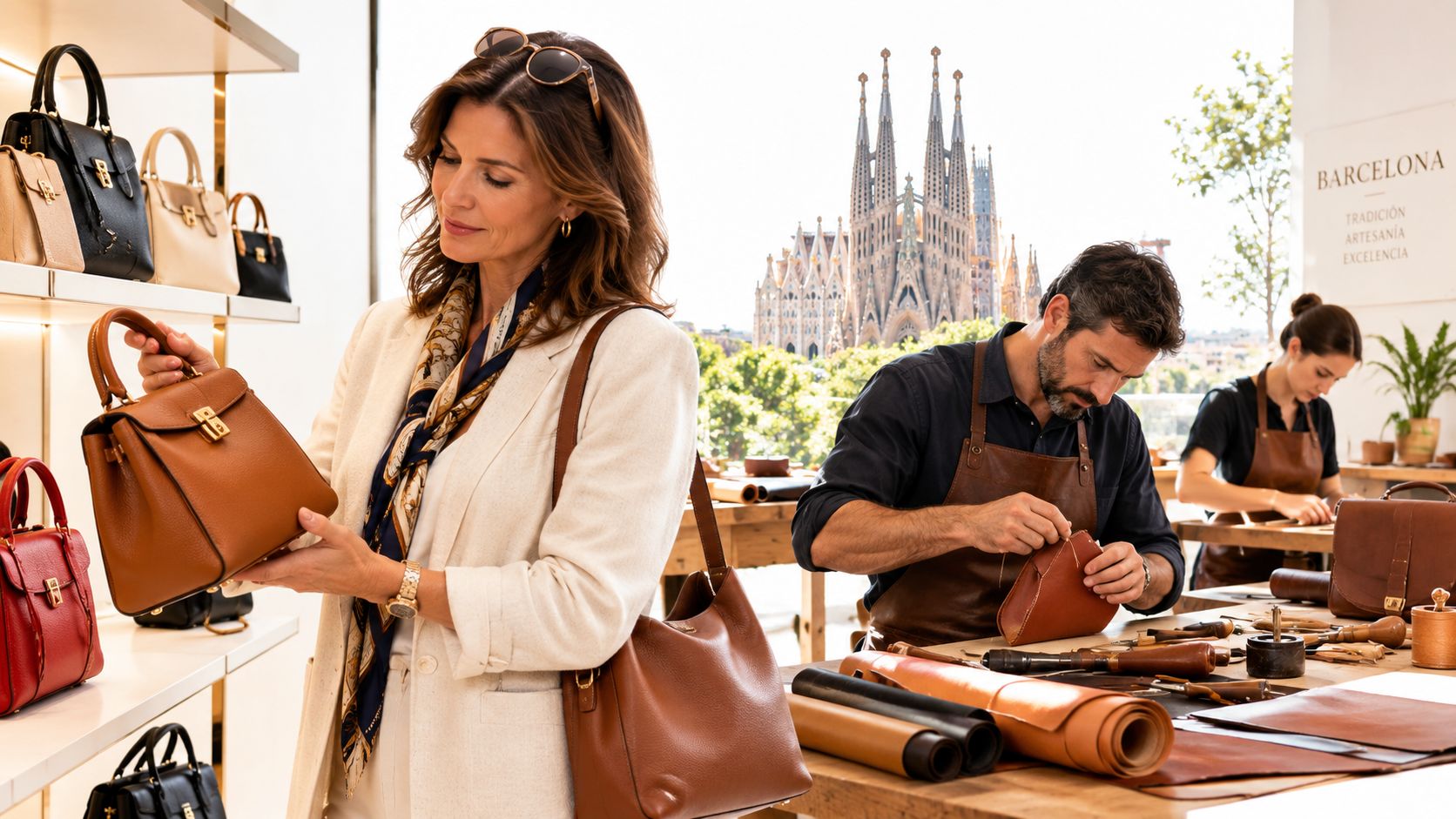
For luxury buyers, touch remains part of the decision. A handbag's structure, a textile's weight, the finish on a silver object, or the glaze on a ceramic vessel can be assessed properly only in person. Savills reported that in-store purchases on the high street accounted for 73% of sales, while online retail represented 9.7% of retail sales, and identified 10.3 retail units per 1,000 inhabitants in its Spain retail snapshot. Savills' high-street retail analysis/2025-high-street-retail-eng-february.pdf) makes the practical point clear: Spain remains a country where the physical shopping environment is unusually important.
Concierge view: Use the internet to shortlist, reserve, compare delivery options, and confirm stock. Use the boutique or workshop to judge quality, build trust, and buy what you couldn't properly evaluate from a screen.
The premium approach is therefore dual-track. Start with the physical experience, then use digital tools for availability, sizing, delivery, returns, and replenishment. That strategy is particularly valuable in Northern Spain, where the most memorable purchase may come from a small regional maker rather than a globally recognized storefront.
Where to Shop – Luxury Flagships and Artisan Markets
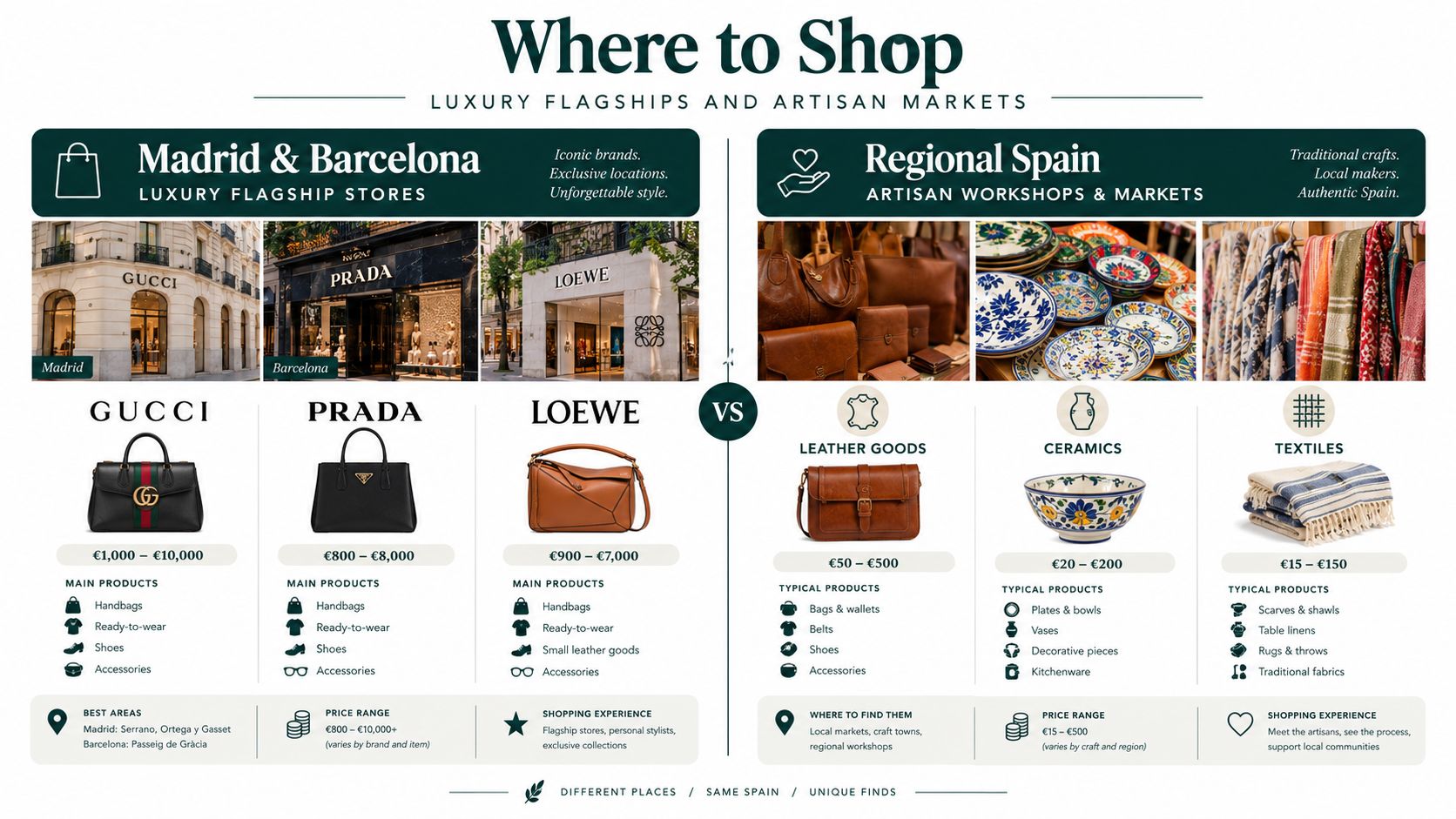
Madrid and Barcelona serve different purposes from the markets and workshops of Northern Spain. Madrid is the efficient choice for international luxury houses, polished department-store appointments, and a concentrated urban retail day. Barcelona adds fashion, design, leather, and a stronger connection between contemporary boutiques and the city's craft traditions.
Northern Spain is more rewarding when you want provenance. The Basque Country offers a refined design culture alongside regional textiles and food markets. Asturias and Galicia bring a more tactile relationship with wool, ceramics, metalwork, leather, and objects shaped by the Atlantic coast. These regions aren't substitutes for Madrid or Barcelona. They answer a different question: not "Which global label can I buy?" but "Who made this, and why does it belong here?"
Match the destination to the purchase
| Destination | Best for | Premium approach |
|---|---|---|
| Madrid | International fashion, luxury accessories, department stores | Book private appointments and group flagship visits by neighborhood |
| Barcelona | Fashion, leather, design, contemporary craft | Combine established brands with independent ateliers |
| Basque Country | Regional design, textiles, food, specialist makers | Ask for workshop access rather than relying on open market hours |
| Asturias | Local craft, ceramics, wool, and food products | Pair a market visit with a maker or producer appointment |
| Galicia | Atlantic design, ceramics, silver, and regional specialties | Build in delivery planning before buying larger or fragile pieces |
Opening hours deserve respect. Many Spanish shops close during the middle of the day, while tourist districts and major department stores often keep more continuous schedules. Don't build an expensive shopping day around assumptions. Ask each boutique whether it opens continuously, whether appointments are required, and whether the person who can advise on a special order will be present.
Private access is usually arranged directly with the store, hotel concierge, local guide, or travel designer. Send a focused request with the product category, preferred date, sizes, materials, and whether you need international delivery. A vague request for “luxury shopping” produces a generic route. A precise request for a particular leather finish, a regional textile, or a commissioned ceramic gives the retailer something useful to prepare.
The guide to beautiful markets in the Basque Country can help identify market stops that fit a wider Northern Spain itinerary. Treat a market as an entry point, not the entire experience. The best result may be a conversation with a stallholder, a recommendation to a nearby maker, or an order arranged for later delivery.
Plan for digital follow-through
Spain's retail environment is large enough to support advanced omnichannel buying. Before leaving a flagship or workshop, ask whether the seller offers online reordering, international shipping, repairs, alterations, or a digital invoice. Photograph the product label and keep the maker's contact details with your travel records.
That small amount of administration separates a memorable purchase from an awkward souvenir. You want to know who will answer if the item arrives damaged, the size is wrong, or you decide to order a matching piece after returning home.
Understanding the Spain VAT Refund Procedure
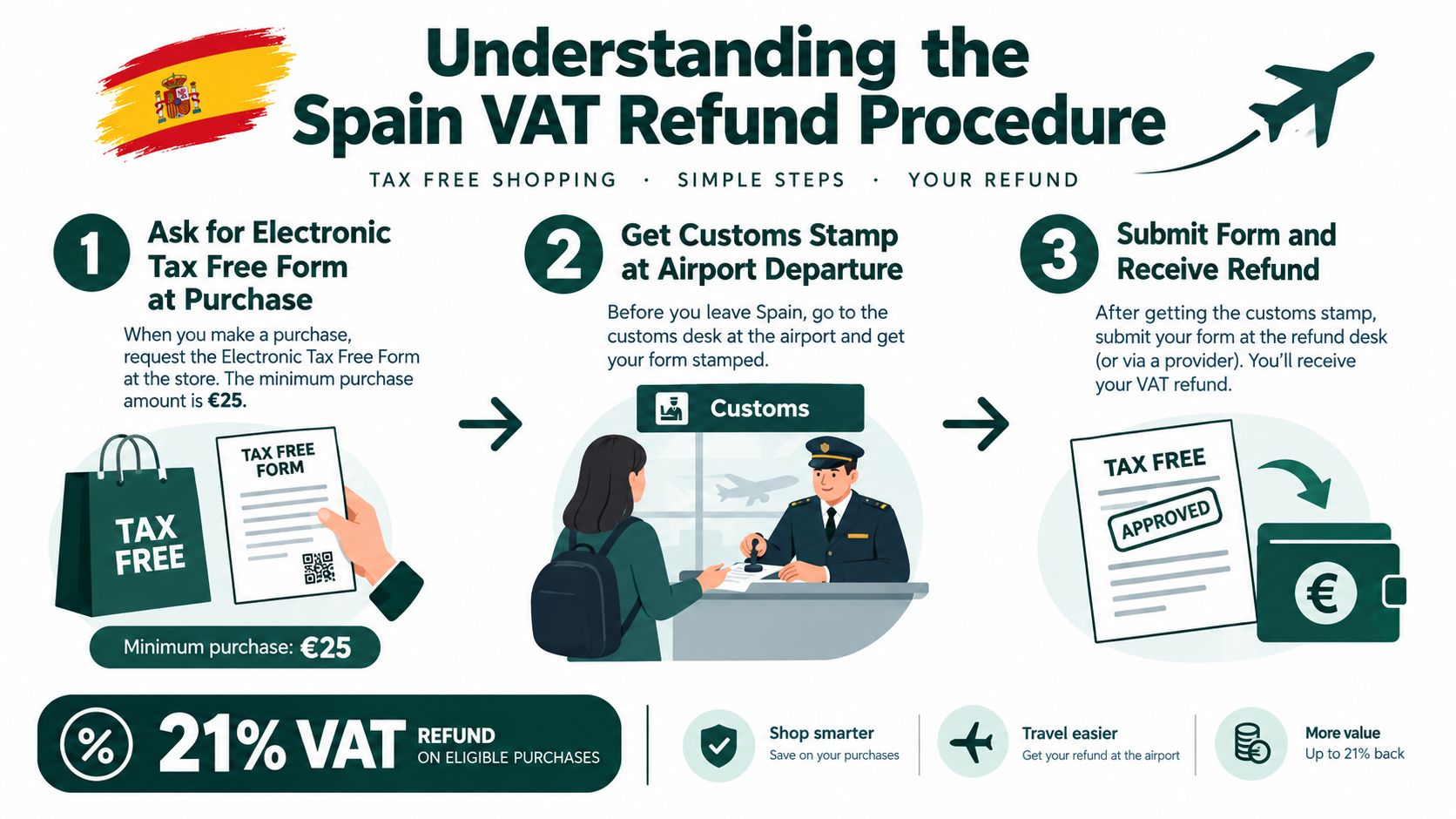
The VAT refund is straightforward only when handled in the correct order. For eligible non-EU residents shopping in mainland Spain or the Balearic Islands, the purchase must be documented with an invoice and an Electronic Refund Document, or DER. The refund must then be validated at departure before you leave the European Union. Spain's official VAT refund guidance for travelers sets out those requirements.
The most common mistake is treating the refund as a counter service that can be fixed after check-in. It can't. Customs needs to validate the documentation before the relevant goods leave the EU, and luggage may need to remain available for inspection.
Follow the process in sequence
-
Request the documents at purchase. Tell the retailer that you're a non-EU resident and ask for the invoice and DER before leaving the shop. Check that your name and travel-document details are accurate. Keep the goods, invoice, DER, and passport or travel documentation together.
-
Keep the purchases accessible. Don't bury the items inside checked luggage before customs has validated the claim. If you're checking a suitcase, ask the airport staff how to present the goods for inspection before handing over the bag. The exact airport arrangement can vary, but the principle doesn't: validate first.
-
Obtain customs validation at departure. The DER must be validated before you leave the EU. Allow generous time, particularly if your itinerary includes a connection or you're departing through a busy airport.
-
Claim the refund after validation. Depending on the retailer and arrangement, you can claim through the store, an authorized intermediary, or an early-refund operator. Payment may be made by cash, card, bank transfer, or cheque, although intermediary fees are typically deducted from the refunded amount. Spain's official refund payment instructions explain the available routes.
Canary Islands, Ceuta, and Melilla are excluded from Spain's VAT refund framework because they use different indirect taxes rather than VAT. Don't assume that a purchase made in one of those territories qualifies just because it was bought in Spain.
Airport rule: The DER is useful only if customs validates it before departure. Store the paperwork with your passport, not in the suitcase you plan to check.
Keep a digital copy of the invoice and DER, but don't rely on a screenshot alone. If the original document is required, you need the original. For general clothing returns after the trip, a practical resource on how to get refunds fast for clothes can help you separate ordinary retail returns from the separate tax-free procedure.
Timing Your Trip – Best Periods for Shopping
The right shopping period depends on what you want to buy. For fashion, traditional sale periods can offer strong value, but the selection narrows quickly. For artisan goods, the better timing may be linked to a local market, a cultural event, a harvest, or the maker's own production calendar. For luxury flagships, a private appointment outside the busiest visitor periods often matters more than a public sale.
Recent market data also shows why tourism is reshaping the retail calendar. Retail sales in Spain grew 4.2% during 2025, shopping-center sales rose 1.5% year on year in December 2025, and fashion, home, and specialty retail were identified as the strongest categories. Tourism hubs including Madrid and Barcelona reached near-historic occupancy levels during the period discussed by Spain's shopping and retail overview. Plan around demand, not just weather.
Choose the season by objective
-
For fashion: Travel when the collections you want are available, then ask the boutique to reserve sizes before your arrival. Sales can be attractive, but don't sacrifice choice for a discount.
-
For regional crafts: Prioritize a market or cultural event that gives you access to local makers. The most distinctive pieces may not be stocked year-round.
-
For privacy: Avoid the busiest public periods and ask a concierge to arrange a morning workshop visit or an after-hours boutique appointment.
-
For home design: Build in time for measurements, production discussions, and shipping estimates. A beautiful object is a poor purchase if it can't reach your home safely.
Northern Spain rewards travelers who leave room for unplanned discovery, but luxury shopping still needs anchors. Select the cities, market visits, and appointments first, then allow flexible time for a second visit or a piece that requires a later collection.
The seasonal luxury guide to Northern Spain is useful when deciding whether your itinerary should follow climate, cultural events, food and wine, or access to regional producers. Crowds are not always a disadvantage. A well-timed event can bring together makers and buyers who are otherwise difficult to meet. The trade-off is that hotels, drivers, and sought-after appointments become harder to secure.
Logistics – Packing, Shipping, and Cross-Border Solutions
The purchase isn't complete when the card is charged. It's complete when the item arrives safely, can be insured and tracked, and can be returned or repaired if necessary.
Separate your purchases into three groups. Items that are compact and sturdy can travel with you. Fragile ceramics, crystal, and delicate objects need specialist packing. Large or high-value pieces should usually be shipped through a professional service arranged by the seller, your hotel, or a trusted forwarding partner.
Decide what travels with you
For a small ceramic, ask the maker to wrap the piece in protective material, place it in a rigid inner box, and then secure that box inside a larger outer carton. Don't place fragile objects loosely among clothing. Keep them in carry-on baggage only if the size and airline rules allow it, and remember that security screening and overhead storage add handling risk.
Perfume, oils, and other liquids require a different approach. Guidance on packing perfume for shipping is useful when a boutique or producer needs to send fragrance internationally rather than hand it to you at the airport. Ask about leak protection, declared contents, carrier restrictions, insurance, and whether the recipient country applies additional customs requirements.
A forwarding service can be preferable when you're buying from several regions. Each seller sends to one controlled address, the forwarding company consolidates the parcels, and you receive one shipment with a single tracking process. Direct delivery from a major retailer may be faster, but it can create several separate arrivals and separate customs records.
Keep the digital trail
Ask for:
-
A detailed invoice: Include the maker, product description, materials, value, and delivery address.
-
A condition record: For fragile or one-of-a-kind pieces, photograph the item and packaging before dispatch.
-
A tracking reference: Confirm the carrier, insurance terms, estimated delivery window, and who handles a claim.
-
A returns route: Find out whether returns go to Spain, a local distributor, or a regional service center.
Online ordering isn't a compromise when the item is better protected by professional fulfillment. It can also allow you to buy after seeing the product in person, reorder a preferred size, or send a bulky home object directly to your residence. Use what to pack for Northern Spain as a practical starting point, but leave room in your planning for purchases that won't travel in your suitcase.
Building Your Personalized Shopping Itinerary
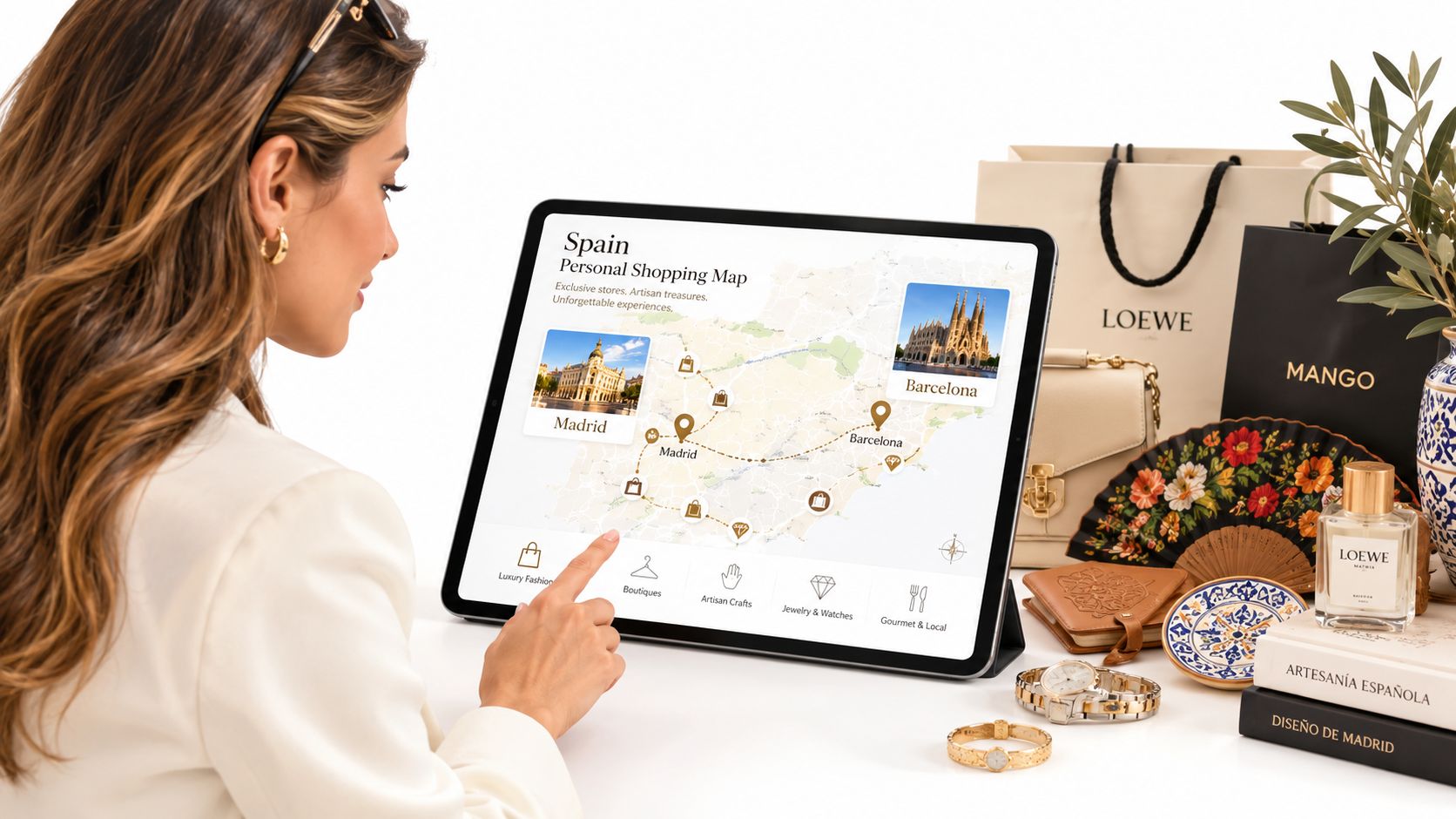
A strong itinerary begins with a buying brief, not a list of famous streets. Write down the categories you care about, the pieces you're prepared to commission, the items you want to handle personally, and the purchases you'd rather ship. Add preferred materials, sizes, colors, dietary or mobility considerations, and the maximum amount of time you want to spend shopping in a day.
Start with the route
Choose one urban luxury anchor and one regional craft focus. Madrid or Barcelona can handle international brands, appointments, alterations, and immediate comparison. Northern Spain then provides the context and originality that make the journey personal.
Give each appointment a purpose. A flagship visit might be for a specific collection or made-to-order consultation. A workshop visit might be for a demonstration, a commission, or a conversation about materials. A market morning might be for regional food products and introductions rather than a large purchase.
A private agency or local concierge should confirm practical details before you arrive:
-
Access: Who will receive you, and is the maker or senior sales adviser available?
-
Timing: How much time does the appointment require, including measurements or customization?
-
Payment: Can you pay by card, deposit, or bank transfer, and will the retailer issue the DER?
-
Delivery: Can the seller ship internationally, or should the purchase go to a forwarding address?
-
After-sales: Who handles alterations, repairs, damage claims, or returns?
Don't underestimate administration. Travelers managing multiple purchases should keep invoices, receipts, delivery records, and VAT documents in one digital folder. These expense reporting best practices are designed for business travel, but the same discipline makes a complex personal shopping journey much easier to audit.
The right itinerary also protects your attention. Schedule demanding shopping appointments when you're fresh, leave time between boutiques, and place fragile or large purchases late enough in the trip that you don't carry them through unnecessary transfers. If a piece requires production or shipping, confirm the address and delivery window before you approve the order.
A local travel designer can coordinate drivers, interpreters, private guides, hotel receiving staff, workshop access, and customs-sensitive paperwork without turning the experience into a group tour. Northern Spain Travel is one option for arranging private, tailor-made journeys that combine regional markets, specialist producers, boutique hotels, guides, and logistics across Northern Spain.
The final decision is simple. Buy in person when touch, provenance, and personal access matter. Order online when stock, safety, or delivery makes that the more intelligent choice. Use the two channels together, and the shopping becomes part of the journey rather than an interruption to it.
A carefully planned Northern Spain itinerary can pair private artisan access with polished city shopping, secure delivery, and calm handling of every purchase. Visit Northern Spain Travel to discuss a private journey built around the makers, boutiques, markets, and cross-border shopping logistics you want to experience.