You've found the right region, shortlisted beautiful hotels, and saved more restaurants than anyone could possibly visit. Yet the itinerary still feels oddly interchangeable. One day is overfilled, the next requires an exhausting transfer, and the experiences that mattered most to you are buried beneath premium rooms and complicated logistics.
That's the central problem with conventional luxury vacation planning. It treats luxury as a collection of upgrades. A private journey works differently. The brief, the route, the hotels, the guides, the transport, and the contingency plan must operate as one system, all designed around how you want to feel when you return home.
Table of Contents
- Start with How the Trip Should Feel
- Build a Realistic Planning Timeline
- Choose Region and Season with Intent
- Select Boutique Hotels and Private Guides
- Arrange Transport and On-the-Ground Logistics
- Design Exclusive Experiences That Earn Their Place
- Plan for Contingency Before You Need It
Start with How the Trip Should Feel
A couple may say they want “somewhere special” and “a bit of food and wine.” That sounds attractive, but it isn't a usable brief. It leaves the planner guessing about privacy, energy, access, accommodation, and the amount of time you're willing to spend in a car.
The strongest journeys begin with an emotional outcome, not a destination. You might want to feel restored, privately immersed, intellectually stimulated, celebrated, or pleasantly surprised. Those words determine whether the right plan includes a quiet Atlantic village, a late dinner in San Sebastián, a private cellar visit, or a slower day with no scheduled activity at all.
YouGov's 2023 analysis of affluent travelers found that 44% of high-income earners considered travel increasingly important, compared with 35% across all income groups. Among young affluents, the figure reached 54%, while 31% of affluent consumers were willing to pay more for meaningful travel options, including nature and remote destinations. Premium demand clearly extends beyond the hotel category.
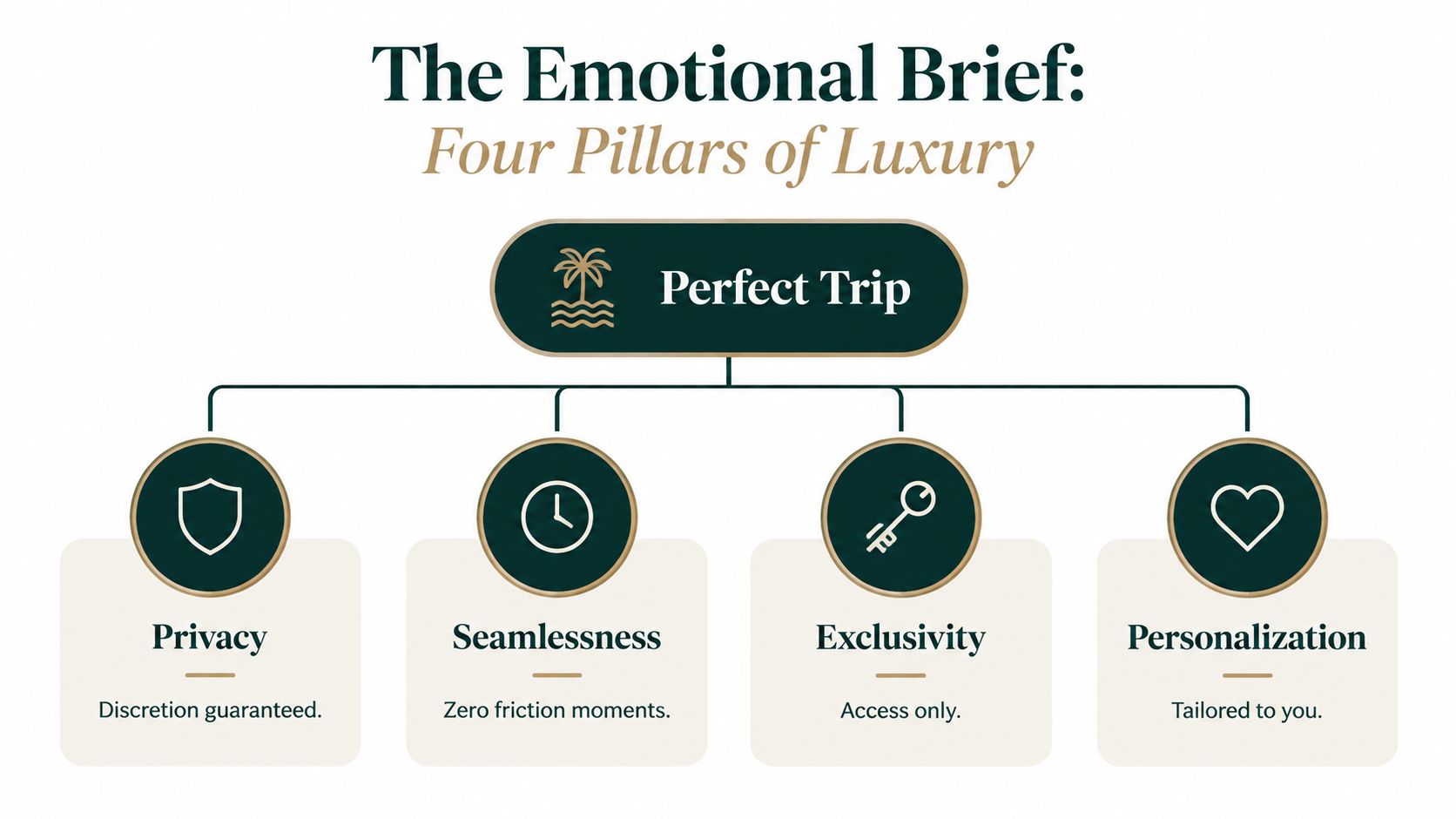
Four questions shape the brief
Privacy means more than a private vehicle. Decide whether you want discreet hotels, private dining rooms, uncrowded sites, a villa, or freedom from group schedules. A couple seeking quiet may prefer a small property with a hidden garden over a larger resort with more facilities.
Pace determines the quality of every other decision. Decide how many active mornings you want, whether late dinners suit the group, and how often you want a full afternoon without a commitment. A beautiful itinerary becomes tiring when its rhythm ignores the traveler.
Access identifies what should feel unavailable to ordinary tourism. That might mean meeting a winemaker in a working cellar, entering a cultural site with an expert before the main crowds, or visiting a family producer through a trusted local relationship.
Comfort standards must be specific. Define room configuration, bed preferences, air conditioning, lift access, dietary requirements, walking tolerance, luggage handling, and the acceptable length of a transfer. “Five-star” doesn't answer these questions.
Practical rule: If a preference can't change a booking, route, timing, or supplier decision, it isn't yet part of the brief.
For a couple, the brief might read: “We want to feel restored and privately connected to Northern Spain, with two meaningful food and wine encounters, elegant small hotels, gentle walking, and no more than one demanding transfer day.” For a family of four, it might be: “We want shared discovery without constant togetherness, with a comfortable base, parallel activities for different energy levels, flexible dining, and reliable downtime.”
That distinction is the foundation of slow, immersive travel. A useful explanation of the philosophy appears in this guide to slow travel and immersive journeys. The point isn't to do less for its own sake. It's to make each decision serve the feeling you came for.
Build a Realistic Planning Timeline
Luxury trips are won or lost before the first reservation is made. A late brief forces compromises, particularly when the itinerary depends on a small boutique property, a respected guide, a sought-after restaurant, or an event with limited access.
A practical planning calendar looks like this:
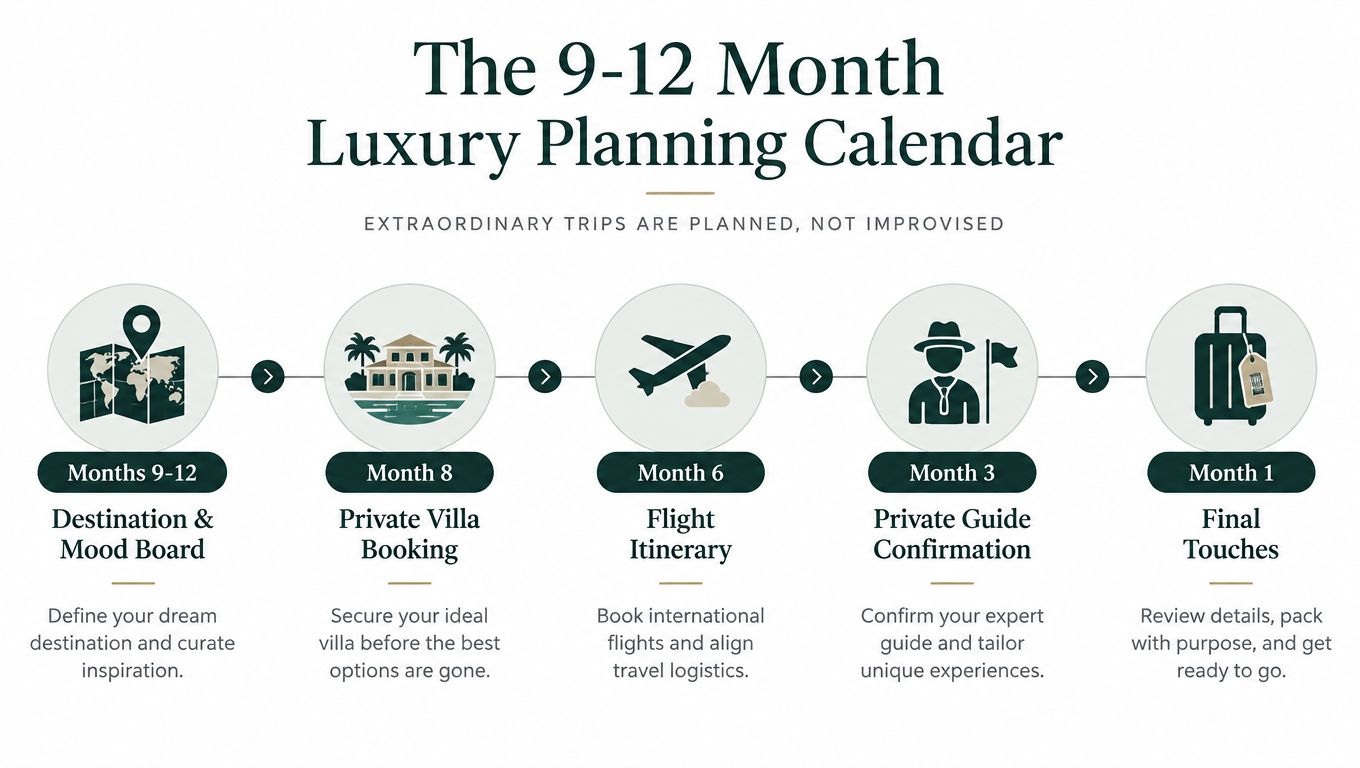
Months 9 to 12
Start with the emotional brief, possible travel windows, and the group's must-haves. The output should be a destination and mood board, not a final itinerary. Compare the Basque coast, La Rioja, Navarra, Cantabria, Asturias, Galicia, and the Pyrenees according to the traveler's desired energy.
At this stage, create a preliminary shortlist of hotels and anchor experiences. Check whether the season supports the experiences you want, rather than assuming every region operates at the same rhythm year-round.
Month 8
Secure the accommodation strategy. That may mean a villa for privacy, adjoining rooms for a family, or a sequence of intimate hotels that each contributes something different. Don't book five versions of the same luxury. One property might win on setting, another on cuisine, and another on access to a particular region.
The output is a lodging shortlist with clear trade-offs, including room layout, location, dining, accessibility, and transfer implications.
Month 6
Build the flight and routing logic around the ground experience. Confirm arrival and departure cities, regional connections, luggage requirements, and the direction of travel. A route that looks elegant on a map can be awkward at street level, particularly when historic centers restrict vehicle access.
Create a vendor hold list for guides, drivers, chefs, restaurants, and specialist hosts. Holds are useful, but they aren't confirmations. Record expiry dates and decision points.
Month 3
Confirm private guides and the anchor experiences that define the trip. This is also the right point to test whether the plan has enough breathing room. Remove activities that repeat the same idea or create unnecessary friction.
A useful companion resource is this stress-free trip planning guide, particularly for organizing decisions before the details become overwhelming.
Month 1 and the final days
Reconfirm every critical supplier in writing. Check arrival times, dietary needs, mobility requirements, cancellation rules, weather alternatives, luggage movement, and the person responsible for escalation. Give the traveler one clean operational document, not a pile of disconnected confirmations.
End with a post-trip debrief. Record what the clients loved, what felt slow or rushed, which room configuration worked, and which suppliers deserve to be used again. A strong profile improves every future journey.
The planning principle is simple: each milestone must produce something concrete. If a planning conversation ends without a shortlist, a decision, a hold, a confirmation, or a contingency, it probably hasn't moved the trip forward.
Choose Region and Season with Intent
Northern Spain does not deliver one luxury travel experience. It delivers several, and the season changes the mood, pace, and practical demands of each.
San Sebastián in July feels entirely different from San Sebastián in May. La Rioja during harvest has a different energy from a quiet spring visit. The Atlantic coast, inland wine country, mountain villages, and pilgrimage regions each require a deliberate balance of weather tolerance, driving appetite, crowd sensitivity, and the emotional outcome the traveler wants to take home.
Start with the feeling the trip must create, then score the regions against that brief. I use a qualitative scale for gastronomy depth, coastal energy, mountain access, crowd tolerance, driving comfort, guide availability, and seasonal relevance. The highest score does not automatically win. A food-focused couple may accept longer drives for a rare cellar visit, while a multigenerational family may prefer one compact base with simple regrouping and fewer daily transitions.
| Primary Motivation | Best Region | Best Months | Why These Months |
|---|---|---|---|
| Refined gastronomy and pintxos | Basque Country | Spring and autumn | Comfortable conditions support walking, dining, markets, and private culinary visits without making the entire trip feel like a peak-season exercise. |
| Wine and cellar access | La Rioja and Navarra | Spring and harvest season | The vineyard setting and producer calendar can add meaning to tastings, while careful scheduling helps avoid the most congested periods. |
| Atlantic villages and coastal scenery | Cantabria, Asturias, and Galicia | Late spring through early autumn | Longer daylight supports scenic drives, gentle coastal walks, seafood experiences, and flexible outdoor planning. |
| Mountain scenery and soft adventure | Picos de Europa and the Pyrenees | Late spring through early autumn | Trails, viewpoints, and village visits are easier to combine with comfortable lodging and private guiding. |
| Cultural depth and quieter immersion | Navarra and inland Basque Country | Spring and autumn | These periods suit slower routing, local conversations, historic sites, and food-led travel with less pressure on the schedule. |
Score experiences, not postcards
A famous destination can still be a poor fit if it creates long transfers, rigid meal timing, or activity levels the party will not enjoy. Score every candidate experience for authenticity, exclusivity, comfort, seasonality, logistical friction, and emotional fit.
A private winery visit may score highly for access and authenticity but poorly for mobility if the cellar has uneven floors or no easy vehicle approach. A celebrated restaurant may serve superb food yet suit a family badly if the meal runs late and no nearby alternative exists. Judge the whole day, including the return to the hotel, rather than the reputation of one component.
Shoulder-season planning works especially well for travelers who value atmosphere over social proof. It can preserve the identity of a destination while creating a calmer pace, better conversations with hosts, and more flexibility around weather and timing. The trade-off is operational: seasonal events, terraces, and specialist producers may run differently. Confirm availability directly instead of assuming the usual program will apply.
The route must support the feeling, too. For Northern Spain, I prefer two or three connected regions over a grand tour that turns every beautiful scene into a view from the back seat. More stops do not create a richer journey when each one consumes energy in transit.
The right season cannot rescue an overambitious itinerary. It gives a well-designed route room to breathe, protects time for spontaneous moments, and keeps the final memory focused on discovery rather than logistics.
Select Boutique Hotels and Private Guides
A couple arrives at a small hotel in the Basque countryside. The property has fewer rooms, a distinctive restaurant, and an owner who knows which local producer is worth visiting. Their private guide isn't there to recite a standard history lesson. She changes the afternoon because the couple is curious about architecture, introduces them to a local contact, and drops the final stop when the day has reached its natural limit.
That is the booking logic luxury travelers should seek. Accommodation and guiding are one connected choice, not separate purchases.
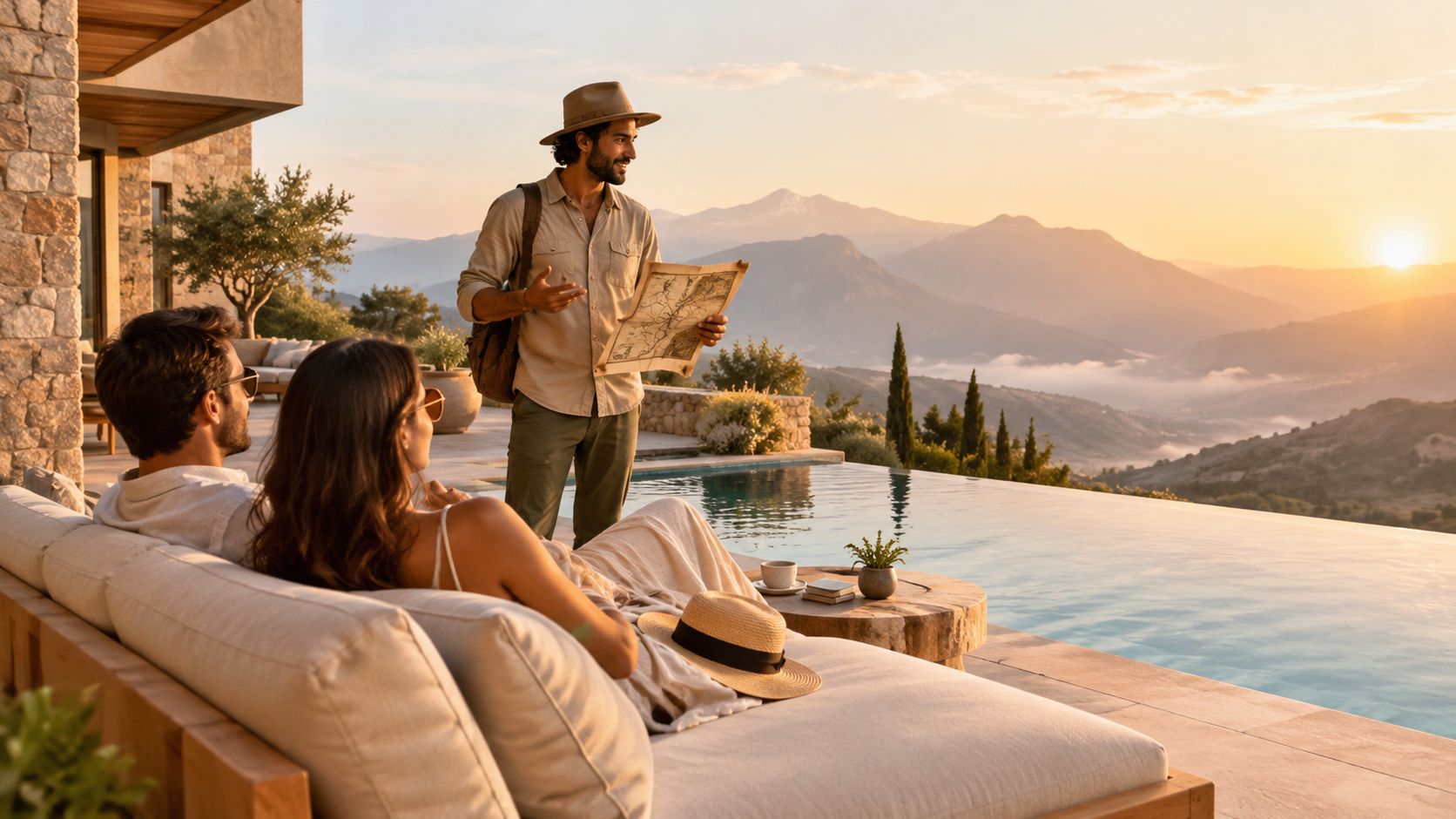
A genuine boutique hotel usually has a point of view. It may be family-run, have a small room count, offer distinctive dining, or occupy a building with a strong relationship to its setting. The label alone proves nothing. Ask who owns the property, whether the restaurant serves local guests as well as hotel residents, how late arrivals are handled, whether rooms differ materially, and how the staff responds when a guest needs something outside the standard routine.
Two parties, two different solutions
For the couple, I might prioritize a quieter property, a highly personal guide, and a room with a terrace or architectural character. The guide should understand when to provide context and when to leave the couple alone. A full day of touring isn't automatically better than a morning with a skilled local followed by an unstructured afternoon.
For a multigenerational family, the hotel must solve practical problems first. Room adjacency, lift access, bathrooms, breakfast timing, outdoor space, and a reliable meeting point matter more than a dramatic lobby. The guide needs to manage different walking speeds and create parallel options. One branch of the family might visit a market or museum while another takes a gentler route, then everyone reunites for lunch.
Test a guide before committing. Ask what they would change for rain, how they handle a teenager who loses interest, which sites they would skip in high season, and where they'd take a traveler who has already seen the obvious highlights. Their answers reveal local judgment better than a polished biography.
For readers assessing working with Haute Black travel experts, the same principle applies: evaluate how an advisor listens, filters, and manages trade-offs, not just the visual quality of their recommendations.
A focused reference to boutique hotels in Northern Spain can help generate ideas, but the final choice still depends on the route and the traveler profile.
The guide should be chosen early enough to shape the stay, not assigned after every important decision has already been made.
Arrange Transport and On-the-Ground Logistics
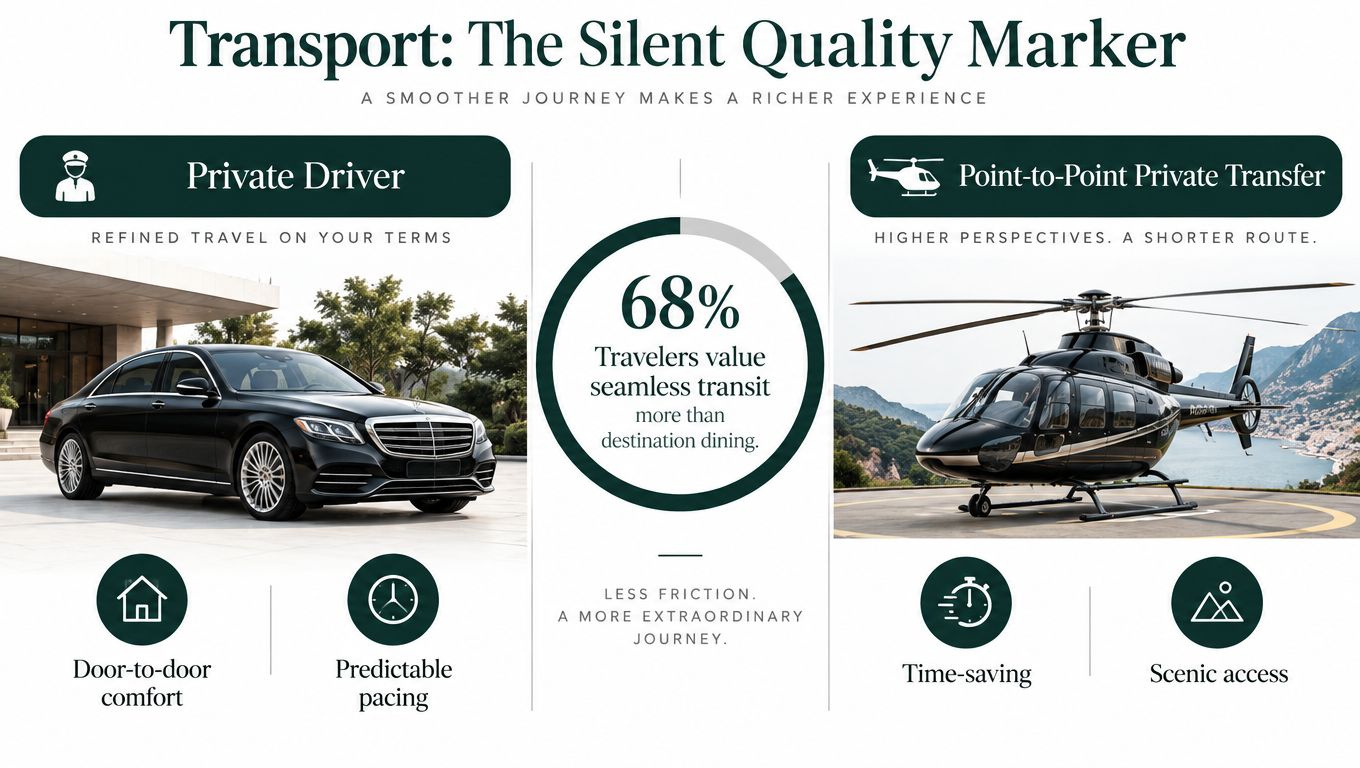
Transport is the silent quality marker of a private journey. When it works, the traveler notices the surroundings, the conversation, and the anticipation of the next stop. When it fails, every beautiful hotel and carefully chosen meal becomes harder to enjoy.
Compare the transport choices honestly
| Option | Best use | Strength | Main trade-off |
|---|---|---|---|
| Private driver | A multi-region route with several scenic or cultural stops | Door-to-door comfort, luggage continuity, flexible pacing, and local judgment | Requires careful driver-hour planning and may be slower than flying |
| Point-to-point private transfer | A direct arrival, departure, or hotel change | Efficient and easy to brief for a single movement | Offers less flexibility once the journey begins |
| Private air | A genuinely long or time-sensitive connection | Can protect time and provide access between distant points | Adds coordination, ground transfers, luggage complexity, and environmental cost |
Map distance isn't enough. A short journey into a historic center may require a drop-off outside restricted streets, a luggage handover, and a walk over uneven ground. A scenic transfer may be longer on paper but far more enjoyable because it replaces a separate excursion.
A single multi-day private driver often beats a chain of disconnected transfers. The driver learns the group's pace, knows when a viewpoint is worth a stop, and can coordinate with hotels that have restricted access. That continuity is especially valuable for families, where one missed handover can consume the patience of the entire party.
Brief the driver and hotels together. Confirm luggage count, child equipment, walking limitations, preferred vehicle style, meal breaks, parking arrangements, and the exact point where the traveler meets the next supplier. A guide to resort transportation ROI offers a useful way to think about transport as an experience investment rather than a background expense.
Regional airports can help, but they don't automatically simplify a route. Compare the complete door-to-door journey, including check-in, ground handling, waiting, luggage, and the transfer from the arrival point. In a luxury itinerary, the winning option is the one that protects energy, not the one that looks fastest in a search result.
For broader routing ideas, use the transportation resources for Spain as a starting point, then validate every movement against the actual hotels and experiences.
Design Exclusive Experiences That Earn Their Place
A premium wrapper doesn't make an ordinary activity exclusive. The experience earns its place when it offers meaningful access, a distinctive host, intelligent timing, or a level of privacy that changes how the traveler feels inside it.
Take a private cellar visit in La Rioja. The weak version is a standard tour followed by a tasting at a crowded table. The stronger version begins with the client's interests. Is it the architecture, the vineyard work, the history of a family estate, or the mechanics of blending? The host meets the traveler in the working environment, the tasting reflects those interests, and the schedule leaves enough time for conversation rather than rushing to the next appointment.
A well-built day in La Rioja
The day starts late enough for an unhurried breakfast. A private driver collects the travelers and takes them through the vineyards, with one purposeful scenic stop rather than a sequence of lookouts. At the cellar, the host knows the travelers' names, dietary requirements, and preferred level of technical detail.
Lunch follows nearby, ideally with a clear relationship to the region rather than a generic luxury menu. The afternoon is deliberately light. It might include a village walk, a quiet hotel terrace, or a restorative pause before dinner. The day succeeds because the cellar visit is the anchor, not because the planner added three more inclusions.
A different rhythm in San Sebastián
A San Sebastián day may begin with a market visit and a culinary conversation, followed by a private architectural or cultural walk. The traveler should have time to return to the hotel before dinner, particularly if the evening centers on a serious restaurant or a carefully chosen pintxos route.
Small details carry the authority of good planning:
- Timing: Ask when a host can offer the most personal welcome, not just when the calendar has an opening.
- Dress: Explain whether the venue expects polished casual clothing, practical shoes, or something more formal.
- Dietary needs: Share allergies and preferences before the menu is designed, not at the table.
- Photography: Confirm where photography is welcome and where discretion matters.
- Group energy: Tell the host whether the party prefers conversation, instruction, tasting, exploration, or quiet observation.
For a family, the anchor might be a private culinary workshop while another family member enjoys a gentler nearby activity. For a couple, it may be a longer conversation with a winemaker or chef. Both can be luxurious, but only if the experience matches the emotional brief.
I remove any activity that exists solely because it looks impressive in a proposal. Luxury is not a crowded list of access claims. It's the confidence to choose fewer experiences and give them enough space to matter.
Plan for Contingency Before You Need It
Contingency belongs in the first draft, not the final week. Northern Spain gives travelers dramatic coastlines, mountain roads, seasonal food, historic centers, and weather that can change the practical shape of a day. A sound plan doesn't eliminate uncertainty. It absorbs uncertainty without transferring the burden to the traveler.
The best contingency plans are invisible. The traveler sees a calm adjustment, not the chain of calls and decisions behind it.
Design alternatives with equal emotional value
A weak backup says, “If the coastal walk is cancelled, we'll visit a museum.” That may be operationally convenient but emotionally wrong. If the original promise was wild Atlantic scenery, the alternative should preserve discovery, atmosphere, or local access.
For a coastal day, prepare an inland food or craft experience that still offers a strong relationship with place. For a mountain excursion, identify a lower-elevation route, a village visit, or a private cultural appointment that can carry the same sense of immersion. The substitute doesn't need to imitate the original activity. It needs to protect the reason the activity was chosen.
A family needs an additional layer of flexibility. If some members are tired, the plan should allow a shorter outing without making them feel they've failed the itinerary. A teenager might have a more active morning while grandparents enjoy a slower cultural visit, with both groups reuniting for a meal or a shared scenic stop.
A contingency isn't a consolation prize. It's a second version of the same emotional promise.
Protect the weak points
Every journey has operational vulnerabilities. Identify them before booking:
- Weather exposure: Mark coastal, mountain, boat, and outdoor experiences that need an alternative.
- Supplier dependency: Note any day that depends on one guide, host, restaurant, boat, or driver.
- Access restrictions: Check vehicle limitations in historic centers, cellar conditions, stairs, lifts, and walking surfaces.
- Dining fragility: Confirm closure days, cancellation rules, dietary handling, and a nearby replacement with comparable quality.
- Timing pressure: Protect arrival buffers after flights, long drives, major meals, and emotionally demanding visits.
- Communication: Give the traveler one 24/7 escalation channel, with a named person responsible for decisions.
Supplier confirmation should be written and specific. Confirm the date, arrival point, guest names, language, duration, inclusions, dietary requirements, accessibility details, cancellation terms, payment status, and the procedure for disruption. A verbal “we should be fine” isn't a control system.
The same discipline applies to hotels. Ask who receives the luggage, where the vehicle can stop, whether the kitchen can manage a late arrival, and what happens if a room isn't ready. These details rarely appear in aspirational hotel copy, but they determine how the first hour feels.
Keep the traveler out of recovery mode
When disruption occurs, the planner should present a decision, not a problem. “The coastal route is unsafe today. We've arranged a private food and heritage program inland, kept your lunch reservation, and moved the scenic drive to tomorrow” is useful. “The weather has caused issues, what would you like to do?” is an invitation to manage logistics on holiday.
Recovery also requires knowing which bookings can move and which cannot. Restaurant rules, guide availability, vehicle hours, weather windows, and hotel commitments must be recorded before the trip. A single change can affect several suppliers, so one person should own the sequence.
Affluent travelers are paying for this operational judgment, not just for access to expensive components. Mastercard's 2024 Affluent Travel Report estimated the global luxury travel market at USD 1.38 trillion in 2023 and projected a 7.9% compound annual growth rate through 2030. The report also found that affluent travelers generated approximately 36% of total global travel spending and nearly 70% of luxury-travel spending. The commercial implication is clear: a concentrated customer segment expects reliability, personalization, and effective recovery.
The same report found that only one in ten consumers globally had stayed in luxury eco-friendly accommodation during the previous three years, compared with five in ten affluent consumers aged 18 to 34. Sustainability therefore needs to be handled as a design choice, not a decorative label. A private vehicle may reduce the friction of multiple rental cars, but a slower route, fewer hotel changes, smaller suppliers, and shoulder-season timing may produce a better balance of comfort and local benefit.
For a multigenerational group, the American Express and Morning Consult survey of 8,137 travelers across seven markets found that 81% preferred destinations with activities for all generations, while 89% of Millennial and Gen Z parents cited quality time as a reason to travel with extended family. Those figures, reported in the American Express travel trends overview, describe the desire. They don't solve the planning mechanics. Parallel activities, protected downtime, accessible routing, and flexible regrouping do.
Use a five-question brief this week
You don't need confirmed dates to begin making better decisions. Write down:
- How should we feel when we return? Choose the emotional outcome, not merely the destination.
- What must remain private? Include rooms, transport, meals, guiding, and personal time.
- What access would make this journey distinctive? Select the encounters that cannot be recreated by a standard tour.
- What pace can everyone sustain? Record walking limits, dining preferences, transfer tolerance, and recovery needs.
- What must happen if the ideal plan fails? Identify the experiences that deserve an equal-quality alternative.
Then send each supplier a one-page questionnaire covering exact timings, meeting points, vehicle access, luggage, accessibility, dietary handling, cancellation rules, weather alternatives, and emergency contact procedures. Keep the answers in a reusable client profile and update it after the trip.
The number of inclusions is a poor measure of luxury. The better measure is whether the traveler feels unhurried, well cared for, and genuinely somewhere they couldn't have reached alone.
A private journey should feel calm from the inside. The traveler shouldn't be calculating transfer times, checking restaurant confirmations, negotiating access, or wondering what happens next. Good luxury vacation planning turns those pressures into a quiet operating system: a precise brief, a few excellent anchors, realistic logistics, and recovery already designed into the route.
Northern Spain Travel designs fully private, tailor-made journeys across the Basque Country, La Rioja, Navarra, Cantabria, Asturias, Galicia, the Pyrenees, and neighboring regions, combining boutique hotels, private drivers, expert guides, food, wine, culture, nature, and local access. Visit Northern Spain Travel to begin with an emotional brief and shape a Northern Spain itinerary that feels personal, unhurried, and operationally sound.