Say you book a mid-March week in Florence, pack for spring, and spend four days in a thin jacket under a grey sky, waiting for an afternoon that never gets warm. Nothing was wrong with the itinerary. March hadn't arrived the way you pictured it.
Where March delivers comes down to three things: latitude, which sea is doing the warming, and how exposed a place is to cold continental air. Islands off the African coast win. The Spanish Mediterranean and southern Portugal come next. Malta and the Balearics sit a step behind. The Bay of Biscay stays mild but rarely warm, which is why San Sebastián closes this list rather than opening it.
What follows ranks the warmest European destinations in March from most to least dependable, with the trade-offs spelled out: rain risk, transfer time, crowd levels and, hardest of all, sea temperature. Air and water don't move together in early spring. The warmest afternoons here come with Atlantic or Mediterranean water that ends most swims in minutes, and any plan that blurs that line is selling you a beach holiday you won't get.
Here's the honest ranking, plus where a warm base pairs well with a cooler, food-led week in the north.
Table of Contents
- 1. Canary Islands (Tenerife and Gran Canaria)
- 2. Madeira (Funchal)
- 3. Costa del Sol (Málaga and Marbella)
- 4. Algarve (Portugal)
- 5. Seville (Andalusia, Spain)
- 6. Malta (Valletta, Mdina and Gozo)
- 7. Mallorca (Palma and Serra de Tramuntana)
- 8. San Sebastián (Basque Country, Northern Spain)
- March temperatures and trade-offs for the 8 warmest European destinations
- Building a Warm March Itinerary That Works
1. Canary Islands (Tenerife and Gran Canaria)
Start with the islands that make every other entry a compromise.
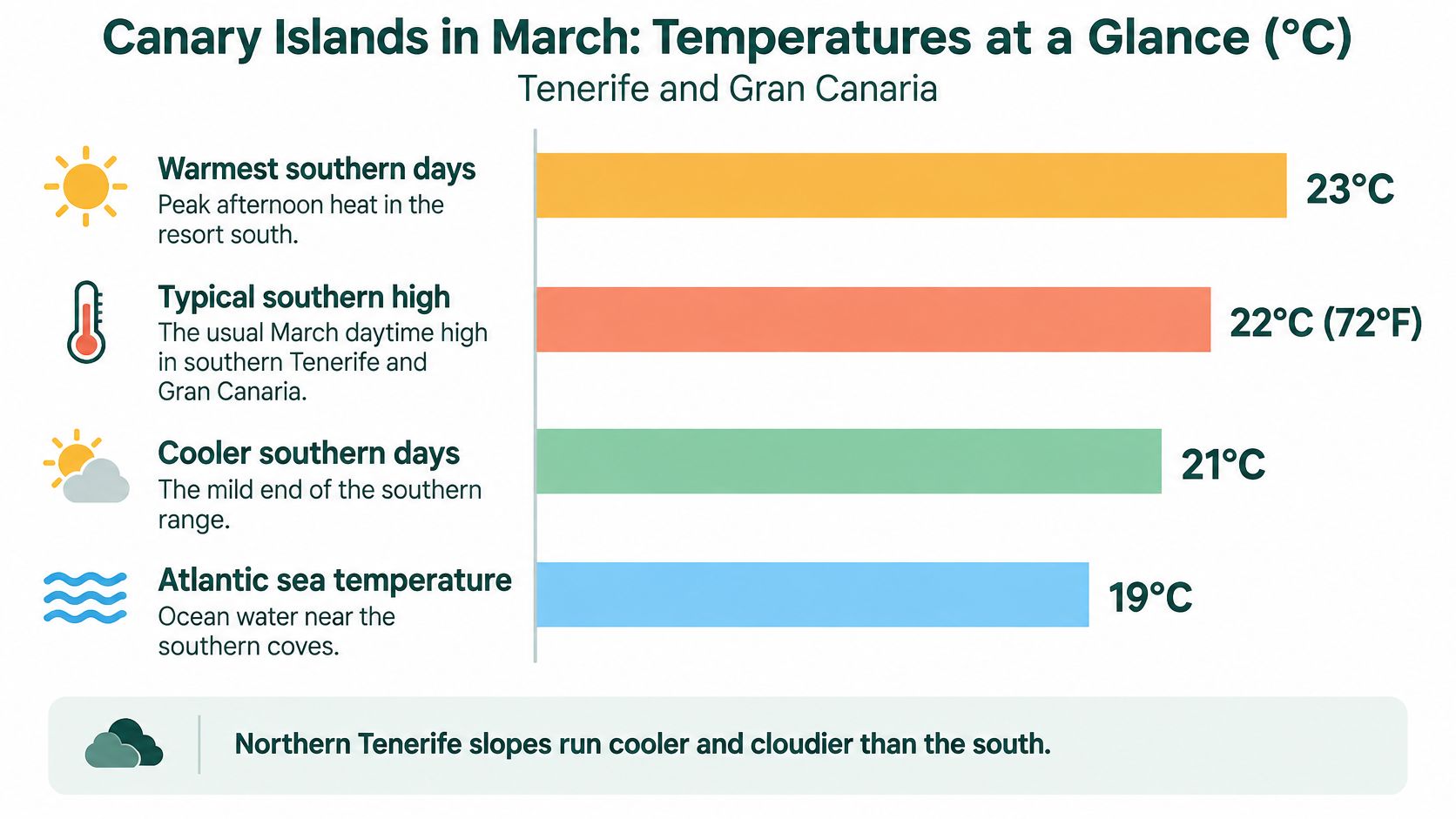
Tenerife and Gran Canaria sit off the African coast, far enough south that March behaves like a mild subtropical spring rather than a European one. The AEMET climate normals for Gran Canaria Airport record a March mean of 19.0°C, an average daytime maximum of 22.3°C and an average nighttime minimum of 15.7°C. The same station measures 12 mm of precipitation across roughly 2.3 rainy days, with 229 hours of sunshine, or about 7.4 hours a day. Nothing else on this list is that dependable.
The sea is where the picture changes. Atlantic water in March still lags well behind the air, so swimming becomes a short, deliberate plunge after a walk rather than an afternoon in the water with children. Build the week around altitude, coastline and food, and treat the ocean as a bonus.
Where to base yourself
The south of Tenerife, around Costa Adeje and Los Cristianos, is drier and sunnier than the green north and holds most of the private villa stock. Gran Canaria's southern resorts, Maspalomas and Meloneras, follow the same logic.
- Base south, tour north. Masca, the laurel forests and the north coast are day trips, not bases; the roads are winding and slow.
- Use a private driver for Teide. Sunrise and late-afternoon light are the whole point, and the summit road rewards someone else doing the driving.
- Book the good tables early. These islands run year-round rather than seasonally, so the best restaurants don't empty out in March.
- Plan for wind. The trades pick up in the afternoon, which is why mornings suit golf, hikes and boat trips.
What to skip: a week built around swimming. Swap it for a Teide sunset, a Masca hike and a long lunch in a fishing village, and the island delivers.
For a sense of the island's scale before you plan driving times, this short aerial view is worth three minutes.
2. Madeira (Funchal)
Madeira is the entry for travelers who want Atlantic mildness without a resort strip. Funchal's March afternoons are cooler than the Canaries', and the island gives you something the beach islands can't: gardens in full bloom, near-empty levada trails and a capital that still feels like a working Portuguese town.
Frost is unknown at sea level, and the weather changes fast with height. You can leave Funchal in sun and walk into cloud and drizzle above Encumeada within the hour. That's the trade-off in one sentence. Madeira sells scenery, walking and wine, not guaranteed sunbathing.
What March does well here
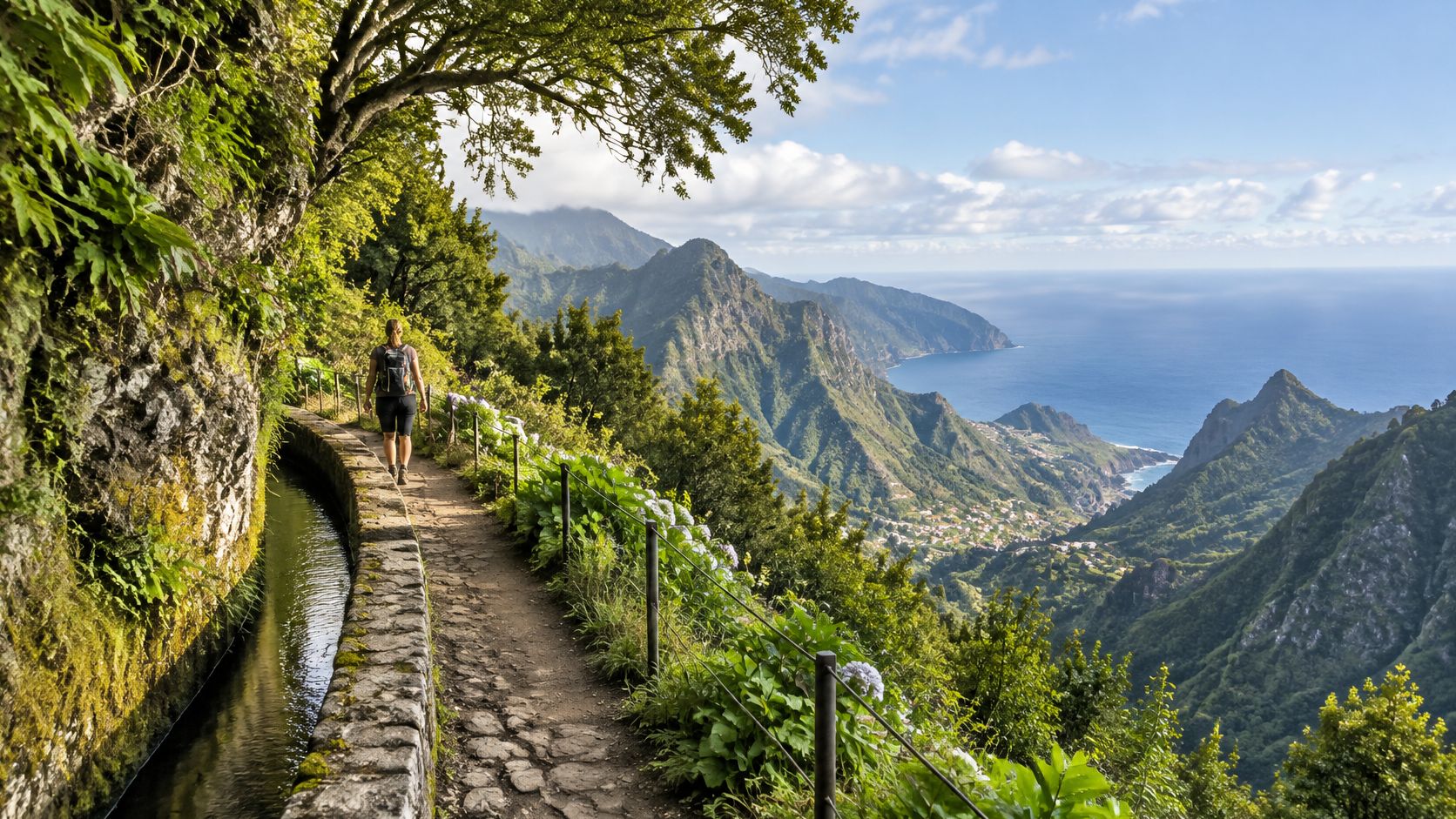
- Levada walks. Take a guided half day on the Caldeirão Verde or Ribeiro Frio routes, with a driver meeting you at the far end so nobody retraces the trail.
- Madeira wine. Book a seated tasting at one of the Funchal lodges rather than a standing flight at a crowded bar; the older vintages deserve the explanation.
- Gardens. Monte Palace and the Botanical Garden are best mid-morning, when the light is clean and the coach groups haven't landed.
- Mountain villages. Curral das Freiras and the north coast roads are quicker with a local driver than with a rental car and a map.
Practical rule: use private transfers for anything above Funchal. The mountain roads are narrow, the cloud comes down without warning, and a wrong turn costs an hour.
For a couple who wants four nights of walking and long lunches without a beach in sight, this is the easiest island on the list to plan. Fly via Lisbon for the widest connections, and give yourself a buffer day at each end.
3. Costa del Sol (Málaga and Marbella)
The Costa del Sol is the strongest mainland option here, and the benchmark puts Málaga close to the islands. A comparison of warm March destinations in Europe places Málaga at roughly 19°C average daytime highs, in the same band as Funchal, Valencia and Alicante and just behind Tenerife's 21°C.
That's warm enough for lunch outside, a coastal walk in a shirt and a round of golf without a sweater at the turn. It isn't sunbathing weather on a cloudy day, and the coast's microclimates matter. Marbella and Estepona catch more shelter than Málaga city, where wind off the bay can bite in the afternoon.
City, coast or hills
- Málaga for culture. The Picasso Museum, the Alcazaba and the Thyssen, plus a food scene that has outgrown its fried-fish reputation.
- Marbella and Puerto Banús for hotels. March rates drop before Easter while the good properties still run at full service, which is the argument for going now rather than in May.
- Ronda and the white villages for a day. The inland drive is the reason to keep a driver on call instead of relying on the coastal train line.
- Gibraltar, if you want it. A straightforward half day from the western coast, and the cable car queues are shorter now than in summer.
Timing: Caminito del Rey slots sell out long before March, so book the entry before you book the hotel. Take the morning departure, when the gorge is still in shade and the path is quiet.
Say a couple has five nights and wants one city, one coast and one white village. Split it as two nights in Málaga, two in Marbella and a driver-led day inland, and nobody spends the week in a car.
4. Algarve (Portugal)
The Algarve rewards travelers who want coastline rather than a resort, and March is when it belongs to the people who live there. The southern coast runs from the Spanish border to Sagres in a line of limestone stacks, sea caves and long beaches, with Faro as the airport and Lagos as the base many visitors pick first.
Temperatures sit below the Costa del Sol. Warm enough for a jacket-free lunch on a sheltered terrace, cool enough that the beach is for walking. The Atlantic is cold and stays cold, so plan the water as scenery.
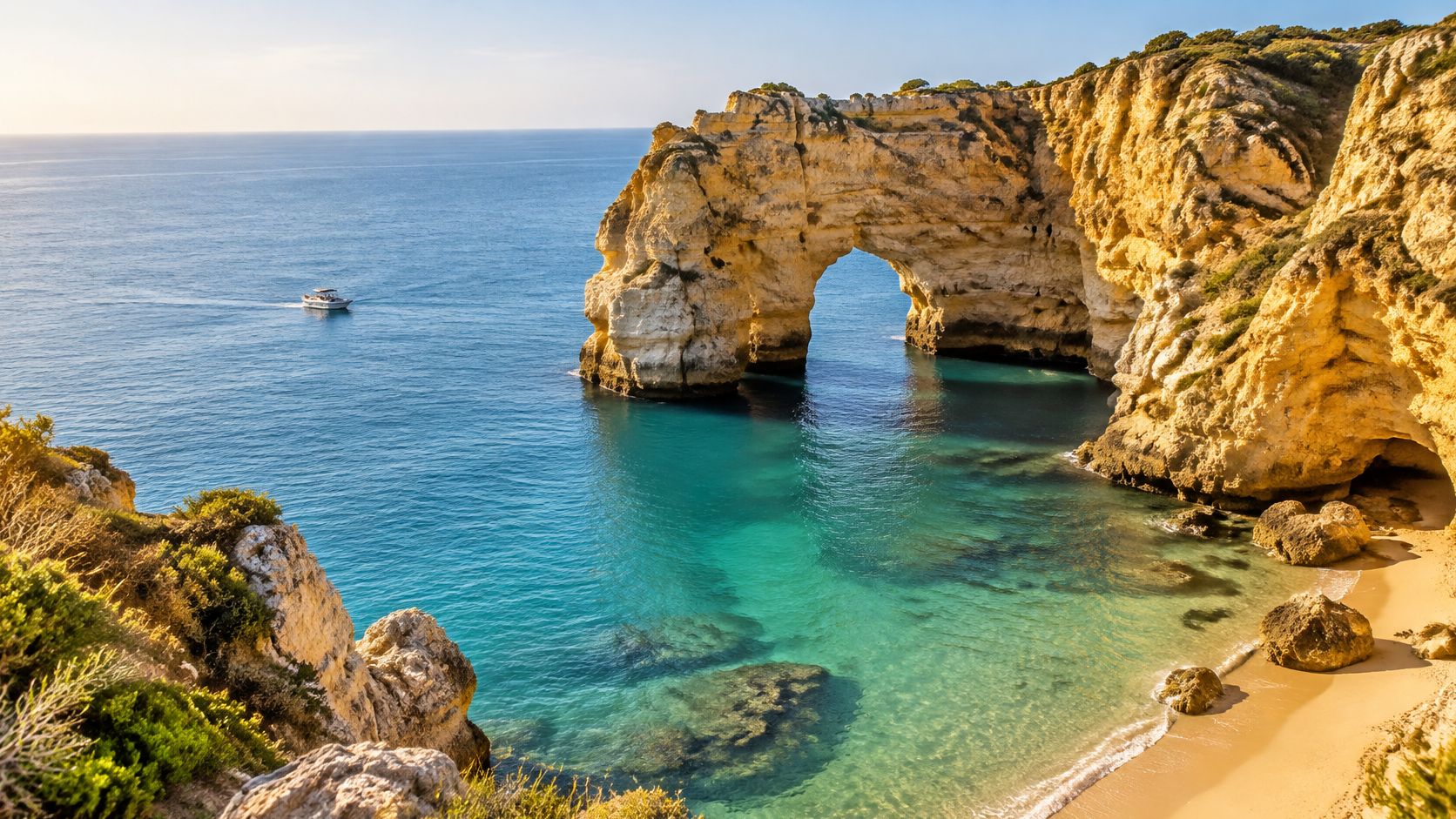
The March trade-off
Boat operators run to Benagil and Ponta da Piedade when the swell allows, and March swell cancels trips more often than summer does. Book the first morning departure, when the sea is calmest, and hold a second morning as a fallback.
- Benagil and the caves. Small boats get closer than kayaks and cover more ground, but rough weather keeps them outside the cave itself.
- Golf. The courses are at their best now: green from winter rain, cool enough to walk, and quieter than in May.
- Seafood. Lunch in Ferragudo or Santa Luzia beats anything on the main beachfront strip.
- Walking. The Seven Hanging Valleys path is manageable in March and punishing in July.
Hiring a driver for the coastal road pays for itself if you want Cape St Vincent, Sagres and a long lunch without arguing about parking. For a fuller month-by-month picture of the country, our Portugal in March guide covers the rest of the itinerary.
5. Seville (Andalusia, Spain)
Seville tops the mainland table on paper, and the numbers beat most travelers' expectations.
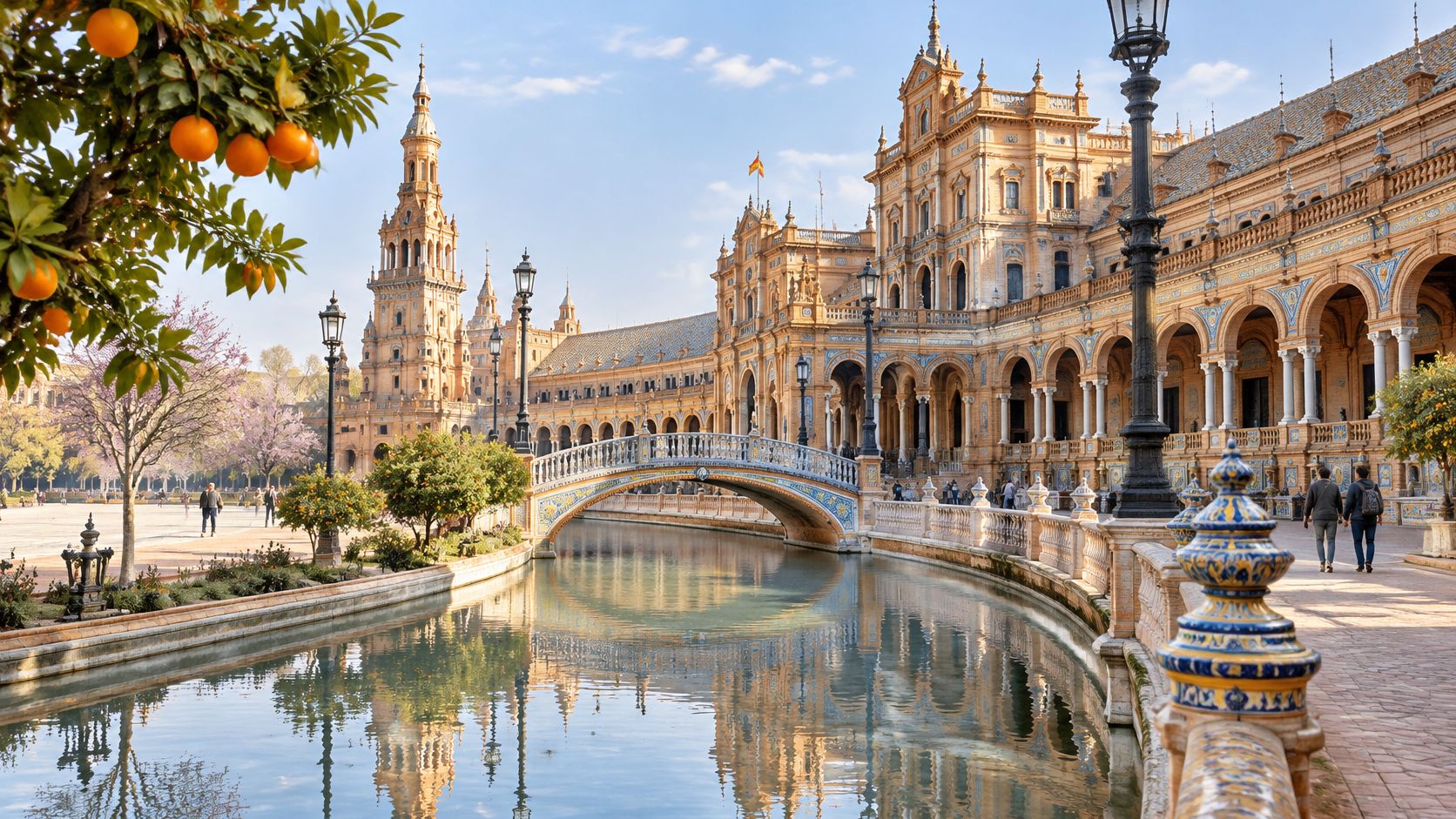
A European Tourism comparison of spring city climate records an average March daily maximum of 19.7°C for Seville, with around four rainy days and eight hours of sunshine a day. Athens, on the same measure, sits at 15.9°C.
What the average hides is the spread. Seville's afternoons feel like late spring, its mornings and evenings don't, and a cold snap can still arrive. Pack the coat you'd wear in London in April and you'll be comfortable.
Timing around Holy Week
If your dates overlap Semana Santa, book hotels and restaurant tables months ahead. The city fills with processions, the good terraces go first, and rates firm up rather than soften. Outside that window, March is a gift: the Alcázar before public opening, the cathedral roof tour, and a tapas crawl through Triana with someone who knows which bars open at eight and which at nine.
What most people get wrong: treating Seville as a beach base. It isn't one. Three nights of culture, food and walking here, then move to the coast.
If you want to add Atlantic coast to the city, our Costa de la Luz guide covers the other side of Andalusia, where the beaches are wider and the crowds thinner.
6. Malta (Valletta, Mdina and Gozo)
Malta is the compact choice: three islands, short transfers, and a March that favors walking over swimming. Valletta is steep in places but small enough to cover on foot in a day, Mdina takes a morning, and Gozo runs on a slower clock entirely.
Air temperatures sit a step below Andalusia, so keep a layer for evenings and for the wind that funnels between the bastions. The sea stays cold, which matters if Comino's blue water was part of the plan. It's a photograph in March, not a swim.
Getting around three islands
- Private driver for the airport and day tours. Distances are short, but the roads are dense and parking near Valletta and Mdina is a time sink.
- Mdina early or late. The silent city earns its name before ten and after four, once the day-trippers have gone.
- Gozo as a base, not a day trip. The ferry crossing is short, and two nights gets you the Ġgantija temples and the coast path without a sprint.
- Flexible boat trips. Blue Grotto and Comino crossings depend on wind, so keep a museum or a wine estate as the backup.
History is the reason to come. The Hypogeum needs booking far ahead, the Co-Cathedral's Caravaggio justifies the queue, and the honey-colored limestone looks best in low spring light. For families with teenagers, the island works because nothing is more than a short drive from anything else.
7. Mallorca (Palma and Serra de Tramuntana)
Palma in March is a city break with a mountain range attached, and it's the quietest the island gets while everything still functions. The old town, the cathedral and the food market fill two days comfortably, and the cafés are full of residents rather than visitors.
Beyond the capital, the Serra de Tramuntana runs along the northwest coast through Valldemossa, Deià and Sóller, with switchback roads, stone villages and walking routes that are miserable in August heat and close to perfect now.
Why spring beats summer here
- Restaurants. Many of the best rooms close in winter and reopen around Easter, so confirm dates before you fix a base. This is the single most common March mistake on the island.
- Sailing. Charter a day boat from Palma in late March and you get calm water and an empty coast; the same trip in July comes with a queue at every cove.
- Driving. The Tramuntana road is a pleasure without summer traffic, but it's narrow, so hire a driver for the Deià and Sa Calobra sections.
- Villages. Valldemossa in the morning, Deià for lunch, Sóller for the return train; that's a full and unhurried day.
A couple who has already done Barcelona and wants something calmer will find Palma easier than expected in March: reservations are obtainable, the museums are quiet, and the mountains are twenty minutes from the hotel. Our guide to things to do in Mallorca covers which villages work as bases and which are lunch stops.
8. San Sebastián (Basque Country, Northern Spain)
San Sebastián is the coolest entry on this list and the one I'd argue hardest for. March here is mild, wet and changeable rather than warm, and that's exactly why the city stays enjoyable.
The national picture corrects anyone who assumes all of Spain is basking. AEMET's March 2026 climate report puts Spain's national mean temperature for the month at 9.9°C, with precipitation at 82% of the 1991–2020 normal, and notes that the northwest, including Galicia, Cantabria and northern Castilla y León, ran warmer than average. A national mean flatters no single city, but the detail is the point: the north often sits on the warm side of a normal Spanish March while the Mediterranean waits for its own spring.
How to pair it with sun
What the Basque coast gives you instead of heat is the best eating in Spain, at off-season prices and without summer queues.
- Pintxos in the Parte Vieja. Go with a guide for the first evening, then return alone to the two bars you liked.
- Michelin tables. Book months ahead even in March; the famous rooms don't discount, they just become possible.
- Txakoli and cider. Getaria for the wine, Astigarraga for the cider houses, both short drives with a car you don't have to park.
- Rioja. A comfortable drive south for private cellar tastings, easily combined with a night in Logroño.
The pairing I recommend: three or four nights of food in San Sebastián, then five nights of sun in the Canaries or the Costa del Sol. Eat and walk first, rest second.
March temperatures and trade-offs for the 8 warmest European destinations
Typical March daytime highs show the warmth gap clearly: the Canary Islands lead, while San Sebastián trades heat for food and coastal walks. Sea temperatures remain cool across most of these destinations, so a sunny forecast does not necessarily mean beach-swimming weather.
| Destination | Typical March High | Best For | Main Trade-off |
|---|---|---|---|
| Canary Islands (Tenerife and Gran Canaria) | 21–23°C in the south | Sunshine, beaches, hiking and resorts | Resort development and strong winds on exposed coasts |
| Madeira (Funchal) | 18–20°C in Funchal | Gardens, levada walks and wine | Steep terrain and few beach options |
| Costa del Sol (Málaga and Marbella) | 17–19°C | Culture, dining, golf and beach stays | Developed coastal areas and seasonal traffic |
| Algarve (Portugal) | 16–18°C | Coastal scenery, golf and seafood | Occasional rain and cool sea temperatures |
| Seville (Andalusia, Spain) | 19–20°C | Architecture, history and flamenco | Holy Week brings crowds and higher prices |
| Malta (Valletta, Mdina and Gozo) | 15–17°C | History, boating and easy island trips | Cool seas and limited beach areas |
| Mallorca (Palma and Serra de Tramuntana) | 15–17°C in Palma | Mountain villages, dining and coastal drives | Cool, windy weather and some seasonal closures |
| San Sebastián (Basque Country, Northern Spain) | 13–16°C | Pintxos, fine dining and coastal walks | Cooler, rainier weather than southern destinations |
Rain risk and logistics shape the choice as much as the high temperature. The Algarve can bring showers, while exposed island coasts may be windy. Mallorca's mountain roads and Madeira's steep terrain call for a more deliberate driving plan; Seville is easier to explore on foot, but Holy Week can raise prices and crowd levels.
For a warm-weather trip with a cooler, food-focused finish, pair the Canaries or Costa del Sol with San Sebastián. The contrast is deliberate: beach or resort time first, then pintxos, fine dining and coastal walks in northern Spain.
Building a Warm March Itinerary That Works
Choose a March base for the days you want, not just the forecast. The Canary Islands offer the strongest chance of sun, followed by the Costa del Sol. The Algarve suits coastal walks and golf, though a jacket is often useful. Madeira and the Algarve make a gentler pairing than the busier islands. For history and boating, Malta and Mallorca offer more variety than a beach-only stay.
March is quieter across much of Europe. Eurostat's analysis of pre-pandemic tourism nights puts the month at approximately 6% of annual EU tourist-accommodation nights, compared with 11% in June. That can make restaurant tables, boutique hotels and private guides easier to arrange than in peak summer.
The Canary Islands are an exception to the quieter-season pattern. Eurostat identifies them as one of the EU's least seasonal regions, with 20.0% of annual tourism nights concentrated in peak months in 2022. Reserve accommodation and any sought-after activities ahead of time, even for a March visit.
Build the schedule around practical needs as well as the weather. Eurostat's work on seasonality in tourism demand identifies travelers aged 65 and over as more likely to travel in the shoulder season, defined as March to June and September to November. Short transfers, hotels with lifts and level access, lunch service, and a weather-proof option each day can make a trip easier for travelers of different ages.
Where a warm base pairs with the north
A two-stop trip can balance warmer weather with a food-focused northern stay. Start with four or five nights in the Canaries, Andalusia or the Algarve, then spend three or four nights in San Sebastián or along the Basque coast. The north is cooler and may be rainy, so pack for walks and plan indoor dining and cultural stops as well as time outdoors.
Northern Spain Travel creates private, tailor-made journeys that can connect a warm-weather stay with the Basque Country, Rioja or the Atlantic coast. For a couple or a three-generation family, arrange transfers and key bookings around the pace of the group. The trade-off is an extra flight and less time in each place, so keep the route to two bases.
Allow time to walk, eat and sightsee in the north before finishing with a slower stretch in the sun. Share your must-have experiences, preferred dates and the style of trip you have in mind. Northern Spain Travel uses those preferences to shape a personalized draft itinerary.
Northern Spain Travel designs private journeys across the Basque Country, La Rioja, Navarra, Cantabria, Asturias, Galicia and the Pyrenees. Its tailor-made itineraries can include boutique hotels, private guides and drivers, and winery and restaurant experiences. If you want to combine a March stay in the Canaries or Andalusia with time in San Sebastián or on the Atlantic coast, Northern Spain Travel can help shape the route.